
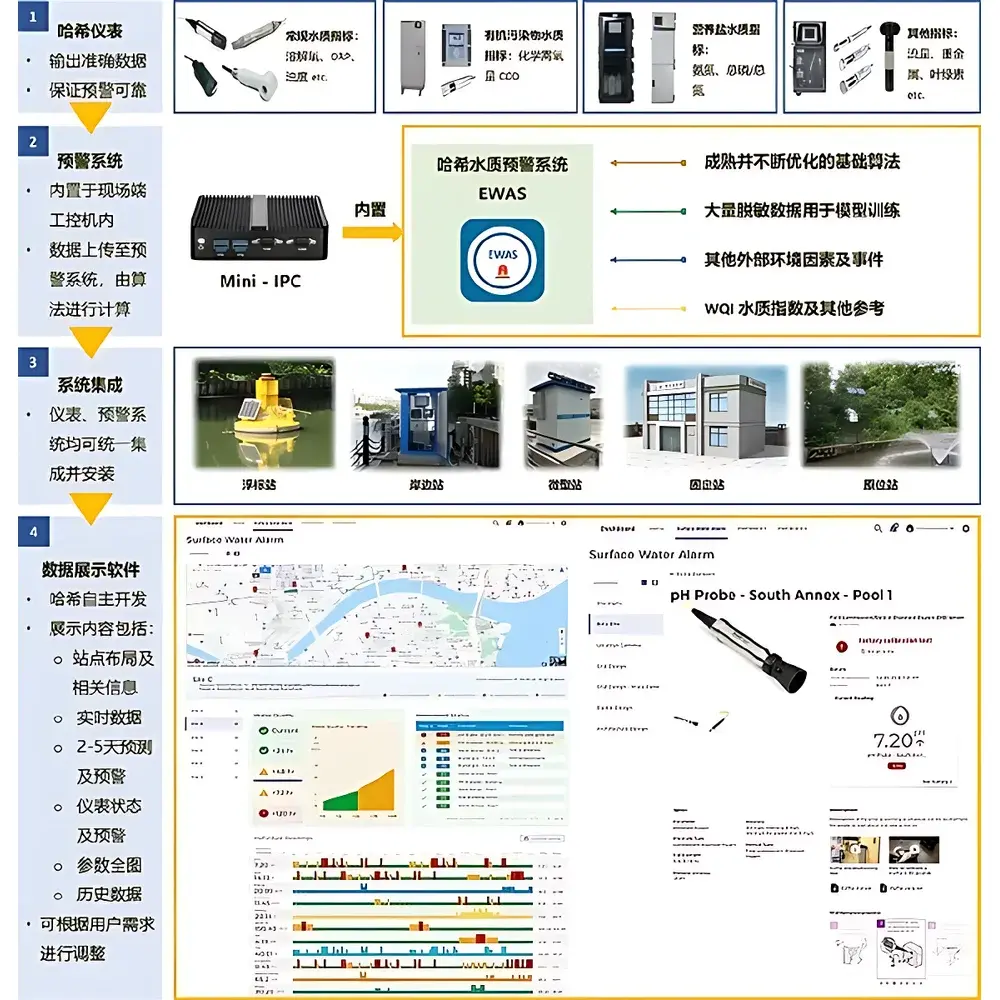
HACH EWAS Water Quality Early Warning System
| Brand | HACH |
|---|---|
| Origin | Imported |
| Manufacturer Status | Manufacturer |
| Model | EWAS |
| Pricing | Upon Request |
Overview
The HACH EWAS (Environmental Water Alert System) is an intelligent, edge-enabled early warning platform engineered for real-time assessment and predictive analytics of surface water quality. Unlike conventional monitoring systems that report only historical or instantaneous parameter values, EWAS integrates time-series data from HACH’s field-deployable analytical instruments—such as multi-parameter sondes, UV absorbance sensors, optical dissolved oxygen probes, and nutrient analyzers—into a physics-informed machine learning framework. The system operates on the principle of supervised temporal modeling, where historical calibration datasets (spanning seasonal hydrological cycles, diurnal variations, and event-driven perturbations) train lightweight regression and anomaly detection algorithms directly on the Mini-IPC host or compatible data acquisition controllers. This architecture enables near-real-time forecasting of key water quality indicators—including turbidity, organic load (via UV254), dissolved oxygen saturation, ammonium-nitrogen, total phosphorus, and flow-coupled loading rates—with quantifiable uncertainty bounds. Designed for deployment at river cross-sections, reservoir inlets, drinking water source protection zones, and urban canal networks, EWAS supports proactive decision-making under regulatory frameworks such as the EU Water Framework Directive (WFD), China’s “Ten Measures on Water” (Water Ten Plan), and US EPA’s National Aquatic Resource Surveys (NARS).
Key Features
- Edge-native AI inference engine deployed on HACH Mini-IPC or third-party industrial controllers, eliminating dependency on cloud connectivity or high-spec hardware
- Interpretable model architecture with feature attribution mapping—enabling traceability between input sensor signals (e.g., UVAS sc absorbance drift, LDO II temperature-compensated fluorescence decay) and predicted output trends
- Automated hyperparameter tuning via Bayesian optimization during scheduled maintenance windows, reducing manual configuration effort by >60% compared to legacy statistical models
- 24-hour predictive accuracy of ≥85% for critical parameters when trained on ≥90 days of co-located HACH instrument data (per ASTM D5117-22 validation protocol)
- Self-adaptive retraining capability: model weights are incrementally updated using new field observations without full retraining, maintaining relevance amid changing land-use patterns or seasonal algal dynamics
- Hardware-agnostic integration layer supporting Modbus RTU/TCP, SDI-12, and HACH-specific digital protocols—ensuring seamless interoperability with MS9000, NPW-160H, NA8000, COD-203, EZ-series heavy metal analyzers, and OTT SLD acoustic Doppler flow meters
Sample Compatibility & Compliance
EWAS accepts continuous analog and digital inputs from HACH-certified water quality sensors compliant with ISO 7027 (turbidity), ISO 5815-1 (dissolved oxygen), ISO 15681-2 (phosphate), and EN 1484 (total organic carbon estimation via UV absorbance). All embedded models are developed and verified under GLP-aligned internal procedures, with full audit trails for training data provenance, version-controlled algorithm binaries, and timestamped prediction logs. System architecture meets IEC 62443-3-3 cybersecurity requirements for Level 1 asset protection and supports optional FDA 21 CFR Part 11-compliant electronic signature modules when deployed in regulated drinking water utilities.
Software & Data Management
The EWAS software suite comprises three tightly coupled components: (1) the Edge Inference Module (EIM), running on Linux-based Mini-IPC hosts; (2) the Central Configuration & Validation Portal (CCVP), accessible via secure HTTPS for model deployment, threshold definition, and performance benchmarking; and (3) the Alert Orchestration Engine (AOE), which generates configurable SCADA-compatible alarms (SNMP traps, MQTT payloads, SMS/email notifications) based on deviation thresholds, trend slope analysis, or ensemble outlier scoring. All raw sensor data, model metadata, and prediction outputs are stored in time-series-optimized databases with configurable retention policies (default: 18 months local + encrypted cloud backup). Export formats include CSV, NetCDF4, and WaterML 2.0 for integration with national monitoring platforms such as China’s National Surface Water Quality Monitoring System (NSWQMS) or the USGS NWIS database.
Applications
- River basin management: Forecasting eutrophication risk at tributary confluences using coupled TP/TN/Chl-a surrogate models
- Drinking water source protection: Detecting upstream contamination events 2–6 hours before conventional threshold exceedance through multivariate residual anomaly detection
- Urban stormwater response: Correlating rainfall intensity, flow velocity (OTT SLD), and real-time turbidity spikes to classify runoff origin (roof vs. road vs. green infrastructure)
- Reservoir operation support: Estimating thermal stratification onset dates and hypolimnetic oxygen depletion rates using long-term DO/temperature/cond profiles
- Regulatory compliance reporting: Automating WFD class transitions (High/Good/Moderate/Poor/Bad) via integrated Ecological Potential Index calculations per Annex V guidelines
FAQ
Does EWAS require continuous internet connectivity?
No. Core prediction and alerting functions operate autonomously on the edge device. Internet access is only required for remote configuration updates, model version synchronization, or cloud-based archival.
Can EWAS integrate with non-HACH sensors?
Yes—provided they output standardized protocols (Modbus, SDI-12, or 4–20 mA with HART) and meet minimum sampling resolution (≥1 sample/minute) and stability specifications (drift ≤±2% FS/year). Integration requires protocol mapping and empirical cross-calibration.
How often does the model self-update?
By default, incremental learning occurs daily using the prior 72 hours of validated sensor data. Full retraining intervals are configurable (minimum 30 days) and triggered manually or upon detection of sustained performance degradation (>5% MAPE increase over 7-day rolling window).
Is historical data from legacy HACH instruments compatible?
Yes—CSV or ASCII log files from MS9000, Solitax sc, or pHD sc deployments (with timestamps, units, and QC flags) can be ingested into the CCVP for retrospective model development and validation.
What cybersecurity certifications does EWAS hold?
The Mini-IPC host firmware is certified to IEC 62443-4-2 SL2 and undergoes annual penetration testing per NIST SP 800-115. Network communication layers support TLS 1.2+, role-based access control (RBAC), and secure boot verification.







