
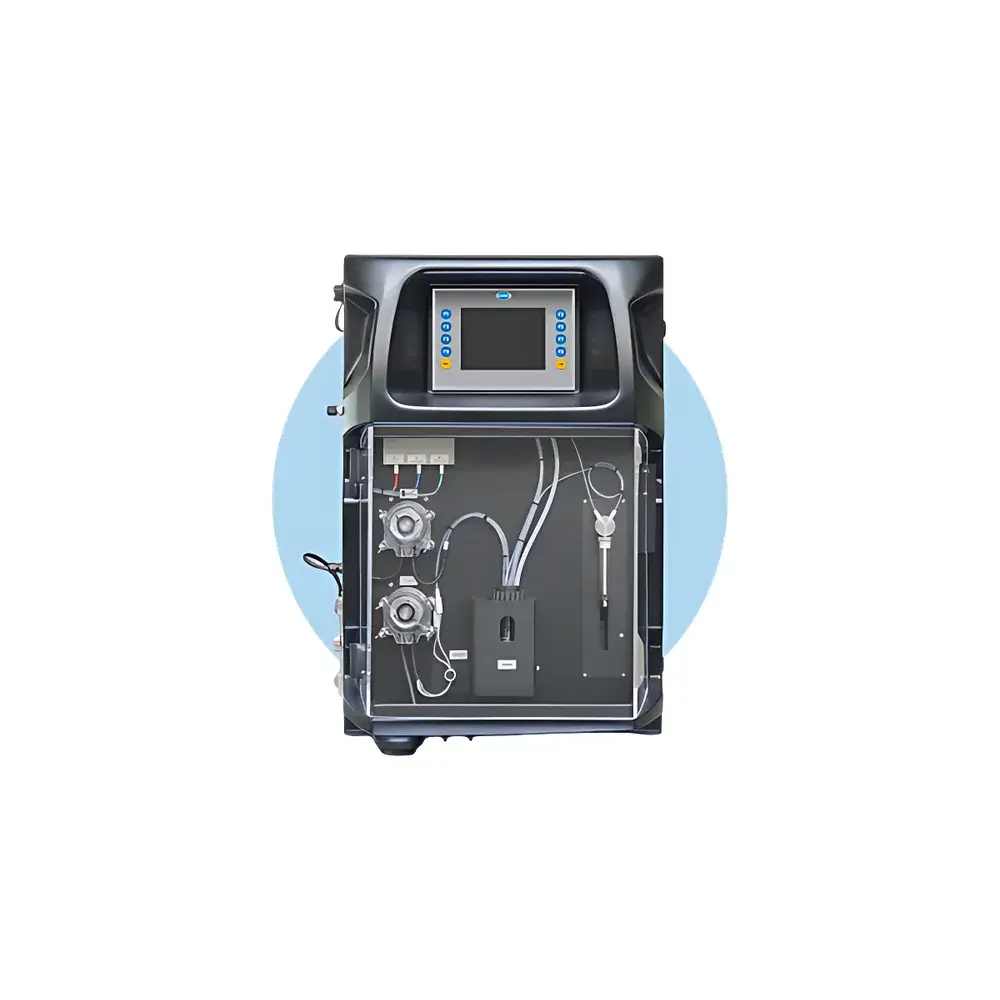
HACH EZ1016 Online Total Hardness Analyzer
| Brand | HACH |
|---|---|
| Origin | Imported |
| Manufacturer Type | Manufacturer |
| Model | EZ1016 |
| Detection Limit | 2.5 µg/L (as CaCO₃) |
| Measurement Range | 0–100 ppm (as CaCO₃) |
| Principle | Colorimetric Method (EDTA Complexometric Titration Analog) |
| Reagent Transparency | Open-formula reagents supported |
| Configuration Options | Multi-channel capable |
| Compliance Context | Designed for industrial water reuse monitoring per ISO 9001/QA workflows and compatible with GLP/GMP data integrity expectations |
Overview
The HACH EZ1016 Online Total Hardness Analyzer is an industrial-grade, colorimetric-based analyzer engineered for continuous, real-time measurement of total hardness—expressed as calcium carbonate (CaCO₃)—in process and reclaimed water streams. It operates on a spectrophotometric adaptation of the standardized EDTA complexometric titration principle (aligned with ASTM D1126 and ISO 6059), where hardness-causing cations (primarily Ca²⁺ and Mg²⁺) react with a chromogenic reagent to form a colored complex proportional to concentration. The instrument integrates automated sample aspiration, precise reagent dosing, reaction timing control, and photometric detection at optimized wavelengths (typically 520–580 nm). Designed specifically for high-reliability deployment in demanding industrial environments—including coal chemical plants, power generation cooling loops, and zero-liquid-discharge (ZLD) systems—the EZ1016 delivers stable performance under variable temperature, pressure, and particulate load conditions typical of secondary treated effluent and membrane filtrate streams.
Key Features
- Low detection limit of 2.5 µg/L as CaCO₃—enabling reliable monitoring of ultra-low hardness in polished reuse water and ion exchange effluents.
- Open reagent architecture: Full disclosure of reagent formulations allows end-users to prepare consumables in-house, reducing long-term operational cost and supply chain dependency.
- Modular multi-channel configuration support: A single controller can manage up to four independent analysis modules, optimizing capital expenditure in multi-point monitoring applications such as parallel ion exchange trains or staged treatment units.
- Robust sample handling system: Incorporates overflow cup sampling design to ensure representative, bubble-free aliquots; integrated filtration and air bubble detection minimize maintenance interventions.
- Self-diagnostic routines and scheduled calibration verification protocols support compliance-readiness for QA/QC documentation requirements under ISO/IEC 17025 and internal quality management systems.
Sample Compatibility & Compliance
The EZ1016 is validated for use with clarified, low-turbidity water matrices—including reverse osmosis permeate, mixed-bed demineralizer effluent, and weak acid cation (WAC) exchanger outlet streams—where total suspended solids (TSS) remain below 5 mg/L and free chlorine is absent or quenched. It meets functional equivalence to EPA Method 130.1 and APHA Standard Methods 2340 C for hardness determination in non-potable industrial waters. While not certified under US EPA drinking water regulations, its measurement traceability aligns with NIST-traceable standards and supports audit trails required for facility-level environmental reporting (e.g., TRI, SPCC) and internal water balance accounting per ISO 46001.
Software & Data Management
The analyzer interfaces via Modbus RTU or 4–20 mA analog output to distributed control systems (DCS) or SCADA platforms. Optional HACH DataStream™ software enables remote configuration, event logging, trend visualization, and alarm threshold management (e.g., configurable high-hardness alerts at 15 mg/L CaCO₃ to trigger WAC resin regeneration). All measurement events, reagent lot tracking, calibration history, and system diagnostics are timestamped and stored locally with optional export to CSV or integration into enterprise LIMS via OPC UA. Audit trail functionality satisfies basic data integrity expectations for GLP-aligned operations and supports 21 CFR Part 11 readiness when deployed with validated user access controls and electronic signature modules.
Applications
- Real-time hardness surveillance at ion exchange effluent points—particularly weak acid cation (WAC) and strong acid cation (SAC) unit outlets—to optimize resin regeneration cycles and extend bed life.
- Monitoring reclaimed water quality prior to recirculation into cooling towers or boiler feedwater pretreatment trains, ensuring compliance with ASME PTC 19.11 or EPRI guidelines for cycle chemistry control.
- Performance validation of softening processes including lime-soda ash treatment, nanofiltration, and electrodialysis reversal (EDR) systems.
- Supporting water balance closure and regulatory reporting in coal chemical, petrochemical, and steel manufacturing facilities operating under national water conservation mandates (e.g., China’s “Water Ten Plan” or EU Water Framework Directive industrial discharge provisions).
FAQ
What hardness range does the EZ1016 cover, and is it suitable for ultrapure water monitoring?
The standard configuration measures 0–100 ppm as CaCO₃. With factory calibration optimization and low-range optical path adjustment, it reliably quantifies down to 2.5 µg/L—making it appropriate for post-polishing reuse streams but not for semiconductor-grade UPW (which typically requires IC or ICP-MS methods).
Can the EZ1016 be integrated into existing plant automation systems?
Yes—it provides native 4–20 mA output and Modbus RTU communication, enabling seamless integration with most DCS, PLC, and SCADA architectures without third-party gateways.
How frequently must reagents be replaced, and what is their shelf life?
Under typical operation (one analysis per 30 minutes), reagent packs last approximately 30 days. Unopened reagents retain stability for 12 months when stored at 2–8 °C; opened vials should be used within 7 days under refrigerated, light-protected conditions.
Does the analyzer require periodic manual calibration, and how is accuracy verified?
While factory-calibrated using NIST-traceable CaCO₃ standards, users perform quarterly verification using certified reference materials (CRM) per internal QA procedures. The system logs all verification results and flags deviations exceeding ±5% of target value.
Is the EZ1016 compliant with cybersecurity standards for industrial IoT devices?
It operates as a non-networked field device by default. When connected via serial-to-Ethernet converters, network segmentation, firewall rules, and role-based access control must be implemented per ISA/IEC 62443-3-3 guidelines—HACH provides security hardening recommendations in its System Integration Guide.







