
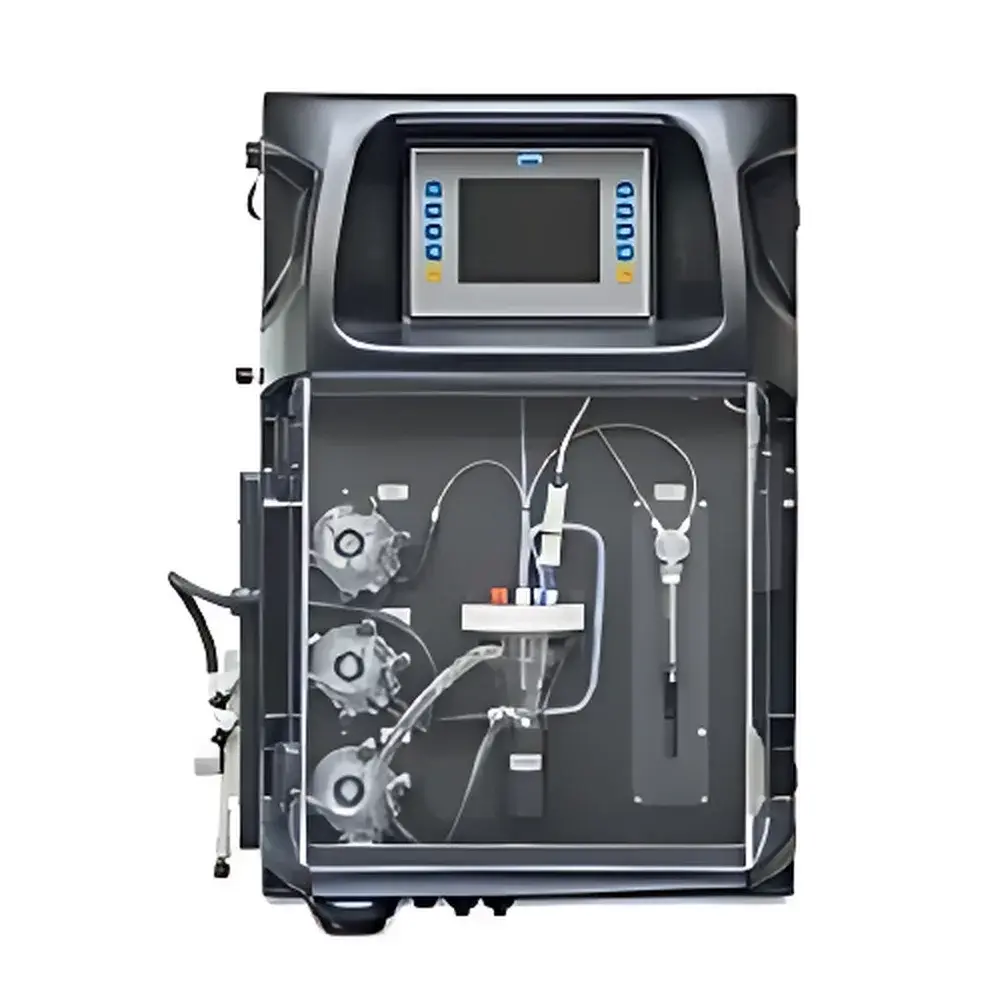
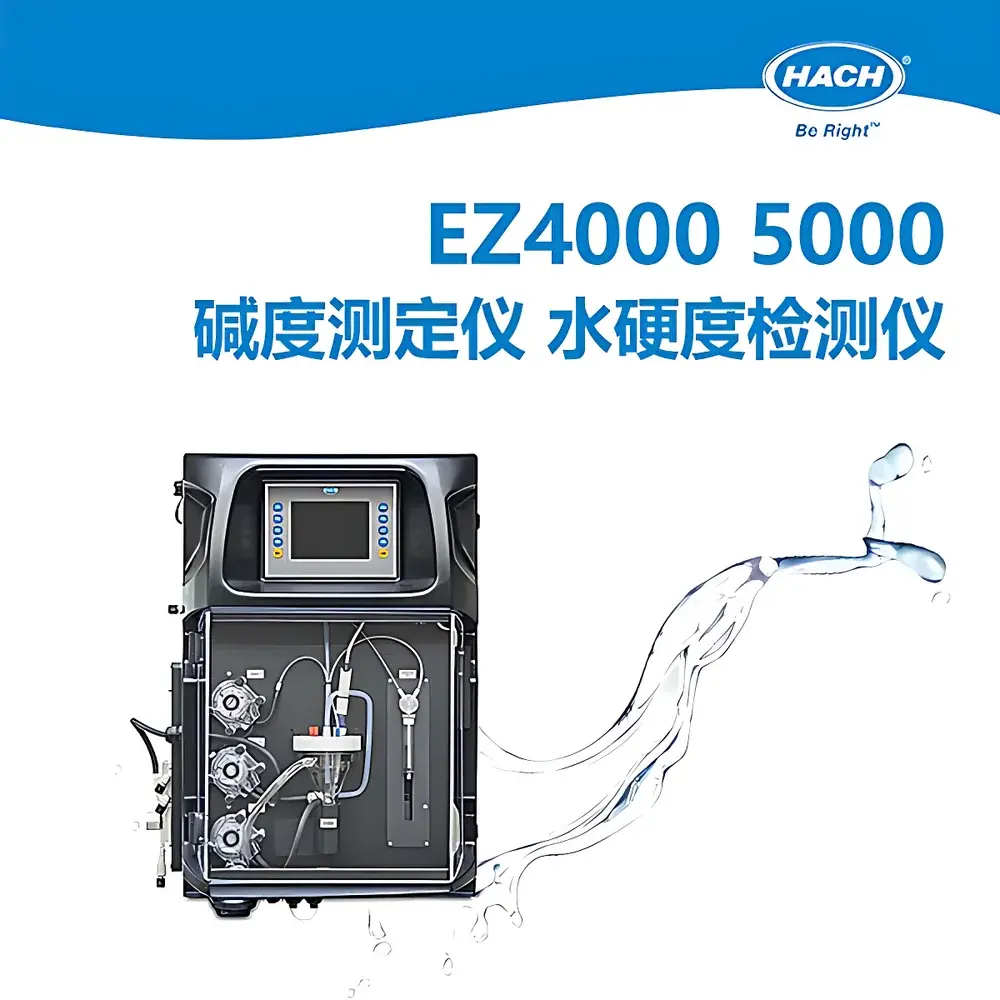
HACH EZ4000/5000 Series Hardness and Alkalinity Analyzers
| Brand | HACH |
|---|---|
| Origin | Imported |
| Manufacturer Type | Manufacturer |
| Model | EZ4000/5000 Series Hardness and Alkalinity Analyzers |
| Measurement Methods | EDTA potentiometric titration (EZ5000) and colorimetric titration using Ca/Mg indicator at 610 nm or Calcon at 620 nm (EZ4000 hardness) |
| Measured Parameters | Total Hardness, Calcium Hardness, Total Alkalinity, Free Alkalinity |
| Range (EZ4000 Hardness) | 100–1000 mg/L as CaCO₃ (EZ4041/EZ4044) |
| Range (EZ4000 Alkalinity) | 100–5000 mg/L as CaCO₃ |
| Range (EZ5000) | Total Hardness: 25–1000 mg/L |
| Total Alkalinity | 40–1000 mg/L (EZ5011) |
| Total/Calcium Hardness & Total/Free Alkalinity | 25–1000 mg/L / 100–5000 mg/L (other models) |
| Detection Limit (EZ4043) | ≤ 0.05 mg/L as CaCO₃ (LED immersion probe) |
| other models | ≤ 10 mg/L |
| Cycle Time | EZ4000: 10–15 min |
| EZ5000 | 20–30 min (up to 40 min with total + calcium hardness) |
| Operating Temperature | 5–35 °C ±5 °C (avoid direct sunlight and rain) |
| Relative Humidity | 5–95 % RH (non-condensing) |
| Sample Temperature | 10–30 °C |
| Storage Temperature (instrument) | −20 to +55 °C |
| (electrodes) | −15 to +55 °C |
| Power Supply | 110–240 VAC, 4 A, 50/60 Hz |
| Max. Power Consumption | 150 VA |
| Outputs | 4–20 mA (standard 1 channel, up to 8 optional), max. 500 Ω load |
| Pneumatic Supply | Dry, oil-free air per ISA-S7.0.01-1996 |
| Sample Flow Rate | 100–300 mL/min |
| Sample Requirements | Particulates ≤ 100 µm, < 0.1 g/L suspended solids |
| Certifications | CE, UL |
| Enclosure Rating | Analyzer cabinet IP55 |
| Dimensions (H×W×D) | 690 × 465 × 330 mm |
| Shipping Weight | 25 kg |
Overview
The HACH EZ4000/5000 Series Hardness and Alkalinity Analyzers are fully automated, online titration-based instruments engineered for continuous, unattended monitoring of critical water quality parameters in municipal, industrial, and environmental applications. These analyzers employ standardized titrimetric principles—EDTA complexometric titration for hardness (potentiometric detection on EZ5000; spectrophotometric endpoint detection at 610 nm or 620 nm on EZ4000) and strong-acid (HCl) titration for alkalinity—ensuring traceable, reproducible results aligned with ASTM D1126 (hardness) and ASTM D1067 (alkalinity) methodologies. Designed for integration into plant-wide SCADA and DCS architectures, the series delivers robust performance under variable influent conditions while maintaining compliance with regulatory reporting requirements for drinking water (e.g., EPA Method 130.1), wastewater discharge permits, and process control specifications in power, semiconductor, and pharmaceutical manufacturing.
Key Features
- Modular dual-platform architecture: EZ4000 optimized for high-sensitivity colorimetric hardness (including low-range EZ4043 with LED immersion probe, LOD ≤ 0.05 mg/L as CaCO₃) and broad-range alkalinity; EZ5000 leverages potentiometric titration with integrated LED-based electrode arrays for enhanced stability in turbid or colored samples.
- Multi-parameter flexibility: Single-unit configuration supports independent or simultaneous measurement of total hardness, calcium hardness, total alkalinity, and free alkalinity—configurable per model variant (e.g., EZ5011 vs. EZ5022).
- Industrial-grade automation: Embedded microprocessor controls reagent dosing, endpoint recognition, blank compensation, and drift correction without manual intervention; cycle times are programmable (EZ4000: 10–15 min; EZ5000: 20–30 min standard, extendable to 40 min for dual-hardness analysis).
- Secure, standards-compliant connectivity: Native Modbus TCP/IP over Ethernet enables seamless integration with PLCs and historians; optional expansion to eight independent measurement channels via rack-mounted I/O modules.
- Ruggedized enclosure system: IP55-rated analyzer cabinet with corrosion-resistant housing; IP65-rated industrial panel PC with capacitive touchscreen interface for local operation, diagnostics, and calibration verification.
- Regulatory-ready output infrastructure: Standard 4–20 mA analog outputs (1 default, up to 8 configurable) with HART-compatible signal conditioning; all outputs support linear or square-root scaling per parameter.
Sample Compatibility & Compliance
The EZ4000/5000 series accommodates raw and treated waters across diverse matrices—including surface water, groundwater, potable distribution systems, cooling tower blowdown, boiler feedwater, and secondary effluent—provided sample particulate load remains below 0.1 g/L and particle size is limited to ≤100 µm. Turbidity must not exceed 50 NTU to ensure optical path integrity in EZ4000 colorimetric cells. All models require dry, oil-free instrument air per ISA-S7.0.01-1996 for pneumatic actuation of solenoid valves and peristaltic pumps. The analyzers operate reliably within 10–30 °C sample temperature range and 5–35 °C ambient envelope (±5 °C tolerance). Certified to CE and UL 61010-1 safety standards, they meet electromagnetic compatibility (EMC) requirements per EN 61326-1 and are designed for GLP/GMP environments with full audit-trail capability in data logging mode.
Software & Data Management
Configuration, calibration, and diagnostic functions are managed through the embedded HACH Insight™ software suite, accessible locally via the panel PC or remotely via secure HTTPS-enabled web interface. All method parameters—including titrant concentration, sample volume, endpoint threshold, and spike recovery settings—are password-protected and version-controlled. Raw titration curves, endpoint logs, and QC flag metadata (e.g., “low signal-to-noise”, “reagent depletion warning”) are timestamped and stored internally for ≥12 months. Data export supports CSV and PDF report generation compliant with ISO/IEC 17025 documentation requirements. Optional integration with HACH DataStream™ cloud platform enables centralized fleet monitoring, predictive maintenance alerts, and FDA 21 CFR Part 11–compliant electronic signatures for validated environments.
Applications
- Municipal drinking water treatment: Real-time monitoring of lime softening efficiency, corrosion control indices (Langelier Saturation Index), and compliance with WHO and national hardness limits (e.g., <500 mg/L CaCO₃).
- Power generation: Boiler feedwater hardness surveillance to prevent scale formation in HRSGs; condensate polishing loop alkalinity tracking for copper alloy protection.
- Pharmaceutical water systems: USP Purified Water and WFI conductivity/hardness correlation verification per Chapter .
- Industrial pretreatment: Effluent characterization prior to membrane filtration or ion exchange; optimization of antiscalant dosing in RO plants.
- Environmental compliance: Continuous reporting for NPDES permits requiring hardness/alkalinity ratios to assess aquatic toxicity buffering capacity.
FAQ
What titration methods are supported across the EZ4000 and EZ5000 platforms?
The EZ4000 uses spectrophotometric endpoint detection (610 nm or 620 nm) for hardness and acid-base potentiometry for alkalinity; the EZ5000 employs fully potentiometric EDTA titration for hardness and acid titration for alkalinity, utilizing solid-state LED immersion probes.
Can a single EZ5000 unit measure both total and calcium hardness simultaneously?
Yes—models such as EZ5022 support sequential or concurrent analysis of total hardness and calcium hardness within one cycle (up to 40 minutes), enabling calculation of magnesium hardness by difference.
Is method validation documentation available for regulatory submissions?
HACH provides IQ/OQ protocols, ASTM-aligned method verification reports, and instrument-specific uncertainty budgets upon request—fully compatible with laboratory accreditation bodies (e.g., A2LA, UKAS).
How is reagent consumption monitored and managed?
Integrated level sensors track titrant and buffer volumes; the system generates low-reagent alarms and automatically disables analysis when thresholds are breached, preventing invalid results.
What cybersecurity features are implemented for remote access?
Role-based authentication, TLS 1.2 encryption, configurable session timeouts, and disabled default credentials meet IEC 62443-3-3 SL2 requirements for industrial control systems.
Related Products







