
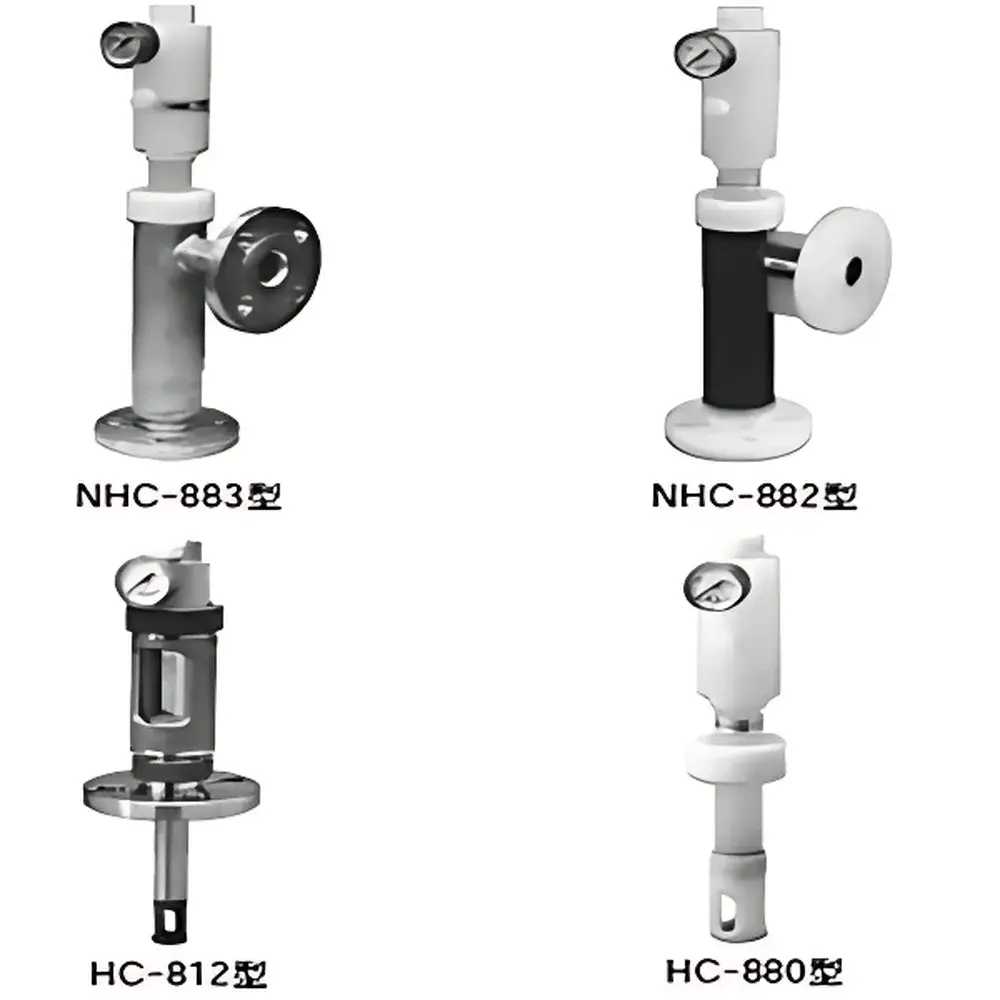
HACH HC-8 Series In-Line pH/ORP Sensor with KCl-Refillable Electrodes
| Brand | HACH |
|---|---|
| Origin | Imported |
| Manufacturer Type | Manufacturer |
| Model | HC-8 |
| Price | Upon Request |
Overview
The HACH HC-8 Series is a family of robust, pressure-rated in-line pH and ORP sensors engineered for continuous, high-reliability measurement in closed-loop process systems—including pressurized piping, side-stream bypass loops, and sealed tanks. Designed around the fundamental electrochemical principles of potentiometric measurement, the HC-8 operates using KCl-refillable combination electrodes that maintain stable liquid junction potential under dynamic flow and variable pressure conditions. Each sensor integrates a glass pH sensing element (or Pt/Au alloy for ORP) with an Ag/AgCl reference system immersed in 3 M KCl electrolyte. Critical to operational integrity is the controlled pressure differential—typically 30–50 kPa—between the internal reference chamber and the process stream, achieved via regulated instrument air pressurization. This design ensures consistent KCl outflow across the liquid junction, minimizing junction clogging and drift while enabling accurate, low-maintenance operation in demanding industrial water treatment, power generation, chemical processing, and pharmaceutical applications.
Key Features
- Pressure-rated construction: Supports operating pressures up to 0.45 MPa (HC-81x models) and temperature ranges from –5 °C to +95 °C, depending on configuration.
- Modular installation options: Includes direct-insertion (threaded or flanged), flow-cell (flanged or screwed), and removable designs to accommodate diverse piping layouts and maintenance protocols.
- Chemically resistant wetted materials: Standard configurations feature PP and FKM seals; high-purity variants utilize SUS316 stainless steel, PTFE, PFA, and Kalrez® for extreme corrosion resistance and compliance with FDA 21 CFR Part 11–aligned environments.
- KCl-refillable electrode architecture: Enables extended service life and predictable electrolyte consumption (~1–3 mL/day under nominal conditions), reducing calibration frequency and supporting GLP/GMP traceability.
- Integrated Pt or Au-alloy ORP sensing elements: Optimized for redox monitoring in wastewater, desulfurization scrubbers, boiler feedwater, and bioprocess streams where sulfide, chloride, or organic interference is present.
- Embedded Pt1000 or thermistor-based temperature sensors: Provide automatic temperature compensation (ATC) for both pH and ORP measurements per ISO 7027 and ASTM D1293 guidelines.
Sample Compatibility & Compliance
The HC-8 series accommodates a broad spectrum of aqueous process streams—including municipal wastewater, flue gas desulfurization (FGD) slurries, boiler condensate, ultrapure water (UPW), food-grade rinse solutions, and pharmaceutical clean-in-place (CIP) effluents. Electrode variants include fluorinated glass membranes (for HF-containing streams up to 1000 ppm at ≤50 °C), high-temperature glass formulations (rated to 95 °C), and chemically inert Kalrez®/Perfluoro-sealed junctions for aggressive solvents or oxidizing media. All configurations comply with international standards for electrical safety (IEC 61000-6-2/4), electromagnetic compatibility, and material biocompatibility (USP Class VI). The pressurized KCl delivery system meets requirements for validated continuous monitoring under GMP Annex 11 and ISO 17025-accredited laboratories.
Software & Data Management
While the HC-8 is an analog 4–20 mA transmitter-compatible sensor, it is fully interoperable with HACH’s SC1000, CL17, and HQd platforms for digital configuration, diagnostics, and data logging. When paired with HACH’s LogR software or third-party SCADA/DCS systems supporting HART v7.5 or Modbus RTU, users gain access to real-time electrode health metrics—including junction resistance, asymmetry potential, and slope deviation—enabling predictive maintenance and audit-ready calibration records. All calibration events, temperature logs, and pressure status flags are timestamped and stored with user-defined metadata, satisfying FDA 21 CFR Part 11 electronic record and signature requirements when deployed with appropriate system validation.
Applications
- Municipal and industrial wastewater treatment: Real-time pH control in equalization basins, anaerobic digesters, and tertiary polishing stages.
- Power plant chemistry monitoring: Feedwater, condensate, and steam cycle pH/ORP tracking per EPRI TR-102398 and IAPWS guidelines.
- Flue gas desulfurization (FGD): Slurry pH control in limestone-gypsum scrubbers to optimize SO₂ removal efficiency.
- Pharmaceutical water systems: USP compliant monitoring of purified water (PW) and water for injection (WFI) distribution loops.
- Food & beverage processing: CIP solution verification, brine pH stabilization, and fermentation broth redox profiling.
- Chemical manufacturing: Batch reactor endpoint detection, neutralization control, and corrosion inhibitor dosing feedback.
FAQ
What pressure differential is required for reliable KCl outflow in pressurized HC-8 installations?
A minimum differential of 30 kPa—and preferably 30–50 kPa—must be maintained between the internal reference chamber and process fluid. Instrument air is recommended as the pressurizing medium; regulators and filters must ensure oil-free, particle-free supply.
Can the HC-8 be used in hydrofluoric acid (HF) solutions?
Yes—only when equipped with the 5615-□F or 5605-□F fluorinated glass membrane electrodes, rated for HF concentrations up to 1000 ppm within –5 °C to +50 °C. Standard glass electrodes are not suitable.
Is temperature compensation automatic?
Yes—integrated Pt1000 or thermistor sensors provide real-time ATC for both pH and ORP outputs, conforming to NIST-traceable temperature response curves.
How often does the KCl electrolyte require refilling?
Under typical operating conditions (30–50 kPa overpressure, 25 °C), electrolyte consumption averages 1–3 mL per day. Refill intervals depend on pressure stability, temperature, and flow dynamics.
Are HC-8 sensors compatible with HART-enabled controllers?
Yes—the analog 4–20 mA output supports HART v7.5 communication for remote configuration, diagnostics, and firmware updates when connected to HART-compatible host systems.
Related Products







