
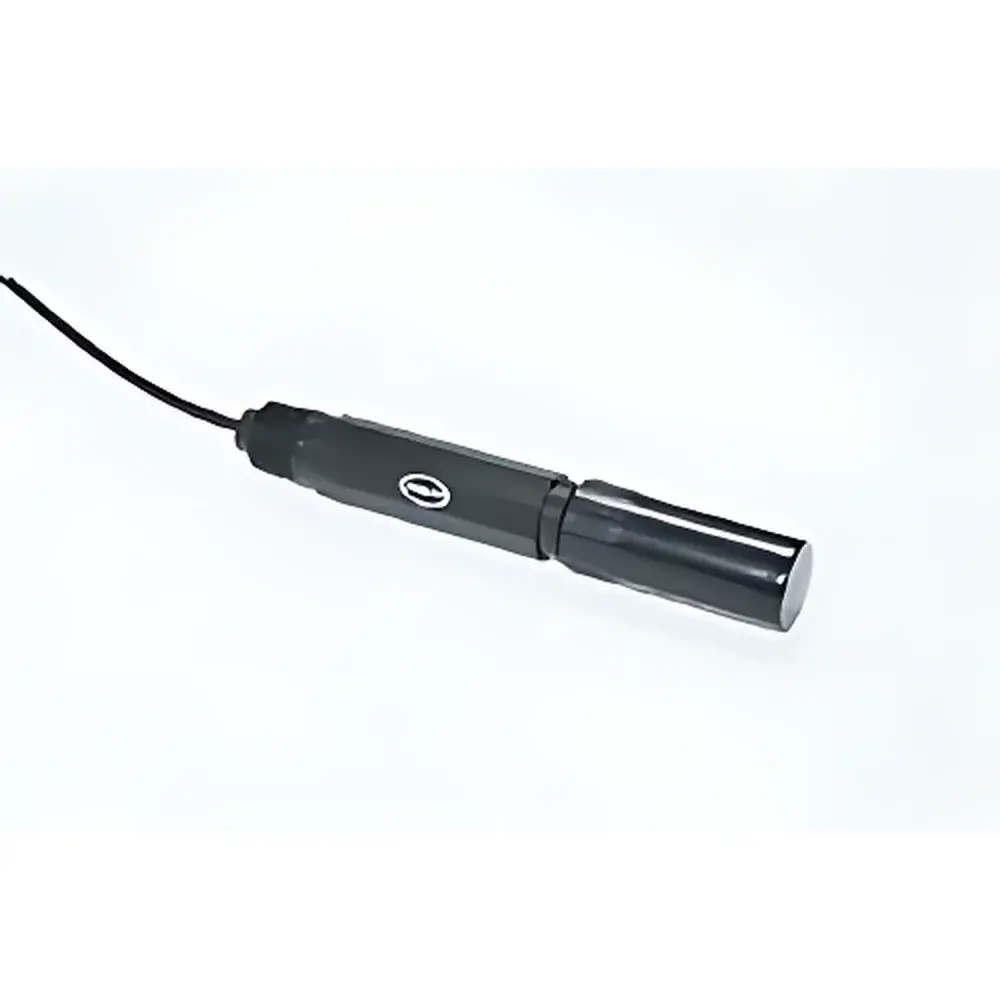
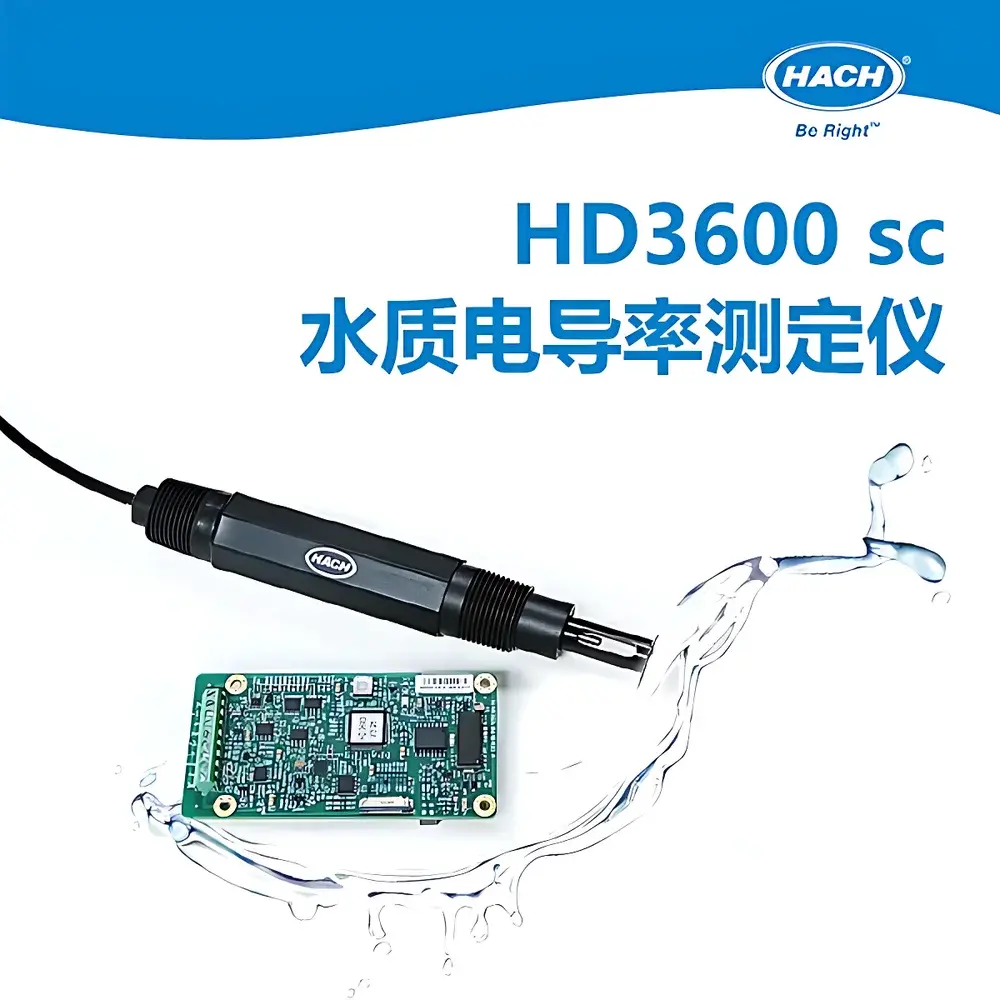
HACH HD3600 sc Conductivity Analyzer
| Brand | HACH |
|---|---|
| Origin | Imported |
| Manufacturer Status | Original Equipment Manufacturer (OEM) |
| Model | HD3600 sc Conductivity Analyzer |
| Pricing | Available upon Request |
Overview
The HACH HD3600 sc Conductivity Analyzer is a rugged, two-electrode contact-type conductivity measurement system engineered for continuous online monitoring of aqueous solutions in municipal, industrial, and environmental applications. It operates on the fundamental principle of conductometric measurement: a known alternating voltage is applied across two stainless steel or graphite electrodes immersed in the sample, and the resulting current is measured. Conductivity (σ) is calculated using Ohm’s law (σ = G × K), where G is conductance and K is the cell constant—pre-calibrated during factory certification. Temperature dependence is inherently addressed via an integrated NTC-30K thermistor embedded directly within the sensor body, enabling real-time, in-situ thermal compensation without external probes or lag. This architecture ensures high reproducibility and minimal drift under variable ambient and process conditions, making the HD3600 sc suitable for regulatory-compliant monitoring of surface water, wastewater effluent, cooling tower make-up, and chemical dosing control loops.
Key Features
- Two-electrode conductivity sensor with factory-calibrated cell constant (K = 1.0 cm⁻¹ standard; optional K = 0.1 or 10 cm⁻¹ configurations available)
- Integrated NTC-30K temperature sensor in direct thermal contact with the measurement zone—eliminates thermal lag and improves compensation accuracy to ±0.1 °C
- Wide conductivity range: 0.05–200 mS/cm (dependent on electrode configuration and calibration)
- IP68-rated sensor housing for submersible or pipe-mounted installation in harsh outdoor or wet-process environments
- 4–20 mA analog output with HART® protocol support for integration into DCS/SCADA systems
- Optional Modbus RTU over RS-485 for digital communication and remote configuration
- Self-diagnostic capability including electrode fouling detection and open/short circuit alerts
Sample Compatibility & Compliance
The HD3600 sc is validated for use with low-to-moderate conductivity aqueous matrices, including freshwater, treated wastewater, brackish influent, and industrial process streams containing dissolved electrolytes (e.g., NaCl, CaSO₄, H₂SO₄, NaOH). It is not intended for highly viscous, abrasive, or strongly oxidizing media without protective housings or flow cells. The analyzer complies with IEC 61298-2 (industrial process measurement devices) and meets EMC requirements per IEC 61326-1. When deployed in drinking water or wastewater treatment facilities subject to EPA Method 120.1 or ISO 7888, the HD3600 sc supports traceable calibration using certified KCl standards (e.g., 1413 µS/cm at 25 °C). Its design facilitates routine verification under GLP and ISO/IEC 17025 quality frameworks.
Software & Data Management
Configuration and diagnostics are performed via HACH’s SC1000 Universal Controller platform or the standalone SC200 controller (sold separately), both supporting multi-parameter expansion. Firmware updates and calibration logs are stored locally with time-stamped audit trails. For enterprise-level deployment, the analyzer integrates seamlessly with HACH’s Asset Insight™ cloud platform—enabling secure remote access, automated alarm notifications (SMS/email), historical trend analysis, and export of CSV or PDF reports compliant with FDA 21 CFR Part 11 when paired with appropriate user access controls and electronic signature workflows. Calibration data includes date/time stamps, operator ID, standard used, and post-calibration verification results.
Applications
- Real-time monitoring of conductivity in raw intake water and finished potable water distribution networks
- Effluent compliance tracking per NPDES permit limits for total dissolved solids (TDS) estimation
- Monitoring of reverse osmosis (RO) reject and permeate streams for membrane integrity assessment
- Chemical feed control in pH neutralization systems and coagulant dosing loops
- Process water quality assurance in pharmaceutical manufacturing (PW, WFI pre-check) and food & beverage production
- Environmental field studies requiring portable or fixed-site long-term deployment with solar-powered telemetry options
FAQ
What is the recommended calibration frequency for the HD3600 sc in continuous operation?
Calibration should be performed at least once per week in critical applications; bi-weekly is acceptable for stable, low-fouling environments. Field verification with a second standard (e.g., 12.88 mS/cm KCl) is advised between full calibrations.
Can the HD3600 sc measure salinity or TDS directly?
It does not measure salinity or TDS natively but provides conductivity output that can be converted to TDS (mg/L) using configurable linear or non-linear conversion factors (e.g., 0.64–0.71 multiplier for natural waters) in the connected controller.
Is the sensor compatible with aggressive cleaning agents such as sodium hypochlorite or citric acid?
Yes—stainless steel electrodes tolerate periodic cleaning with ≤500 ppm NaOCl or 2–5% citric acid solutions; extended exposure to strong oxidizers requires evaluation of gasket material compatibility (EPDM standard; Viton® optional).
Does the HD3600 sc support automatic temperature compensation below 0 °C?
The NTC-30K sensor is rated from –10 °C to +60 °C; however, conductivity algorithms assume liquid-phase water and are not validated for ice formation or supercooled conditions.
How is sensor fouling detected and mitigated?
The analyzer monitors electrode impedance and conductance stability; sustained deviation triggers a “Fouling Alert” in the controller UI. Recommended mitigation includes scheduled mechanical brushing, air scouring, or intermittent chemical cleaning cycles.







