
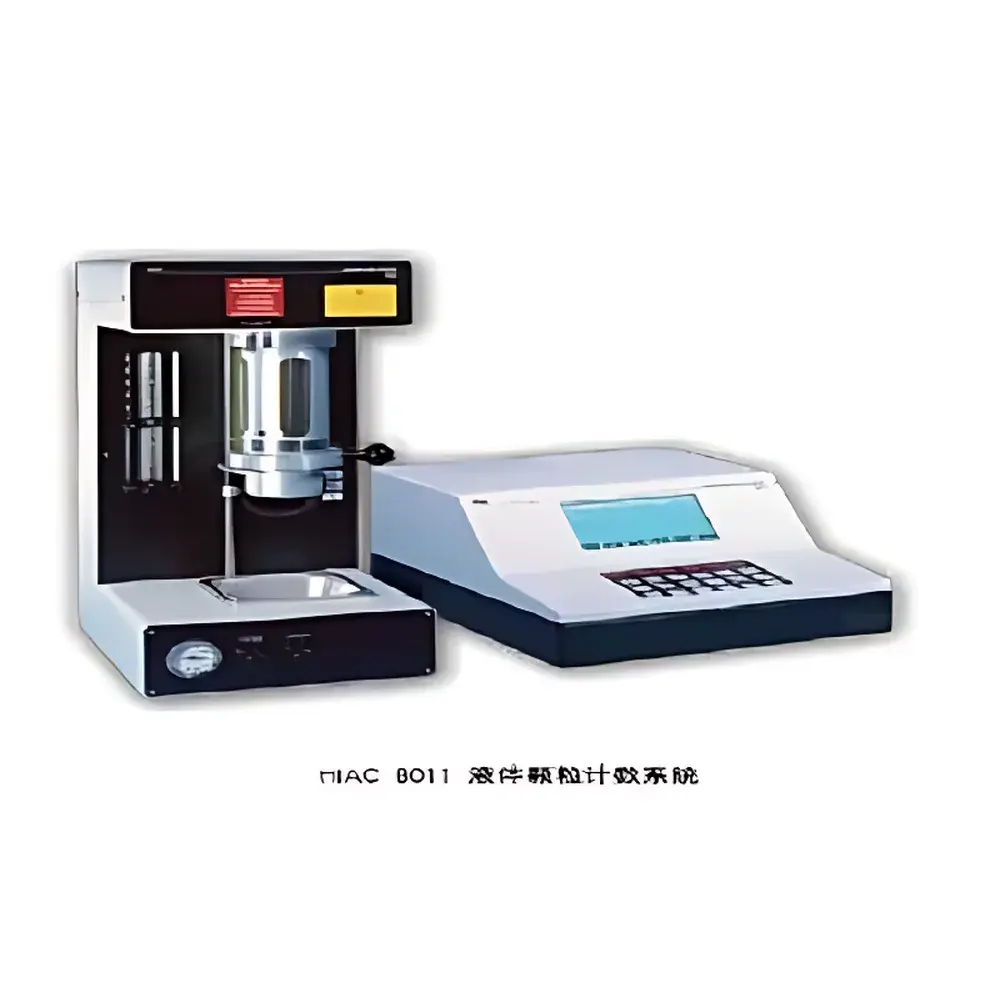
Hach HIAC 8011 Liquid Particle Counter System
| Brand | Hach |
|---|---|
| Model | HIAC 8011 |
| Measurement Principle | Light Obscuration (LO) and Dual-Mode Sensing |
| Particle Size Range | 0.5–400 µm |
| Viscosity Range | 0–80 cP |
| Compliance Standards | ISO 4406, NAS 1638, ISO 11171, ASTM F312, USP <788> (contextual applicability) |
| Sample Volume Accuracy | Engineered via pressurized flow control in ABS-2 Automated Sampler |
| Repeatability | <5% RSD |
| Sampling Time | <60 seconds per run |
| Calibration Standards Supported | ISO 11171, ACFTD, MTD, PSL |
| Simultaneous Channel Counting | Up to 8 user-defined size thresholds |
| Operating Mode | Standalone (integrated touchscreen interface), no external PC required |
| Regulatory Readiness | Audit trail-capable data logging |
Overview
The Hach HIAC 8011 Liquid Particle Counter System is an engineered solution for quantitative particulate contamination analysis in hydraulic fluids, lubricants, aviation fuels, and other industrial liquids. It operates on the principle of light obscuration (LO), where particles suspended in a liquid stream pass through a focused laser beam, causing transient reductions in detected light intensity proportional to particle cross-sectional area. This enables precise, real-time enumeration and sizing of individual particles across a broad dynamic range—from submicron (0.5 µm) up to 400 µm—without reliance on external computing hardware. The system integrates a pressurized fluid delivery architecture via the ABS-2 Automated Sampler, ensuring consistent volumetric flow and minimizing sampling bias caused by viscosity fluctuations (up to 80 cP). Its design adheres to foundational metrological requirements for particle counting instrumentation, including optical alignment stability, sensor thermal management, and laminar flow conditioning—critical for achieving <5% measurement repeatability under routine laboratory or field-deployed conditions.
Key Features
- Standalone operation with integrated high-resolution touchscreen interface—no external PC or driver installation required.
- Dual-mode sensing capability: configurable for standard light obscuration or enhanced dual-wavelength detection to improve discrimination between transparent and opaque contaminants.
- Eight independent, user-definable particle size channels within the 0.5–400 µm range, enabling customizable reporting aligned with application-specific cleanliness codes.
- Pressurized sample delivery via ABS-2 Automated Sampler ensures accurate, repeatable volumetric aspiration—even for viscous or low-surface-tension fluids.
- Built-in calibration verification routines compliant with ISO 11171, using traceable reference materials including ACFTD (Air Cleaner Fine Test Dust), MTD (Medium Test Dust), and PSL (Polystyrene Latex) spheres.
- Onboard compliance engine supporting automatic generation of reports formatted to ISO 4406 (code-based classification), NAS 1638 (contamination level grading), and custom threshold logic.
- Full audit trail functionality with timestamped operator actions, method changes, and calibration events—designed to support GLP and GMP documentation requirements.
Sample Compatibility & Compliance
The HIAC 8011 accommodates a wide range of non-corrosive, optically transparent to semi-transparent liquids, including mineral oils, synthetic lubricants, phosphate esters, glycol-based fluids, and deionized water used in component rinsing validation. Its sensor housing and wetted path materials (316 stainless steel, fused silica flow cell, Kalrez® seals) resist chemical degradation while maintaining dimensional stability during repeated thermal cycling. The system meets the physical and procedural criteria referenced in ISO 11171 for instrument calibration and verification, and its output structure conforms to data formatting expectations in ISO 4406:2017 and NAS 1638 Rev. 2019. While not inherently FDA-certified as a medical device, its data integrity features—including electronic signatures, change control logs, and exportable CSV/Excel-compatible datasets—support validation against 21 CFR Part 11 when deployed in regulated manufacturing environments.
Software & Data Management
The HIAC 8011 runs embedded firmware (v4.x+) that manages all acquisition, calculation, and reporting functions locally. Data are stored internally on encrypted flash memory with configurable retention policies (up to 10,000 test records). Export options include USB mass storage mode for raw count data, summary PDF reports with embedded metadata (operator ID, date/time, method name, calibration status), and structured CSV files compatible with LIMS integration. The onboard software supports method templates, user role-based access control (admin/operator/viewer), and automated pass/fail evaluation against stored acceptance limits. All critical events—including sensor clean cycles, calibration deviations, and power interruptions—are logged with ISO 8601 timestamps and retained for post-analysis forensic review.
Applications
- Hydraulic system fluid health monitoring: trending particle counts to predict filter breakthrough or internal wear onset.
- Cleanliness certification of aerospace components per SAE AS4059 and DEF STAN 91-91.
- Validation of final rinse processes for semiconductor tooling and medical device manufacturing.
- Wear debris analysis in turbine oil surveillance programs, correlating particle morphology trends with tribological failure modes.
- Quality release testing of bulk lubricants prior to packaging, per ISO 4406 code specifications.
- Supporting root cause investigations in contamination-related equipment failures through sequential sampling and statistical process control (SPC) charting.
FAQ
Does the HIAC 8011 require external computer software to operate?
No—the system is fully self-contained with an integrated processor and touchscreen interface. All measurement, calibration, and reporting functions execute natively.
Can it measure particles smaller than 1 µm?
Yes. The optical design achieves reliable detection down to 0.5 µm using optimized laser wavelength, signal-to-noise amplification, and background noise suppression algorithms.
Is ISO 11171 calibration mandatory before each test?
No. ISO 11171 defines calibration methodology and reference materials—not frequency. Daily verification using certified check particles is recommended; full recalibration is performed per scheduled maintenance or after sensor servicing.
How is sample volume accuracy ensured at high viscosity?
The ABS-2 sampler applies regulated pneumatic pressure to drive fluid through the sensor at constant flow rate, decoupling volumetric precision from pump speed variability or fluid rheology.
Can historical data be migrated to a central database?
Yes. Exported CSV files contain all raw channel counts, timestamps, and method parameters, enabling direct ingestion into SQL-based asset management or predictive maintenance platforms.







