
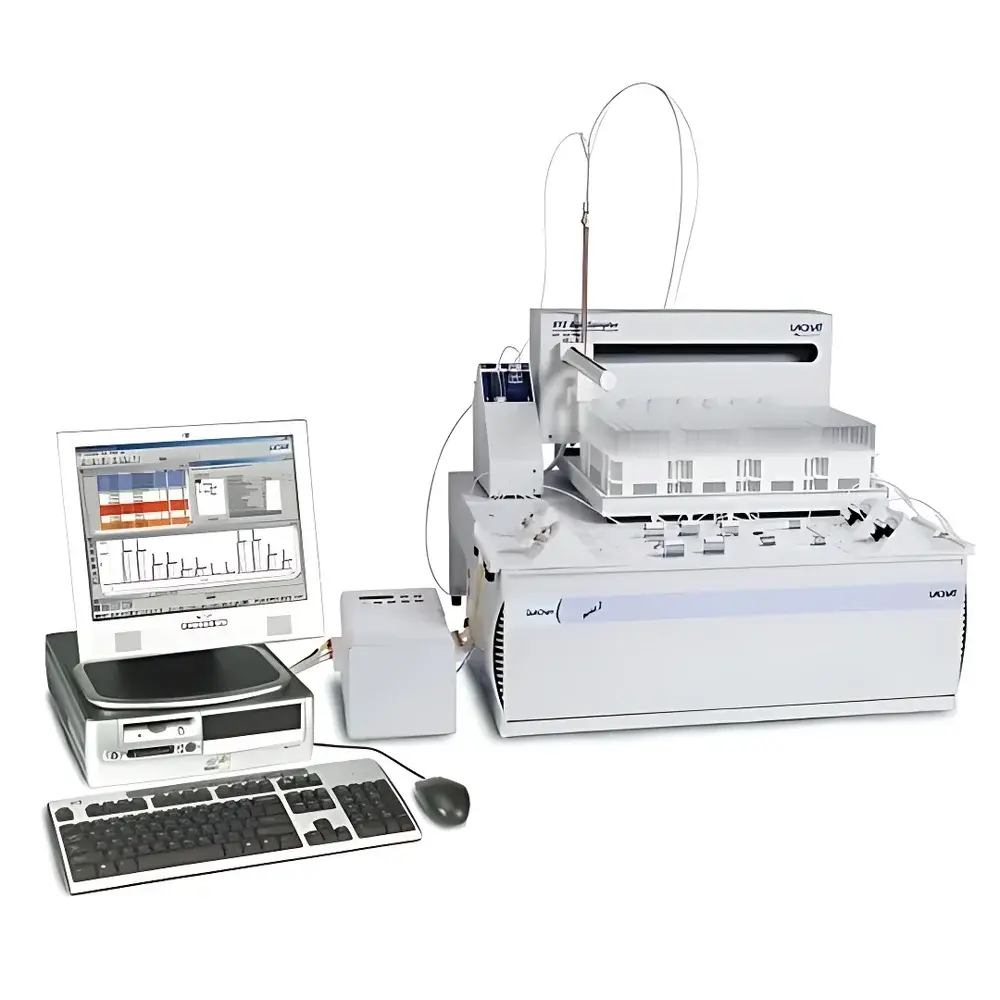
HACH Lachat Quickchem 8500S2 Flow Injection Analyzer
| Brand | HACH |
|---|---|
| Manufacturer | Lachat Instruments (a HACH company) |
| Model | Quickchem 8500S2 |
| Technique | Flow Injection Analysis (FIA) |
| Detection Limit | sub-µg/L |
| Channels | up to 5 |
| Wavelength Range | 340–880 nm |
| Light Source | Tungsten-halogen lamp |
| Detector | Single-wavelength, dual-beam photometer |
| Heating Range | 25–160 °C |
| Injector Valve | High-efficiency 6-port selection valve |
| Filter Type | Interference filters |
| Peristaltic Pump | 12- or 16-channel programmable pump |
| Dilution Range | 1.6× to 4000× |
| Mixing Coil | PTFE tubing |
| Flow Cell Pathlength | 10 mm and 20 mm |
| Peak Measurement | Area and height integration |
| Sample Volume | 2–250 µL |
| Throughput | up to 90 samples/hour per channel |
| Software | Omnia 3.0 (32-bit), Windows-compatible |
| Data Compliance | Supports 21 CFR Part 11 audit trails, LIMS integration, real-time QC闭环 control |
| Dimensions (5-channel) | 70.1 × 61.0 × 25.1 cm |
| Standards Compliance | EPA Methods, ISO 15681, DIN 38405, USP <1058> |
Overview
The HACH Lachat Quickchem 8500S2 Flow Injection Analyzer is a fully automated, modular benchtop system engineered for high-throughput, multi-parameter water and environmental sample analysis using standardized flow injection analysis (FIA) methodology. Based on non-steady-state kinetic principles, the system introduces discrete sample zones into a continuously flowing carrier stream, enabling precise temporal control of reagent mixing, reaction timing, and detection—without requiring equilibrium conditions. This design eliminates carryover between samples, ensures reproducible dispersion profiles, and delivers robust analytical performance across diverse matrices including surface water, groundwater, wastewater, seawater, soil extracts, plant digests, and industrial process streams. As a mature platform with over three decades of field deployment, the Quickchem 8500S2 serves as a reference-grade instrument in accredited environmental laboratories where method traceability, regulatory compliance, and long-term operational stability are critical requirements.
Key Features
- Fully automated operation under PC-based Omnia 3.0 software control—including auto-dilution, standard series preparation, sample aspiration, on-line digestion (where applicable), chemical derivatization, and endpoint detection.
- Modular architecture supporting up to five independent analytical channels, each configurable with dedicated pumps, heaters, reactors, and optical detectors—enabling simultaneous determination of multiple analytes (e.g., nitrate, phosphate, ammonia, silica, cyanide, phenol) in a single run.
- Dual-beam photometric detection with tungsten-halogen illumination and interference filters (340–880 nm), providing high signal-to-noise ratio and drift compensation for sub-µg/L detection limits across validated methods.
- PTFE-based fluidic path with 0.5 mm and 0.8 mm ID tubing and precision-machined flow cells (10 mm and 20 mm pathlengths) ensuring chemical inertness, low memory effect, and minimal reagent consumption.
- Programmable 12- or 16-channel peristaltic pump with real-time speed calibration, coupled with a high-precision 6-port selection valve for accurate, low-volume (2–250 µL) sample introduction and repeatable zone segmentation.
- On-board temperature-controlled reaction modules (25–160 °C) supporting enzymatic, catalytic, and colorimetric reactions with defined thermal residence times per method protocol.
Sample Compatibility & Compliance
The Quickchem 8500S2 is validated for use with liquid-phase environmental samples requiring minimal pre-treatment—such as filtered natural waters, clarified wastewater effluents, acid-digested soil leachates, and centrifuged biological extracts. Its FIA configuration inherently minimizes matrix interferences through controlled dispersion and segmented reaction kinetics. Method validation aligns with U.S. Environmental Protection Agency (EPA) guidance documents (e.g., EPA Methods 353.2, 365.2, 365.4), ISO 15681-1/2 (phosphorus and nitrogen species), DIN 38405 (German standard methods), and USP analytical instrument qualification criteria. The system supports GLP/GMP workflows via Omnia 3.0’s 21 CFR Part 11-compliant audit trail, electronic signatures, and user-access controls—ensuring data integrity during regulatory inspections.
Software & Data Management
Omnia 3.0 is a dedicated 32-bit Windows application designed exclusively for Lachat FIA platforms. It provides full method development, sequence scheduling, real-time chromatogram visualization, peak integration (area/height), calibration curve fitting (linear, quadratic, log-log), and automatic quality control flagging (e.g., %RSD, recovery, blank drift). Raw and processed data are stored in structured binary format with embedded metadata (operator ID, timestamp, instrument state, calibration history). Export options include CSV, Excel, and XML for seamless LIMS integration. Built-in QC modules execute real-time closed-loop verification—reinjecting standards at user-defined intervals and halting analysis if acceptance criteria (e.g., ±5% calibration drift, ≤2% RSD) are breached.
Applications
The Quickchem 8500S2 is routinely deployed in municipal water utilities, environmental testing laboratories, research institutions, and industrial QA/QC facilities for routine monitoring of nutrient species (NO₃⁻-N, NO₂⁻-N, NH₄⁺-N, PO₄³⁻-P), anions (CN⁻, F⁻, Cl⁻), metals (Fe²⁺/Fe³⁺, Mn²⁺), organic compounds (phenol, formaldehyde), and enzymatic substrates (glucose, urea). Its adaptability extends to non-environmental sectors—including fermentation broth analysis in biopharma, macronutrient profiling in agricultural feedstuffs, and surfactant quantification in cleaning product manufacturing—where standardized, high-reproducibility wet chemistry remains the regulatory benchmark.
FAQ
What regulatory methods are supported by the Quickchem 8500S2?
The system implements over 500 published FIA methods, including EPA-approved protocols for nitrogen and phosphorus speciation, ISO 15681 for orthophosphate and total phosphorus, and DIN 38405 for ammonium and nitrate in water.
Can the system interface with laboratory information management systems (LIMS)?
Yes—Omnia 3.0 supports bidirectional data exchange via ASTM E1394-compliant file transfer and direct ODBC connectivity for automated result upload and sample tracking.
Is hardware calibration traceable to national standards?
All photometric modules undergo factory calibration against NIST-traceable neutral density filters; wavelength accuracy is verified using holmium oxide reference solution per ISO 6425.
How is cross-contamination prevented between samples?
The FIA principle—combined with air segmentation, precise flow velocity control, and PTFE fluidic surfaces—ensures zero physical contact between successive sample zones, eliminating memory effects without rinsing steps.
What maintenance is required for sustained performance?
Routine tasks include monthly pump tube replacement, quarterly optical window cleaning, annual lamp replacement, and semi-annual verification of valve timing and detector linearity using certified reference materials.
Related Products







