
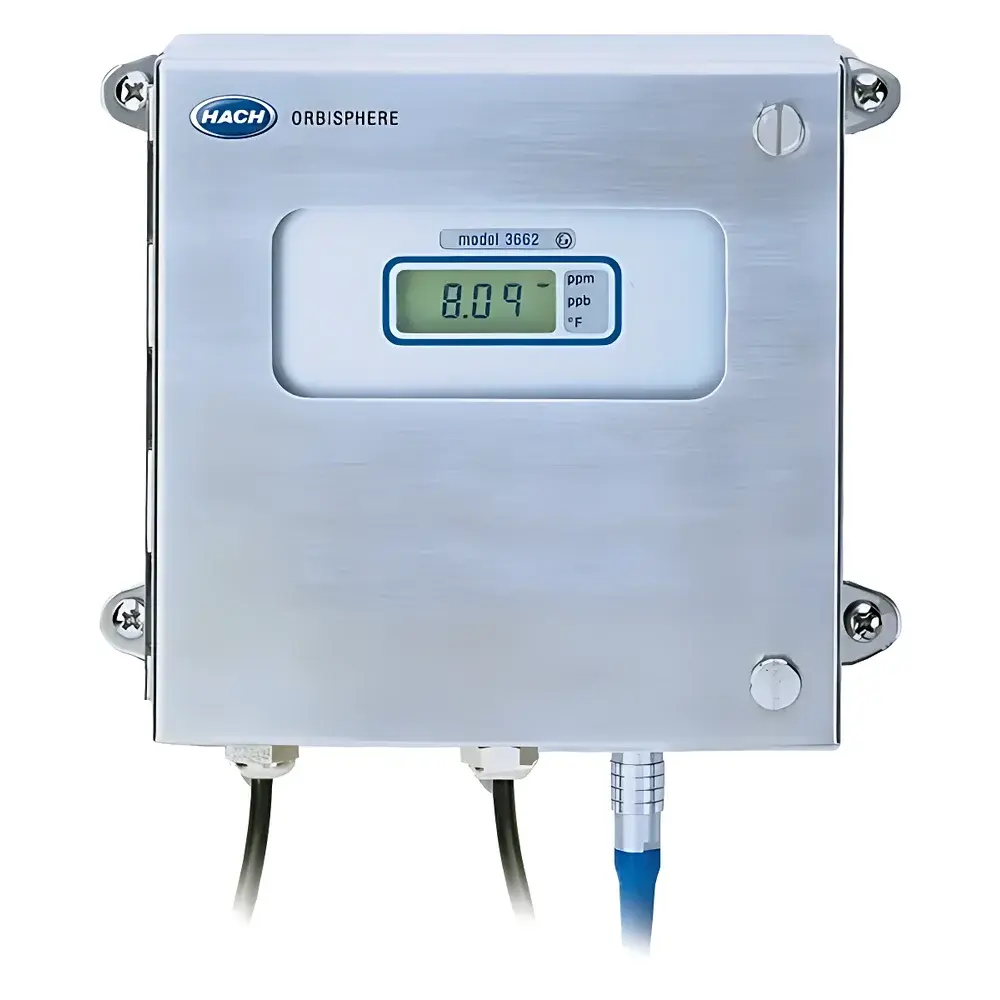
HACH Orbisphere 3660EX Intrinsically Safe Dissolved Oxygen and Hydrogen Analyzer
| Brand | HACH |
|---|---|
| Model | Orbisphere 3660EX |
| Certification | ATEX II 1G Ex ia IIC T4 Ga |
| Enclosure Rating | IP67 / NEMA 4X |
| Construction | Full 316L stainless steel housing |
| Sensor Technology | Patented electrochemical (Clark-type or galvanic) cell |
| Power Supply | 2×AA NiCd or alkaline batteries (2.4–3 V DC) |
| Battery Life | Up to 40 hours continuous operation |
| Signal Drift | <0.5% FS/month |
| Temperature Range (Operation) | 0–45 °C |
| Temperature Range (Measurement) | –5–100 °C |
| Output Options | 4–20 mA, RS232, RS485 |
| Maximum Remote Display Distance | 1000 m (with 3662 display unit) |
| Sample Compatibility | Aqueous solutions, process streams, hazardous gas atmospheres (O₂, H₂, O₃) |
| Data Logging | Internal non-volatile memory with PC download capability |
Overview
The HACH Orbisphere 3660EX is an intrinsically safe, field-deployable electrochemical analyzer engineered for continuous, real-time measurement of dissolved oxygen (DO), hydrogen (H₂), or ozone (O₃) in hazardous environments classified under ATEX Zone 0/1 and IECEx Category 1G. Unlike conventional analyzers requiring thermal stabilization, the 3660EX employs a patented electrochemical sensing architecture that delivers stable, high-fidelity readings immediately upon power-up—eliminating warm-up delays and enabling rapid response during critical process interventions. Its measurement principle relies on diffusion-controlled amperometric detection across a selective membrane, where target analytes undergo redox reactions at noble-metal electrodes, generating a current linearly proportional to concentration. This design ensures long-term baseline stability, minimal zero drift (<0.5% FS/month), and immunity to flow-rate variations typical in industrial effluent, bioreactor, or chemical synthesis applications.
Key Features
- Intrinsically safe certification per ATEX II 1G Ex ia IIC T4 Ga and IECEx compliance—approved for installation in explosive gas atmospheres (e.g., chlorine generation cells, hydrogenation reactors, wastewater aeration basins).
- Zero warm-up requirement: Achieves full measurement accuracy within seconds of activation, supporting immediate commissioning and emergency diagnostics.
- Ruggedized 316L stainless steel enclosure rated IP67/NEMA 4X—resistant to corrosion, high-pressure washdown, and mechanical impact in outdoor or confined-space deployments.
- Modular sensor interface accommodating multiple membrane-based electrochemical probes—including DO Clark cells, H₂-specific galvanic sensors, and ozone-selective membranes—each calibrated traceably to NIST-traceable standards.
- Dual communication architecture: Simultaneous analog (4–20 mA isolated output) and digital interfaces (RS232 and RS485 Modbus RTU) for integration into DCS, SCADA, or PLC systems without protocol conversion hardware.
- Onboard non-volatile data logging with timestamped records; data export via RS232 to Windows-based configuration software for trend analysis, audit trail generation, and regulatory reporting.
Sample Compatibility & Compliance
The 3660EX is validated for use with aqueous matrices across pH 2–12 and conductivity up to 20 mS/cm, including saline wastewater, pharmaceutical process water, and aggressive chemical streams containing low concentrations of sulfides or chloramines. It meets ISO 5814:2012 (electrochemical DO measurement), ASTM D888-12 (dissolved oxygen in water), and USP for oxygen monitoring in purified water systems. For hydrogen monitoring in electrolyzer off-gas or fuel cell purge streams, it complies with IEC 60079-29-1:2016 for flammable gas detection performance. All firmware and calibration routines support ALCOA+ data integrity principles, with configurable audit trails, electronic signatures, and user-access controls aligned with FDA 21 CFR Part 11 requirements for regulated laboratories and GMP manufacturing sites.
Software & Data Management
Configuration, calibration, and diagnostics are managed through HACH’s Orbisphere Configuration Utility—a Windows desktop application supporting password-protected user roles (Operator, Technician, Administrator). The utility enables multi-point calibration verification, sensor lifetime tracking (based on polarization voltage decay), and automatic generation of calibration certificates compliant with ISO/IEC 17025 documentation standards. Logged data includes raw sensor signals, temperature-compensated values, diagnostic flags (e.g., membrane breach, electrolyte depletion), and operator-initiated events—all time-stamped with UTC synchronization. Export formats include CSV and XML, compatible with LIMS integration and automated report generation for environmental compliance submissions (e.g., EPA NPDES, EU WFD).
Applications
- Continuous dissolved oxygen monitoring in activated sludge basins and membrane bioreactors (MBRs) for optimized aeration control and energy reduction.
- In-situ hydrogen concentration measurement in PEM electrolyzer stack purge lines and hydrogen compression skids—critical for explosion risk mitigation.
- Ozone residual monitoring in municipal drinking water disinfection systems, ensuring CT-value compliance while minimizing bromate formation.
- Process safety instrumentation in chemical plants handling flammable solvents, where ambient O₂ depletion or H₂ accumulation must be detected below LEL thresholds.
- Pharmaceutical water-for-injection (WFI) loop surveillance per EU Annex 1 and USP , verifying oxygen ingress during storage and distribution.
FAQ
Does the 3660EX require periodic recalibration?
Yes—recommended every 30 days for critical applications or after membrane replacement; interval may extend to 90 days under stable conditions with daily zero checks.
Can the same analyzer measure both dissolved oxygen and hydrogen interchangeably?
No—sensor modules are analyte-specific; switching requires physical replacement of the probe and corresponding firmware configuration.
Is remote display functionality limited to the 3662 unit?
The 3660EX supports RS485 daisy-chaining for up to 32 devices on one bus; the 3662 is the dedicated local display, but third-party HMIs with Modbus RTU can also serve as remote interfaces.
What maintenance is required for the electrochemical sensor?
Annual electrolyte replenishment (for Clark cells) or sensor replacement every 12–24 months depending on exposure to fouling agents; membrane cleaning with isopropyl alcohol is permitted.
Does the device support temperature compensation for all measured parameters?
Yes—integrated Pt1000 RTD provides real-time temperature input; compensation algorithms follow ISO 5814 and ASTM D1129 for DO, and manufacturer-specific H₂ solubility models per IAPWS guidelines.
Related Products







