
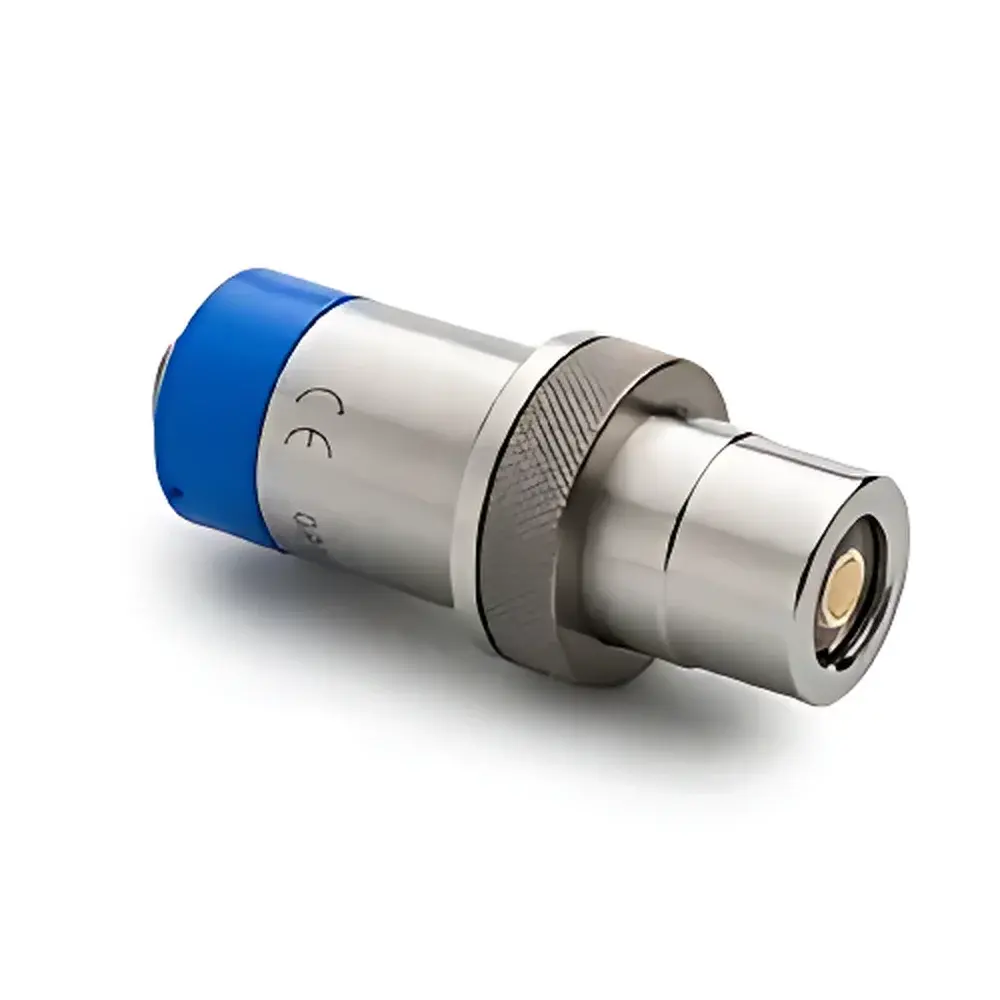
HACH Orbisphere GA2X00 Dissolved Oxygen Sensor Probe
| Brand | HACH |
|---|---|
| Origin | Imported |
| Manufacturer Type | Manufacturer |
| Model | Orbisphere GA2X00 |
| Measurement Principle | Electrochemical (Galvanic Cell) |
| Detection Limit | 0.1 ppb |
| Accuracy | ±1% of reading |
| Replaceable Membrane Cartridge | Yes, pre-assembled with membrane and electrolyte |
| Maintenance Time | <5 minutes |
| ATEX Certification | Yes (for GA2800 variant) |
| Application Fields | Beverage processing, boiler water monitoring, cooling water systems, industrial process water, ultrapure water (UPW) |
Overview
The HACH Orbisphere GA2X00 is a high-precision electrochemical dissolved oxygen (DO) sensor probe engineered for continuous, real-time measurement in demanding liquid-phase applications where trace-level oxygen quantification is critical. Operating on the galvanic cell principle, the probe generates a current proportional to the partial pressure of molecular oxygen diffusing through a gas-permeable membrane into an internal electrolyte solution. This zero-power, self-polarizing design eliminates the need for external polarization voltage—enhancing long-term stability, reducing drift, and extending calibration intervals. Unlike polarographic sensors, the GA2X00 requires no warm-up time and delivers immediate, stable output upon immersion. Its ultra-low detection limit of 0.1 ppb enables reliable monitoring in ultrapure water (UPW) systems used in semiconductor fabrication, pharmaceutical water-for-injection (WFI) loops, and high-purity steam generation—where even sub-ppb oxygen ingress can accelerate corrosion or compromise product sterility.
Key Features
- Sub-ppb sensitivity: Optimized membrane diffusion kinetics and low-noise signal conditioning support consistent detection down to 0.1 ppb O₂, validated per ASTM D888 and ISO 5814 protocols.
- Modular maintenance architecture: Integrates a factory-calibrated, pre-filled membrane cartridge containing both the fluorinated hydrophobic membrane and proprietary electrolyte gel—ensuring reproducible performance across replacements.
- Rapid field serviceability: Full sensor refurbishment—including membrane replacement, electrolyte replenishment, and cathode cleaning—is achievable in under five minutes without specialized tools or technician certification.
- Robust mechanical construction: 316L stainless steel body with IP68-rated sealing; compatible with pressurized flow cells (up to 10 bar) and high-temperature installations (up to 95°C).
- Hazardous area compliance: When paired with the GA2800 transmitter housing, the probe meets ATEX II 2G Ex db IIB T4 Gb and IECEx standards for use in Zone 1 explosive atmospheres.
Sample Compatibility & Compliance
The GA2X00 probe is chemically inert toward common process media including deionized water, condensate, boiler feedwater, carbonated beverages, and low-conductivity ultrapure water (resistivity >15 MΩ·cm). It exhibits minimal interference from chloride, CO₂, or dissolved solids below 100 ppm TDS. The sensor complies with key regulatory frameworks governing water quality instrumentation: USP for purified water testing, FDA 21 CFR Part 11 requirements when integrated with HACH SC1000 or LAN-1000 data loggers (audit trail enabled), and ISO/IEC 17025 traceability guidelines for calibration documentation. All factory calibrations are performed against NIST-traceable zero-oxygen (nitrogen-sparged) and saturated-air standards.
Software & Data Management
The GA2X00 operates as a smart analog (4–20 mA) or digital (HART® v7 or Modbus RTU) sensor node. When connected to HACH’s SC200, SC1000, or LAN-1000 controllers, it supports full two-point calibration with automatic temperature compensation (Pt1000 RTD embedded), dynamic range scaling, and configurable alarm thresholds. Data logging includes timestamped DO values, sensor health diagnostics (e.g., membrane integrity index, electrolyte depletion warning), and calibration history—all exportable in CSV or XML format. Firmware updates and configuration changes comply with IEC 62443-3-3 security profiles, and electronic records meet ALCOA+ principles (Attributable, Legible, Contemporaneous, Original, Accurate, Complete, Consistent, Enduring, Available) for GLP/GMP environments.
Applications
- Pharmaceutical manufacturing: Continuous DO monitoring in WFI storage tanks and distribution loops to prevent biofilm formation and ensure USP compliance.
- Semiconductor fab UPW systems: Real-time detection of oxygen breakthrough in polishing resin beds and loop recirculation lines.
- Power generation: Feedwater deaeration verification in thermal power plants and nuclear secondary coolant circuits.
- Beverage production: In-line oxygen ingress control during bottling, canning, and sterile filtration stages to preserve shelf life and flavor stability.
- Chemical process optimization: Closed-loop control of catalytic hydrogenation reactors and anaerobic bioreactors requiring strict oxygen exclusion.
FAQ
What is the recommended calibration frequency for the GA2X00 in ultrapure water applications?
Calibration should be performed at installation and verified weekly using nitrogen-saturated water (zero point) and air-saturated water (span point), per ASTM D888 Section 9.3.
Can the GA2X00 probe be used in seawater or high-chloride brines?
No—it is not rated for chloride concentrations exceeding 100 ppm; prolonged exposure causes accelerated cathode passivation and irreversible signal drift.
Does the probe require temperature compensation, and how is it implemented?
Yes; built-in Pt1000 RTD provides real-time temperature input to the transmitter, enabling automatic correction based on the solubility curve defined in ISO 5814 Annex A.
Is the membrane cartridge interchangeable between GA2X00 and older GA2000 series probes?
No—the GA2X00 uses a redesigned cartridge with optimized membrane thickness and electrolyte formulation; cross-compatibility is not supported.
How does the GA2X00 handle flow dependence compared to optical DO sensors?
It exhibits minimal flow sensitivity above 0.3 m/s due to its hydrodynamic membrane geometry—unlike luminescence-based sensors, which require strict minimum flow rates to prevent boundary layer artifacts.







