
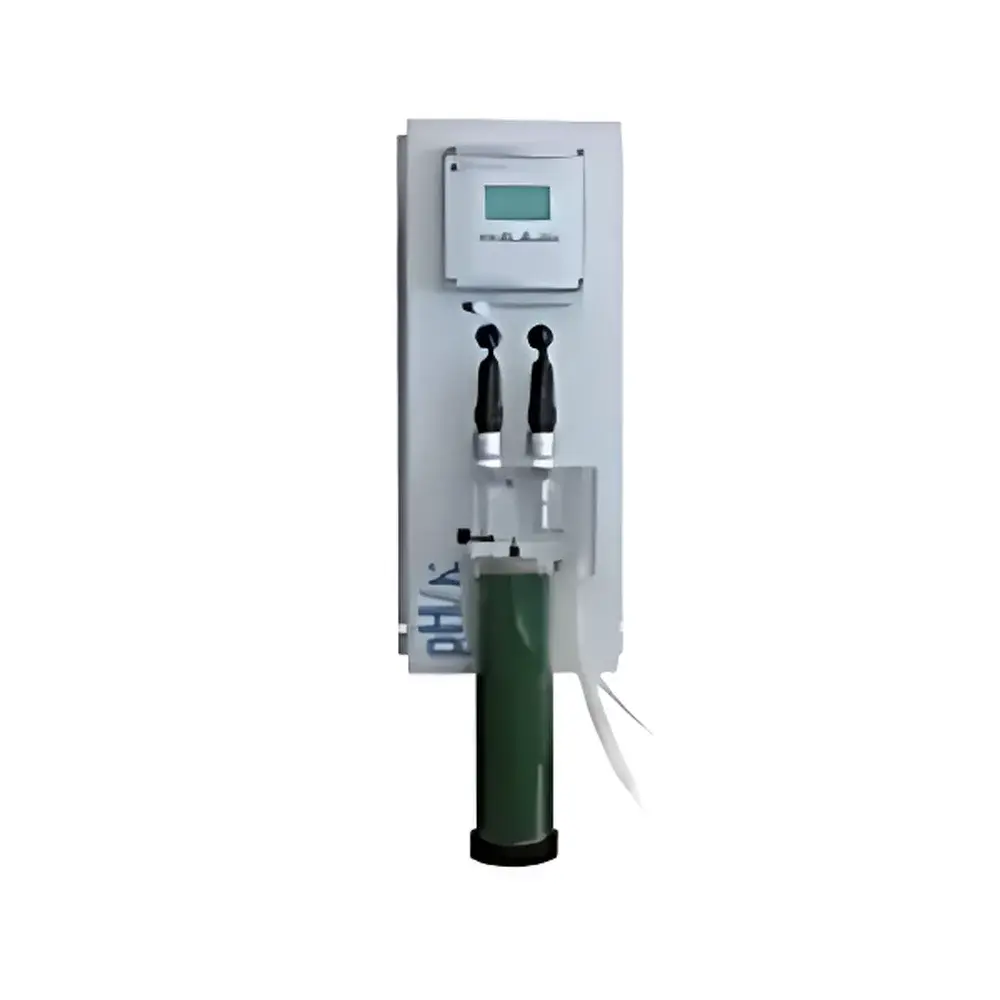
HACH Polymetron 9123 Online Turbidimeter and Particle Counter
| Key | Brand: HACH |
|---|---|
| Model | 9123 |
| Origin | Imported |
| Manufacturer Type | Original Equipment Manufacturer (OEM) |
| Pricing | Available upon Request |
Overview
The HACH Polymetron 9123 is a high-performance, dual-function online analytical instrument engineered for continuous, real-time monitoring of turbidity and particle concentration in potable water, wastewater, and industrial process streams. Utilizing nephelometric measurement principles compliant with ISO 7027 and EPA Method 180.1, the 9123 employs a stable 860 nm infrared LED light source and precision optical geometry to deliver highly reproducible turbidity readings across a wide dynamic range (0.001–4000 NTU). In parallel, its integrated laser-based particle counting module detects and classifies suspended particles in three size channels (≥2 µm, ≥5 µm, ≥10 µm), providing granular insight into particulate contamination that correlates directly with filtration efficiency, coagulant dosing performance, and membrane integrity. Designed for permanent installation in demanding municipal and industrial environments, the 9123 features a robust stainless-steel flow cell, pressure-rated housing (up to 10 bar), and automatic air bubble rejection algorithms—ensuring data continuity under variable hydraulic conditions.
Key Features
- Dual-parameter operation: Simultaneous, independent measurement of turbidity (NTU) and particle count (particles/mL) in a single analyzer
- Compliance-ready optics: Nephelometric detection per ISO 7027 and US EPA 180.1; particle sizing calibrated against NIST-traceable latex standards
- Intelligent flow management: Integrated sample pump with adjustable flow rate (50–200 mL/min), self-cleaning flush cycle, and pressure-compensated flow control
- Ruggedized wetted path: 316L stainless steel flow cell with sapphire optical windows; IP66/NEMA 4X enclosure rating
- Embedded diagnostics: Real-time signal-to-noise ratio monitoring, lamp intensity tracking, window fouling detection, and automatic zero drift compensation
- Modular communication architecture: Native support for Modbus RTU/ASCII/TCP, Profibus DP, and HART 7; optional integration with HACH SCADA platforms (e.g., HACH DataStream)
Sample Compatibility & Compliance
The Polymetron 9123 is validated for use with clarified surface water, filtered drinking water, secondary effluent, and low-turbidity industrial cooling water. It accommodates sample temperatures from 0 °C to 50 °C and operates reliably at pH 4–12. The analyzer meets electromagnetic compatibility requirements per EN 61326-1 and safety standards per IEC 61010-1. Its measurement methodology supports regulatory reporting under the U.S. Safe Drinking Water Act (SDWA), EU Drinking Water Directive (2020/2184), and ISO 24510 for utility performance assessment. Audit trails, user access levels, and configuration change logging are configurable to align with GLP and GMP documentation practices.
Software & Data Management
The embedded firmware includes a web-based interface accessible via Ethernet or optional Wi-Fi module, enabling remote calibration verification, alarm threshold adjustment, and historical trend review without physical access. All measurements are timestamped with millisecond resolution and stored locally (up to 30 days of 1-minute averages). Data export supports CSV and XML formats compatible with LIMS and enterprise SCADA systems. Optional HACH Insight software provides advanced analytics—including particle count/turbidity correlation heatmaps, early-warning alerts for filter breakthrough, and automated compliance report generation aligned with DMR (Discharge Monitoring Report) templates.
Applications
- Drinking water treatment: Monitoring post-filtration turbidity to verify filter performance and ensure regulatory compliance (e.g., <0.3 NTU at point-of-entry)
- Wastewater reuse facilities: Detecting colloidal carryover in tertiary filtration and assessing membrane bioreactor (MBR) integrity
- Power plant condensate polishing: Identifying resin fines and corrosion particulates before turbine injection
- Pharmaceutical water systems: Supporting USP and EP 2.2.2 guidelines for purified and water-for-injection (WFI) quality surveillance
- Food & beverage process lines: Verifying clarity of final rinse water and detecting upstream particulate ingress in CIP validation
FAQ
What is the minimum detectable turbidity level for the Polymetron 9123?
The instrument achieves a lower detection limit of 0.001 NTU under controlled laboratory conditions, with typical field repeatability of ±0.002 NTU at low-range (<1 NTU) measurements.
Can the 9123 be used in seawater or high-salinity applications?
No—its optical design and calibration are optimized for freshwater matrices; salinity >5,000 µS/cm may induce refractive index artifacts and require application-specific validation.
Does the analyzer support automatic calibration verification?
Yes—using built-in reference standards (zero and span), it performs periodic self-checks with configurable frequency and logs all verification events with pass/fail status.
Is the particle counting function compliant with ISO 21501-4?
While the optical detection principle aligns with ISO 21501-4 fundamentals, the 9123 is not certified as a standalone particle counter per that standard; it is validated as a turbidity/particle indicator system for process control—not metrological certification.
How often does the flow cell require manual cleaning?
Under typical municipal water conditions, scheduled cleaning intervals range from 3 to 6 months; the unit’s fouling detection algorithm triggers maintenance alerts based on optical signal attenuation trends.







