
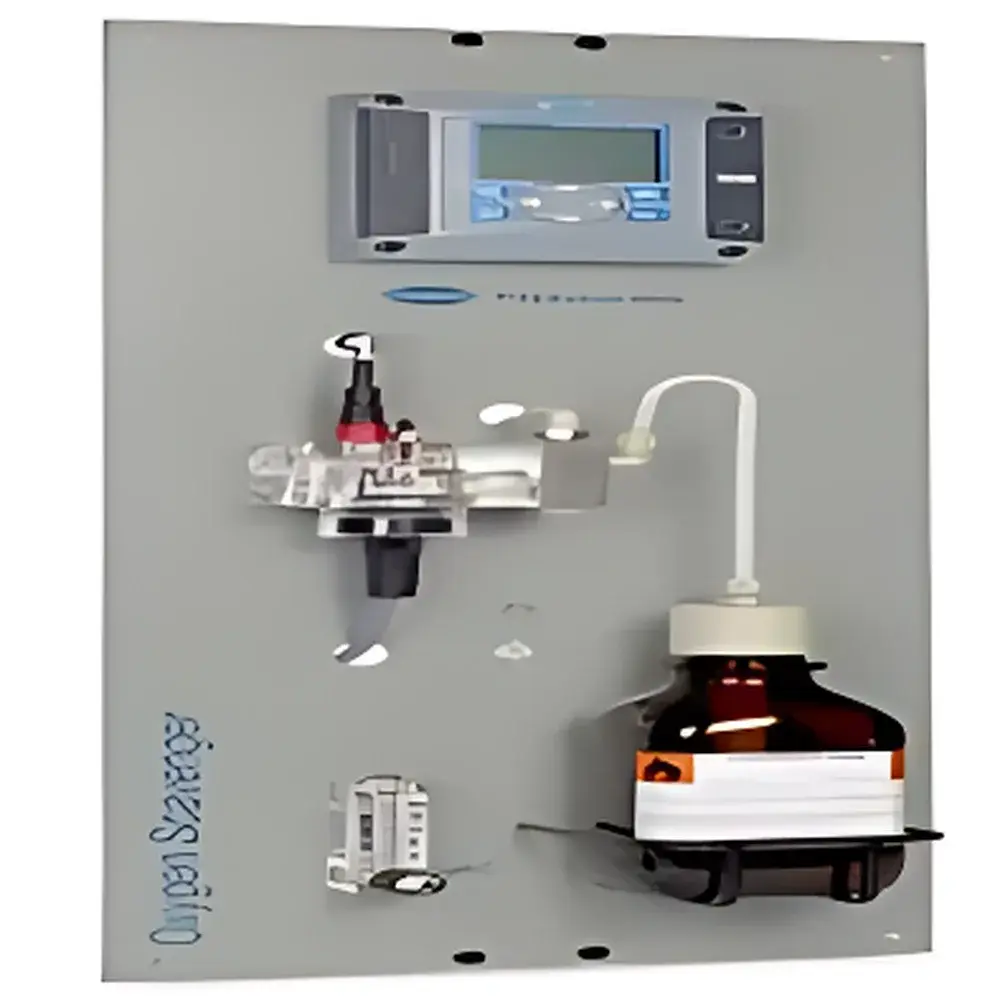
HACH POLYMETRON 9586 Hydrazine Analyzer
| Brand | HACH |
|---|---|
| Origin | Imported |
| Manufacturer Type | Manufacturer |
| Model | POLYMETRON 9586 |
| Price | Upon Request |
Overview
The HACH POLYMETRON 9586 Hydrazine Analyzer is a continuous online electrochemical analyzer engineered for precise, real-time monitoring of hydrazine (N₂H₄) concentration in high-purity water streams—primarily within fossil fuel and nuclear power plant boiler feedwater and condensate systems. It operates on a validated three-electrode amperometric principle: a platinum working electrode (anode), a stainless-steel counter electrode (cathode), and an integrated reference electrode. A fixed polarization potential of 480 mV is applied across the working and counter electrodes; hydrazine undergoes catalytic oxidation at the platinum surface, generating a diffusion-controlled current linearly proportional to its concentration over the 0–500 ppb (µg/L) measurement range. To ensure reaction specificity and kinetic stability, sample pH must be elevated to ≥10.2 via inline addition of volatile alkalizing agents—including diethylamine, monoethylamine, ammonia, or diisopropylamine—delivered through a venturi-based reagent dosing module. Temperature compensation is performed continuously using an integrated Pt100 sensor embedded within the flow cell.
Key Features
- Three-electrode amperometric detection optimized for ultra-trace hydrazine quantification in low-conductivity, high-purity water (typical conductivity <1 µS/cm)
- Integrated pH conditioning system with venturi-driven reagent injection—eliminates need for external peristaltic pumps or separate pH adjustment loops
- Self-contained flow cell with temperature-sensing capability (Pt100) and automatic thermal compensation algorithm
- Modular architecture compliant with HACH’s unified POLYMETRON platform—enabling hardware/software interoperability with other POLYMETRON analyzers (e.g., silica, sodium, dissolved oxygen)
- Standardized HMI interface with intuitive menu navigation, guided calibration workflows, and step-by-step fault diagnostics
- Configurable alarm outputs (relays & 4–20 mA) with event logging and timestamped diagnostic messages for root-cause analysis
- Designed for 24/7 unattended operation under ASME B31.1-compliant sampling system integration
Sample Compatibility & Compliance
The POLYMETRON 9586 is validated for use with deaerated, low-TDS boiler feedwater and turbine condensate streams where hydrazine serves as an oxygen scavenger. It meets functional requirements outlined in ASTM D129-19 (Standard Test Method for Sulfur in Petroleum Materials) for analogous redox-active species detection methodology, and supports compliance with EPRI TR-102892 and IAPWS Technical Guidance Document “Chemical Control in Fossil Plants.” Its design aligns with ISA-84.00.01 (IEC 61511) for safety-related instrumentation in process industries. While not intrinsically rated, it is suitable for installation in non-hazardous areas per NEC Class I, Division 2. Data integrity features—including user-access logs, audit trail-enabling firmware, and configurable password protection—facilitate alignment with FDA 21 CFR Part 11 expectations for electronic records in regulated utility environments.
Software & Data Management
The analyzer interfaces natively with HACH’s SCADA-agnostic POLYMETRON Control Software (v5.2+), supporting Modbus TCP/IP, Profibus DP, and HART 7 communication protocols. All calibration events, maintenance logs, alarm histories, and raw current/pH/temperature readings are stored locally with 30-day circular buffer retention. Optional cloud-enabled data forwarding (via MQTT or OPC UA) allows integration into centralized asset performance management (APM) platforms. Firmware updates are delivered via secure HTTPS download with SHA-256 signature verification. Configuration files adhere to IEC 62443-3-3 cybersecurity guidelines for industrial control systems.
Applications
- Real-time hydrazine residual monitoring in high-pressure boiler feedwater systems to verify oxygen scavenging efficacy and prevent under-dosing (corrosion risk) or over-dosing (N₂H₄ decomposition to ammonia and nitrogen gas)
- Condensate polishing loop surveillance in nuclear PWR and BWR secondary circuits
- Startup chemistry control during unit commissioning and wet layup procedures
- Validation support for ASME RTP-1-recommended hydrazine control bands (target: 10–30 ppb, alarm thresholds: 5 ppb low / 100 ppb high)
- Integration into fully automated chemical feed control schemes using feedback from multiple POLYMETRON analyzers
FAQ
What sample flow rate and pressure are required for optimal operation?
A minimum continuous flow of 100 mL/min at 1–3 bar (14–44 psi) is recommended; flow must be stable and free of entrained air or particulates.
Is manual calibration required, and how often?
Yes—initial factory calibration is traceable to NIST-certified hydrazine standards; field recalibration is recommended every 30 days or after maintenance events, using certified 50 ppb and 200 ppb hydrazine standard solutions.
Can the analyzer operate without pH adjustment?
No—pH ≥10.2 is mandatory for selective hydrazine oxidation and suppression of interfering redox reactions; failure to maintain alkalinity invalidates measurement accuracy and accelerates electrode fouling.
Does the system support remote diagnostics and firmware updates?
Yes—via Ethernet-connected POLYMETRON Control Software or HACH’s cloud-based Asset Insight portal, provided network security policies permit outbound HTTPS and inbound Modbus TCP traffic.
What is the expected service life of the electrochemical sensor module?
Under typical power plant operating conditions (25°C, pH ≥10.2, no chloride ingress), the three-electrode cartridge has a nominal service life of 12 months; replacement intervals may vary based on sample cleanliness and duty cycle.
Related Products







