
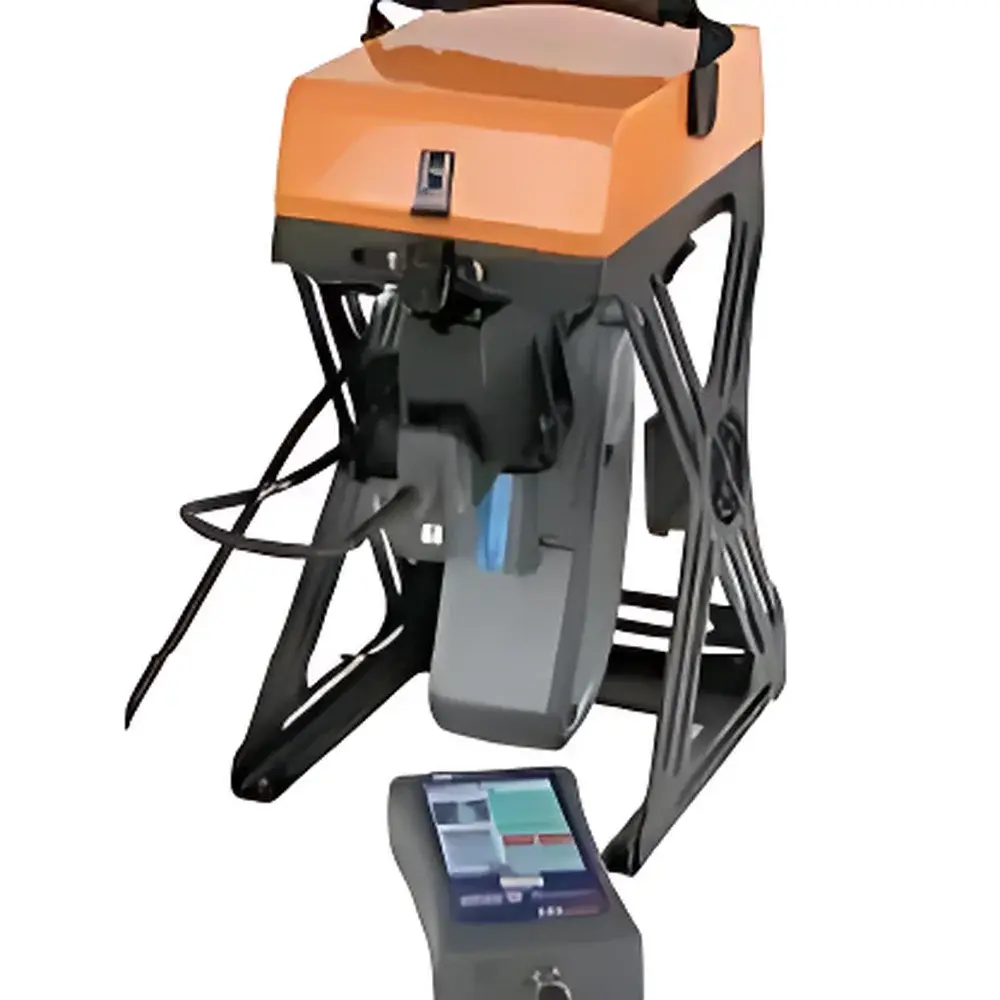
HACH Rocksand Portable Heavy Metal Analyzer for Soil
| Brand | HACH |
|---|---|
| Origin | Imported |
| Manufacturer Type | Manufacturer |
| Model | Rocksand |
| Detection Principle | High-Definition X-Ray Fluorescence (HDXRF) |
| Sample Forms | Solid, Powder, Slurry, Filtered Liquid |
| Operating Modes | Handheld, Tripod-Mounted, Quantitative Benchtop |
| Key Elements Detected | As, Cd, Cr, Cu, Hg, Ni, Pb, Zn, and up to 40 elements total |
| Detection Limits | Sub-ppm (µg/g) range for key heavy metals in soil matrices |
| Compliance | Designed for ASTM D6988, EPA Method 6200, ISO 18587, and CLP/RCRA screening workflows |
| Software | Pre-loaded regulatory decision logic with real-time exceedance alerts |
| Data Management | GLP-compliant audit trail, CSV/PDF export, cloud-sync capable |
| Weight | <3.5 kg (instrument only) |
| Power | Rechargeable Li-ion battery (≥8 hrs continuous operation) |
Overview
The HACH Rocksand Portable Heavy Metal Analyzer is an engineered field-deployable instrument built upon High-Definition X-Ray Fluorescence (HDXRF) technology—a non-destructive, physics-based elemental analysis method that quantifies characteristic X-ray emissions induced by primary X-ray excitation. Unlike conventional ED-XRF systems, HDXRF employs optimized polycapillary optics, high-resolution silicon drift detector (SDD) architecture, and advanced spectral deconvolution algorithms to achieve sub-part-per-million (sub-ppm) detection limits for priority toxic metals—including As, Cd, Cr(VI), Cu, Hg, Ni, Pb, and Zn—in heterogeneous soil, sediment, sludge, rock, and industrial waste matrices. The Rocksand bridges the operational gap between laboratory-grade accuracy and on-site analytical responsiveness, enabling regulatory-grade screening and semi-quantitative assessment directly at the point of sampling—without acid digestion or sample preparation.
Key Features
- Triple-mode operation: handheld scanning for rapid reconnaissance, tripod-mounted stabilization for improved precision, and quantitative benchtop configuration using the integrated lightweight test stand with motorized sample cup rotation.
- Pre-calibrated, matrix-matched soil calibration sets compliant with U.S. EPA Region 9 and EU CLP soil screening protocols; supports user-defined calibrations via Fundamental Parameters (FP) algorithm with automatic inter-element correction.
- Real-time regulatory alert engine: embedded decision logic compares measured concentrations against jurisdiction-specific thresholds (e.g., EPA Regional Screening Levels, Dutch Intervention Values, China GB 15618–2018) and flags exceedances during acquisition.
- Robust mechanical architecture: IP54-rated enclosure, shock-absorbing housing, and temperature-compensated detector electronics ensure stable performance across ambient conditions from –10 °C to 50 °C.
- On-device data integrity controls: time-stamped spectra, operator ID logging, GPS-tagged location metadata, and immutable audit trail aligned with GLP and ISO/IEC 17025 documentation requirements.
Sample Compatibility & Compliance
The Rocksand accepts unprocessed solid samples—including air-dried soils, crushed rocks, mine tailings, wetland sediments, fly ash, slag, and homogenized compost—with particle size tolerance up to 2 mm. Slurries and filtered aqueous extracts may be analyzed in sealed sample cups with Mylar film windows. No digestion, drying, or grinding is required for screening-level compliance. Instrument performance validation follows ASTM D6988-22 (Standard Test Method for Determination of Metals in Soils and Sediments by Field Portable X-Ray Fluorescence Spectrometry) and EPA Method 6200 (Field Portable X-Ray Fluorescence Spectrometry). Regulatory traceability is supported through NIST-traceable reference materials (e.g., SRM 2710a, 2711a) and documented uncertainty budgets per ISO/IEC 17025:2017 Clause 7.6.
Software & Data Management
The onboard Rocksand OS provides intuitive workflow navigation, live spectrum visualization, and automated report generation in PDF or CSV format. All raw spectral data, processing parameters, and QA/QC metrics are stored locally with optional encrypted synchronization to HACH’s secure cloud platform. Software features include multi-user role-based access control, electronic signature capability compliant with FDA 21 CFR Part 11, and full audit trail export for internal audits or third-party verification. Firmware updates maintain alignment with evolving regulatory guidance, including recent revisions to EU Soil Framework Directive reporting templates and U.S. DoD Environmental Laboratory Accreditation Program (ELAP) requirements.
Applications
- Site characterization and Phase I/II environmental site assessments under ASTM E1527 and E2247.
- Rapid response to spill events or illegal dumping incidents requiring immediate metal speciation screening.
- Long-term monitoring of capped landfills, brownfield redevelopment zones, and industrial facility perimeters.
- National-scale agricultural soil surveys supporting heavy metal mapping under national food safety initiatives.
- Pre- and post-remediation verification testing aligned with ASTM D7757 and ISO 18587:2016 (Soil quality — Determination of elemental composition by portable XRF).
FAQ
Does the Rocksand require sample digestion prior to analysis?
No. The instrument performs direct solid-phase analysis using HDXRF, eliminating the need for acid digestion, fusion, or solvent extraction for screening applications.
Can it distinguish between Cr(III) and Cr(VI)?
No. HDXRF measures total chromium concentration. Speciation requires complementary techniques such as ion chromatography coupled with ICP-MS.
Is calibration transfer possible between instruments?
Yes. Factory calibrations are traceable to NIST standards and can be validated across units using certified reference materials; cross-instrument reproducibility is maintained within ±5% RSD for major soil metals.
What regulatory frameworks does the software support out-of-the-box?
EPA RSLs, Dutch SSI/IV values, UK CLEA guidelines, China GB 15618–2018, and EU Soil Thematic Strategy thresholds are pre-loaded with configurable alert thresholds.
How is measurement uncertainty reported?
Uncertainty estimates—derived from counting statistics, calibration model residuals, and matrix effects—are calculated per ISO/IEC Guide 98-3 (GUM) and displayed alongside each result in the final report.
Related Products







