
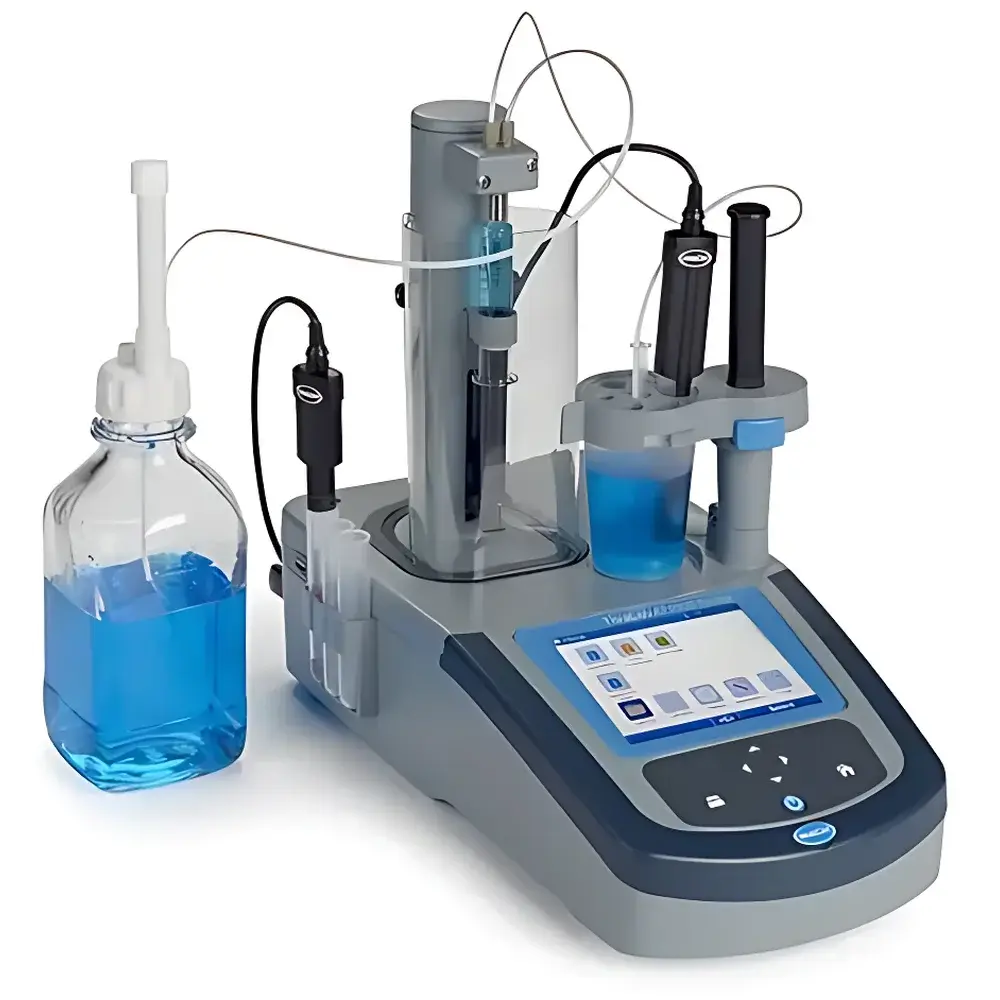
Hach TitraLab AT1000 Series Automatic Titrator
| Brand | Hach |
|---|---|
| Origin | Imported |
| Manufacturer Type | Manufacturer |
| Model | TitraLab AT1000 |
| Titration Types | Potentiometric (zero-current or controlled-current), Amperometric, Colorimetric |
| Titration Modes | Sample, Blank, Sample + Blank, QC Sample, QC Sample + Blank |
| Measured Parameters | mV/pH, Conductivity, Temperature |
| Resolution | mV/pH: ±0.1 mV / ±0.001 pH |
| Conductivity | ±0.5% of reading |
| Temperature | ±0.3 °C / ±0.51 °F |
| Sample Holder | Integrated design with magnetic stirring |
| max. beaker capacity | 250 mL |
| Electrode Inputs | Dual-channel |
| Burette Capacities | 2.5 / 5 / 10 / 25 mL (ISO 8655-3 compliant) |
| Motor Resolution | 20,000 steps with microstepping (128 μsteps/step) |
| Calibration Modes | Electrode & titrant calibration — automatic, fixed-point, or user-defined (up to 5 points) |
| Calibration Scheduling | Configurable interval-based alerts and reminders |
| Data Storage | Last 100 measurements (samples, blanks, QC samples) + last 10 calibrations, including timestamp, operator ID, sample ID |
| Data Export | USB drive |
| Interface | 5.7" color VGA touchscreen |
| Calibration Curve Display | Direct or derivative plots |
| Connectivity | 2× electrode ports, 2× USB, 1× RS-232, 1× Ethernet |
| Dimensions (H×W×D) | 220 × 400 × 360 mm |
| Weight | 4 kg |
| Power Supply | 100–240 V AC, 50/60 Hz |
| Operating Environment | 15–35 °C, 20–80% RH (non-condensing) |
| Storage Range | −5–40 °C |
| Safety Certification | IEC/EN 61010-1 |
| EMC Compliance | IEC/EN 61326-1 |
Overview
The Hach TitraLab AT1000 Series Automatic Titrator is a modular, application-optimized potentiometric and amperometric titration platform engineered for reproducible, traceable, and regulatory-compliant analysis across environmental, food & beverage, pharmaceutical, and industrial laboratories. Built upon a robust electrochemical architecture, the system implements classical endpoint detection principles—including first-derivative (dE/dV) and inflection-point algorithms—alongside advanced signal processing to resolve subtle potential transitions in complex matrices. Its dual-channel input architecture enables simultaneous monitoring of multiple parameters (e.g., pH + conductivity), supporting multi-parameter titration protocols such as alkalinity profiling or hardness determination via ion-selective electrodes (ISE). Designed for routine compliance testing, the AT1000 series meets foundational requirements for method validation under ISO/IEC 17025 and supports audit-ready workflows aligned with GLP and GMP environments.
Key Features
- Modular hardware configuration: Select from single- or dual-burette models (AT1102 to AT1222), with optional integrated peristaltic pumps for reagent delivery, sample conditioning, or AUTOCAT-based chlorination analysis.
- IntelliCAL™ digital electrode support: Plug-and-play connectivity with automatic electrode recognition, built-in calibration history, and NIST-traceable sensor diagnostics—eliminating manual electrode ID entry and reducing setup errors.
- High-resolution titration control: 20,000-step burette motor with 128 µsteps per full step ensures sub-microliter dispensing precision, critical for low-volume samples and high-sensitivity endpoints (e.g., free chlorine, SO₂, or TAN/TBN).
- Pre-validated application packages: Over 20 factory-loaded methods—including AP0001 (pH/alkalinity), AP0009 (chloride by ISE), AP0012 (free/total SO₂ in wine), and AP0015 (TAN in lubricants)—are pre-optimized for accuracy, repeatability, and compliance with ASTM D664, ISO 9964-1, USP , and EPA 310.1.
- Full traceability framework: Embedded operator authentication, time-stamped measurement logs, configurable audit trails, and password-protected method editing ensure data integrity per FDA 21 CFR Part 11 requirements when paired with optional PC software.
Sample Compatibility & Compliance
The AT1000 accommodates aqueous and semi-aqueous samples ranging from drinking water and wastewater to fruit juices, dairy products, crude oil distillates, and fermentation broths. Its integrated 250 mL magnetic stirrer base supports standardized vessel geometry per ISO 8655 and ASTM D2896. For regulated environments, the system’s firmware enforces method lock-down, electronic signature capture, and calibration verification logs—key elements for laboratories undergoing ISO 17025 accreditation or FDA inspections. All application packages are developed and verified against reference materials certified by NIST, BAM, or LGC, and include documented uncertainty budgets per GUM (JCGM 100:2008). The AT1000 series complies with IEC/EN 61010-1 (safety) and IEC/EN 61326-1 (EMC), and its electrical isolation meets pollution degree 2 requirements for laboratory use.
Software & Data Management
Data acquisition, reporting, and method management are supported via TitraSoft PC software (optional), which provides full remote instrument control, customizable report templates (PDF/CSV), statistical process control (SPC) charts, and automated export to LIMS. Measurement records include raw sensor signals, derivative curves, equivalence point calculations, and metadata (operator ID, sample ID, calibration status). USB export enables offline review without proprietary software dependencies. Internal memory retains the last 100 analyses with full contextual metadata, while calibration history preserves up to 10 sessions—including electrode slope, offset, and titrant normality drift trends. Scheduled maintenance alerts and consumables tracking (e.g., burette piston wear, electrode shelf-life) further support long-term operational reliability.
Applications
- Environmental Water Testing: Alkalinity (AP0001/AP0002), FOS/TAC in anaerobic digesters (AP0006), free/total chlorine and ClO₂ (AP0007), and sulfite quantification using AUTOCAT modules.
- Food & Beverage Quality Control: Total acidity in wines and soft drinks (AP0008), salt content via argentometric titration (AP0010), free/total SO₂ in must and wine (AP0012/AP0013), and volatile acidity per AOAC 940.05.
- Petrochemical Analysis: Total Acid Number (TAN) and Total Base Number (TBN) in lubricants and fuels (AP0015/AP0016), mercaptan sulfur (R-SH) per ASTM D974, and bromine/iodine indices (AP0018).
- Pharmaceutical & Biotech: Assay of active ingredients (e.g., citric acid, sodium bicarbonate), residual chloride in APIs, and excipient purity testing per USP monographs.
FAQ
Does the TitraLab AT1000 support GLP-compliant data handling?
Yes—when used with TitraSoft and configured with user roles, electronic signatures, and audit trail logging, it satisfies core GLP documentation requirements for raw data retention, change control, and reviewer approval workflows.
Can I use non-Hach electrodes with this titrator?
Yes—the AT1000 accepts standard BNC and DIN analog electrodes, though IntelliCAL™ digital electrodes provide enhanced traceability, auto-configuration, and diagnostic feedback not available with third-party analog sensors.
What is the maximum number of calibration points supported for titrant standardization?
Up to five points can be defined in custom titrant calibration routines, enabling non-linear normality verification across concentration ranges—particularly useful for aged or temperature-sensitive titrants.
Is method transfer between AT1000 instruments possible?
Yes—application packages and method files are portable via USB drive and retain all parameters, curve settings, and calculation logic, ensuring consistent performance across instruments within a lab network.
How does the system handle air bubbles in the burette or tubing?
The AT1000 includes an automated bubble purge function that sequences precise upward and downward piston movements, combined with programmable flow-rate ramping to evacuate trapped gas without compromising titrant stability or volume accuracy.







