
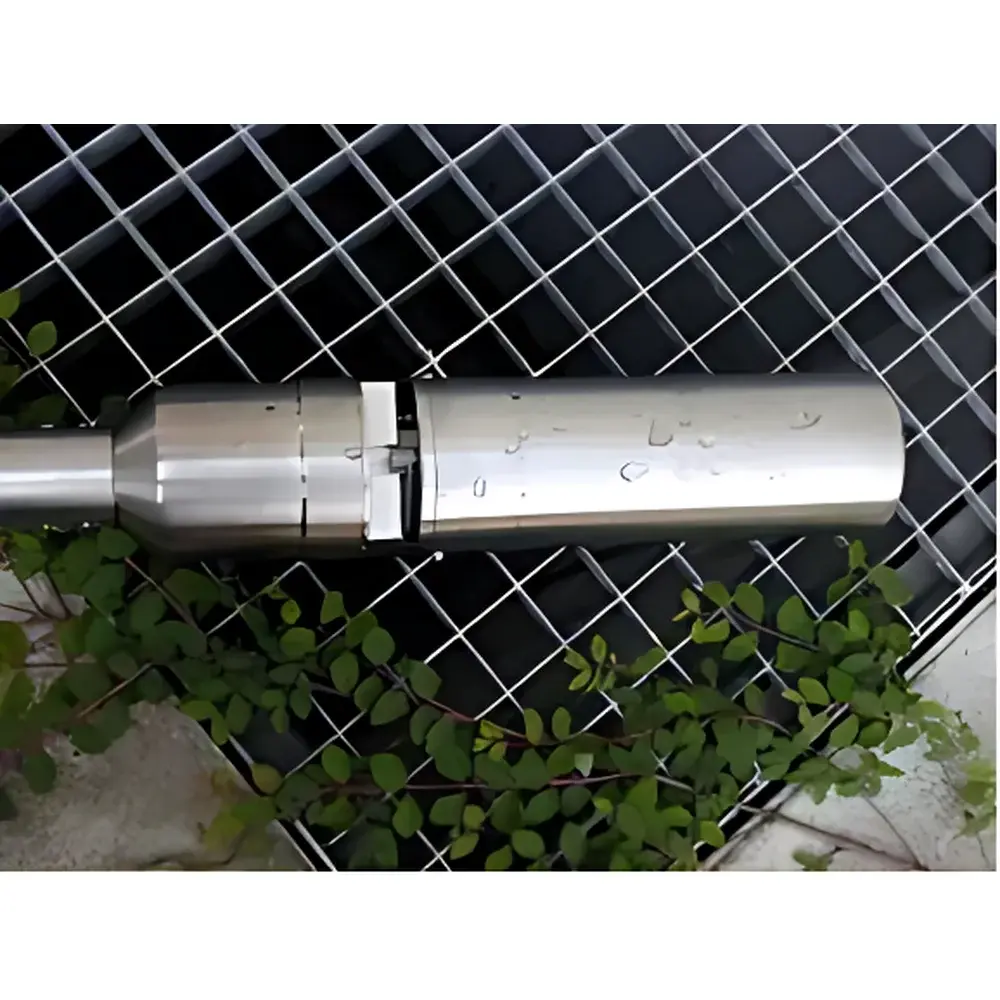
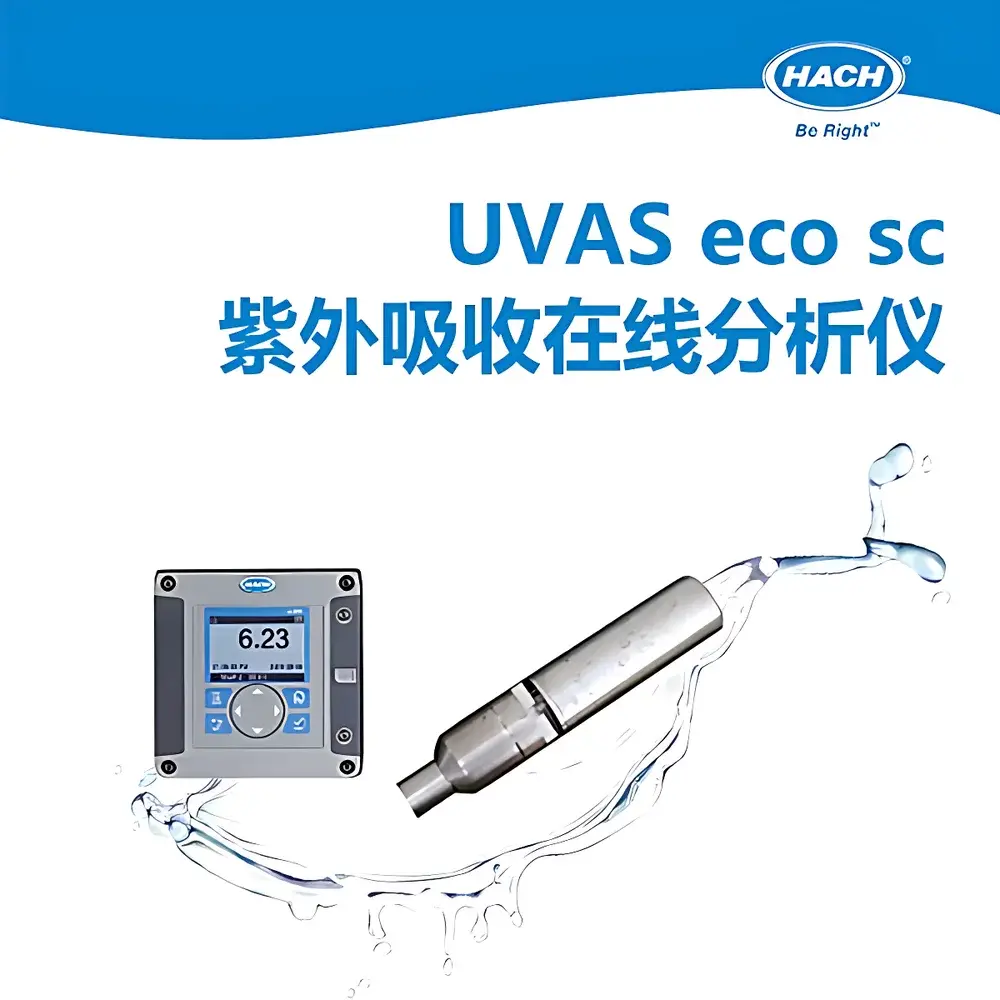
Hach UVAS eco sc Organic Matter Analyzer
| Brand | Hach |
|---|---|
| Model | UVAS eco sc |
| Measurement Principle | UV Absorption (Dual-Beam) |
| Compliance Standard | DIN 38404-3 (C3) |
| Parameter | SAC254 |
| Resolution | 0.5 m⁻¹ (or mg/L, ppm) |
| Accuracy | ±5% of reading or ±10 m⁻¹ |
| Optical Path Length | 1 mm |
| Range | 5–1500 m⁻¹ |
| Compensation Wavelength | 550 nm |
| Measurement Interval | ≥5 minutes |
| Cable Length | 10–100 m |
| Max Operating Pressure | 0.5 bar |
| Sample Temperature Range | +2 to +40 °C |
| Sample pH Range | 4.5–9.0 |
| Dimensions | ~75 × 323 mm |
| Weight | ~3.3 kg |
| Maintenance Interval | Every 6 months |
| User Maintenance Time | ~1 hour/month |
| Control Interface | Compatible with sc100 controller (PID, time-based, 2-point control) |
Overview
The Hach UVAS eco sc Organic Matter Analyzer is a compact, dual-beam ultraviolet absorption sensor engineered for continuous, reagent-free monitoring of dissolved organic carbon surrogates in water and wastewater streams. It operates on the principle of specific UV absorbance at 254 nm (SAC254), a well-established optical proxy correlated with chemical oxygen demand (CODuv), total organic carbon (TOCuv), and biochemical oxygen demand (BODuv). Unlike wet-chemistry analyzers, the UVAS eco sc requires no consumables, acid reagents, oxidants, or catalysts—eliminating operational complexity, hazardous waste generation, and calibration drift associated with traditional methods. Its 1-mm optical path length enables high sensitivity across low-to-moderate organic load ranges (5–1500 m⁻¹), making it especially suitable for surface water intake monitoring, biologically treated effluent verification, and process control in municipal and industrial wastewater facilities.
Key Features
- Dual-beam UV photometry architecture ensures stable baseline correction and minimizes signal drift from lamp aging or fouling-induced light attenuation.
- Integrated 550 nm reference wavelength compensation corrects for turbidity and colored non-organic interferences, improving specificity for aromatic organic compounds.
- Robust stainless-steel and PEEK housing rated for submersible deployment up to 0.5 bar pressure; IP68-rated for continuous immersion in open-channel or pipe-mounted configurations.
- Low-power design optimized for remote or solar-powered installations; compatible with Hach sc100 universal controllers for PID regulation, timed dosing, or two-point threshold logic.
- No routine calibration required—factory-calibrated traceable to NIST-traceable UV absorbance standards; zero-point stability verified during 6-month maintenance intervals.
- Minimal user intervention: cleaning and inspection typically completed within one hour per month using supplied soft brush and deionized water rinse—no disassembly or optical alignment needed.
Sample Compatibility & Compliance
The UVAS eco sc is validated for use with natural waters, secondary and tertiary effluents, and pre-treated industrial discharges meeting pH 4.5–9.0 and temperature +2 to +40 °C operational limits. It complies with DIN 38404-3 (C3) for determination of spectral absorption coefficient at 254 nm—a method widely accepted by European environmental authorities as a rapid, indicative parameter for organic loading. While SAC254 is not a direct replacement for laboratory COD or TOC measurements, its strong empirical correlation (established via site-specific linear regression) supports trending, early-warning detection, and mass-balance estimation in compliance reporting frameworks aligned with EU Water Framework Directive (WFD) and national discharge permits. The instrument’s output format is compatible with SCADA systems and meets basic requirements for data integrity under ISO/IEC 17025-accredited laboratories performing method validation.
Software & Data Management
When integrated with the Hach sc100 controller or connected via Modbus RTU/ASCII to distributed control systems (DCS), the UVAS eco sc delivers time-stamped SAC254 values, diagnostic status flags (e.g., lamp intensity, window transmittance, temperature deviation), and event logs. Data export supports CSV and XML formats for integration into LIMS or enterprise environmental management software (EMS). Audit trail functionality—including operator ID, timestamp, and parameter change history—is available when deployed with sc100 firmware v3.2 or higher, supporting GLP-aligned recordkeeping practices. Though not inherently 21 CFR Part 11 compliant, the system may be configured within validated IT environments to meet FDA-regulated water quality monitoring requirements for pharmaceutical facility utilities.
Applications
- Real-time organic load monitoring at drinking water treatment plant intakes to detect upstream contamination events.
- Effluent compliance verification at municipal wastewater treatment plants prior to discharge—reducing reliance on daily grab sampling.
- Process optimization in activated sludge and membrane bioreactor (MBR) systems by correlating SAC254 trends with nitrification/denitrification efficiency.
- Industrial pretreatment verification for food & beverage, pulp & paper, and textile facilities subject to local organic discharge limits.
- Research applications in limnology and watershed science requiring high-frequency, non-invasive organic matter profiling.
FAQ
Does the UVAS eco sc require periodic calibration with standard solutions?
No. It is factory calibrated using traceable UV absorbance references and relies on dual-beam compensation and 550 nm turbidity correction to maintain measurement stability. Field verification with clean water zero checks is recommended but not mandatory.
Can it be installed in pressurized pipelines?
Yes—up to 0.5 bar static pressure. For higher-pressure applications, a flow cell with pressure-relief bypass or a dedicated mounting sleeve is required.
How does SAC254 relate to COD or TOC values?
SAC254 correlates empirically with COD and TOC in consistent matrices. Site-specific correlation equations must be developed using concurrent lab analyses; Hach provides statistical tools within the sc100 interface to generate and validate these models.
What maintenance is required beyond monthly cleaning?
Only biannual inspection of O-rings, cable gland integrity, and optical window clarity. No lamp replacement or internal electronics servicing is needed within the specified 5-year operational lifetime.
Is the sensor compatible with third-party PLCs or SCADA platforms?
Yes—via RS-485 Modbus RTU/ASCII protocol. Register maps and communication configuration guides are included in the technical documentation package.







