
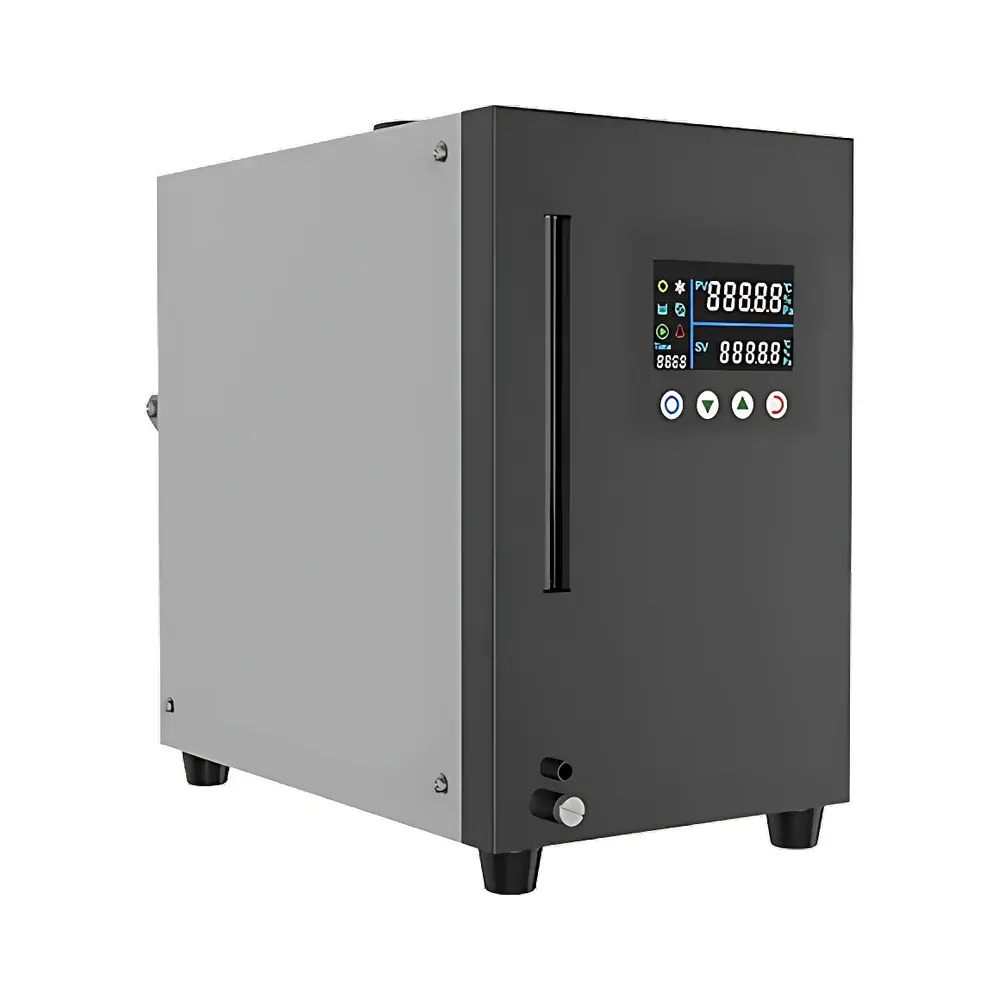
Hanon FC400 Circulating Chiller
| Brand | Hanon |
|---|---|
| Origin | Shandong, China |
| Model | FC400 |
| Instrument Type | Integrated Circulating Chiller |
| Cooling Method | Water-Cooled |
| Temperature Control Range | 5°C to 100°C |
| Refrigeration Capacity | 400 W |
| Temperature Stability | ±0.3°C |
| Circulation Pump Pressure | 0.35 bar |
| Circulation Flow Rate | 10 L/min |
| Reservoir Volume | 4.5 L |
| Operating Mode | Continuous |
| Heating Power | 1000 W |
| Temperature Resolution | 0.1°C |
| Temperature Sensor | PT100 |
| Refrigerant | R134a |
| Power Supply | 220 V AC ±10%, 50 Hz |
Overview
The Hanon FC400 Circulating Chiller is an integrated, water-cooled temperature control system engineered for precision thermal management in laboratory and analytical instrumentation environments. It operates on a dual-mode thermoregulation principle—employing a hermetically sealed scroll-type compressor for active refrigeration and a high-efficiency resistive heating element for precise upward temperature control—enabling continuous, stable operation across a wide working range of 5°C to 100°C. Designed for compatibility with heat-sensitive benchtop instruments—including small-scale bioreactors, rotary evaporators, spectrophotometers, polarimeters, refractometers, and electrophoresis systems—the FC400 delivers consistent coolant flow under controlled backpressure, minimizing thermal drift and ensuring reproducible experimental conditions. Its compact footprint and modular internal layout support seamless integration into constrained lab spaces while maintaining service accessibility for routine maintenance and fluid replacement.
Key Features
- Integrated dual-mode thermal regulation: compression-based cooling (R134a refrigerant) combined with 1000 W resistive heating for bidirectional, high-fidelity temperature control
- Fuzzy PID algorithm implementation for rapid setpoint acquisition and minimized overshoot—achieving ±0.3°C stability under dynamic load conditions
- Motor-driven, mold-cast turbine circulation pump delivering 10 L/min flow at 0.35 bar pressure with full electrical–hydraulic isolation to eliminate risk of electrical leakage or grounding interference
- 5.5-inch high-brightness color LCD display with 0.1°C resolution, supporting real-time monitoring of setpoint, actual temperature, pump status, and alarm conditions
- Robust safety architecture including overcurrent protection, high/low temperature cutoffs, overtemperature lockout, low-level fluid detection with audible/visual alerts, and dry-run prevention circuitry
- 4.5 L corrosion-resistant reservoir with drain valve and level indicator; optimized for easy cleaning, refilling, and coolant exchange without disassembly
Sample Compatibility & Compliance
The FC400 is routinely deployed as a primary cooling source for instruments requiring stable, low-noise thermal coupling—particularly where vibration sensitivity or electromagnetic interference must be minimized. Its closed-loop design supports use with aqueous or water–glycol mixtures (up to 30% v/v), making it suitable for applications governed by ISO 17025-accredited laboratories. While not certified to UL/CSA or CE for standalone medical device integration, the unit complies with IEC 61010-1:2010 for laboratory electrical safety and incorporates safeguards aligned with GLP documentation requirements—including non-volatile event logging of temperature excursions and fault codes. All materials in contact with coolant are FDA-compliant for indirect food contact (e.g., 304 stainless steel reservoir, EPDM seals), supporting use in pharmaceutical QC labs operating under cGMP-aligned workflows.
Software & Data Management
The FC400 operates as a stand-alone analog-controlled chiller with no embedded network interface or remote software protocol. Temperature setpoints, pump activation, and alarm silencing are managed exclusively via front-panel controls and the local LCD interface. However, its analog voltage output (0–10 V DC) provides proportional feedback of real-time bath temperature, enabling integration with third-party data acquisition systems (e.g., LabVIEW, MATLAB, or PLC-based SCADA platforms) for time-stamped thermal logging and trend analysis. The built-in event memory retains the last 16 fault codes with timestamps—accessible via diagnostic menu—for root-cause analysis during preventive maintenance audits per ISO/IEC 17025 Clause 7.7.
Applications
- Thermal stabilization of condensers in rotary evaporation systems to maximize solvent recovery efficiency at fixed bath temperatures
- Cooling jacket support for small-volume (≤5 L) fermentation vessels during aerobic microbial cultivation, preventing exothermic runaway
- Temperature regulation of optical path components in UV-Vis and FTIR spectrometers to reduce baseline drift and improve signal-to-noise ratio
- Heat dissipation management for high-power LED light sources in digital polarimeters and automated refractometers
- Controlled electrophoretic separation environments where gel matrix integrity depends on uniform thermal distribution
FAQ
What coolant fluids are compatible with the FC400?
Deionized water is recommended for general use. For sub-ambient operation or freeze protection, aqueous solutions containing ≤30% (v/v) propylene glycol or ethylene glycol may be used—provided compatibility with connected equipment is verified.
Is the FC400 suitable for external recirculation loops exceeding 10 meters in length?
The pump is rated for 0.35 bar maximum head pressure; extended tubing runs, multiple fittings, or inline filters will reduce effective flow rate. For loop lengths >8 m or systems with >2 m vertical lift, a secondary booster pump is advised.
Does the unit support RS232 or USB communication for remote control?
No. The FC400 lacks digital communication ports. Remote monitoring requires analog signal interfacing via its 0–10 V DC temperature output.
Can the FC400 maintain 5°C ambient temperature in a 35°C lab environment?
Yes—its 400 W refrigeration capacity is sufficient for heat rejection under typical laboratory ambient conditions when paired with adequately sized external coils or heat exchangers.
What maintenance intervals are recommended for long-term reliability?
Reservoir cleaning and coolant replacement every 6 months; annual inspection of condenser coil cleanliness, refrigerant charge verification, and electrical connection integrity per manufacturer’s service bulletin HB-FC400-Rev.D.



