
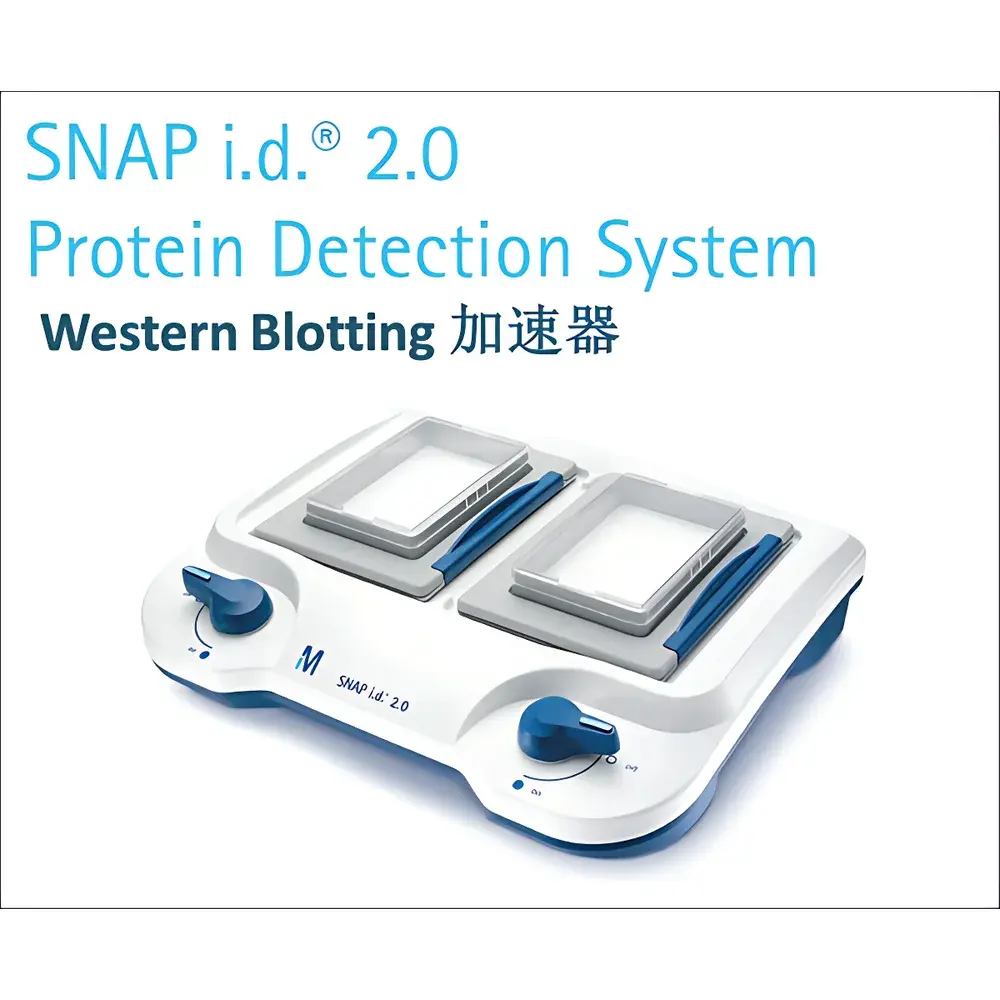
Millipore SNAP i.d. 2.0 Western Blotting System
| Brand | Millipore |
|---|---|
| Origin | USA |
| Model | SNAP i.d. 2.0 |
| Automation Level | Semi-Automatic Western Blot Processing System |
| Voltage Options | 115 V/60 Hz or 220 V/50 Hz |
| Maximum Membrane Capacity | 6 membranes (simultaneous) |
| Processing Time for Blocking, Washing & Antibody Incubation | ≤30 minutes |
| Compatible Membrane Formats | Single-, Dual-, and Triple-slot blotting cassettes |
Overview
The Millipore SNAP i.d. 2.0 Western Blotting System is an engineered semi-automatic platform designed to accelerate and standardize critical post-electrophoretic immuno-detection workflows. Unlike conventional manual or gravity-fed blot processing methods, the SNAP i.d. 2.0 employs a precisely regulated vacuum-driven fluid delivery mechanism—based on controlled negative pressure across porous nitrocellulose or PVDF membranes—to ensure uniform reagent distribution, reproducible flow kinetics, and minimized diffusion artifacts. This architecture enables consistent protein epitope accessibility and antibody binding efficiency across the entire membrane surface. The system operates independently of electrophoresis equipment or transfer apparatus, serving as a dedicated downstream module for immunoblot development. Its design prioritizes experimental rigor over speed alone: by reducing procedural variability in blocking, primary/secondary antibody incubation, and washing steps, it directly supports quantitative interpretation, inter-laboratory reproducibility, and compliance with GLP-aligned documentation practices.
Key Features
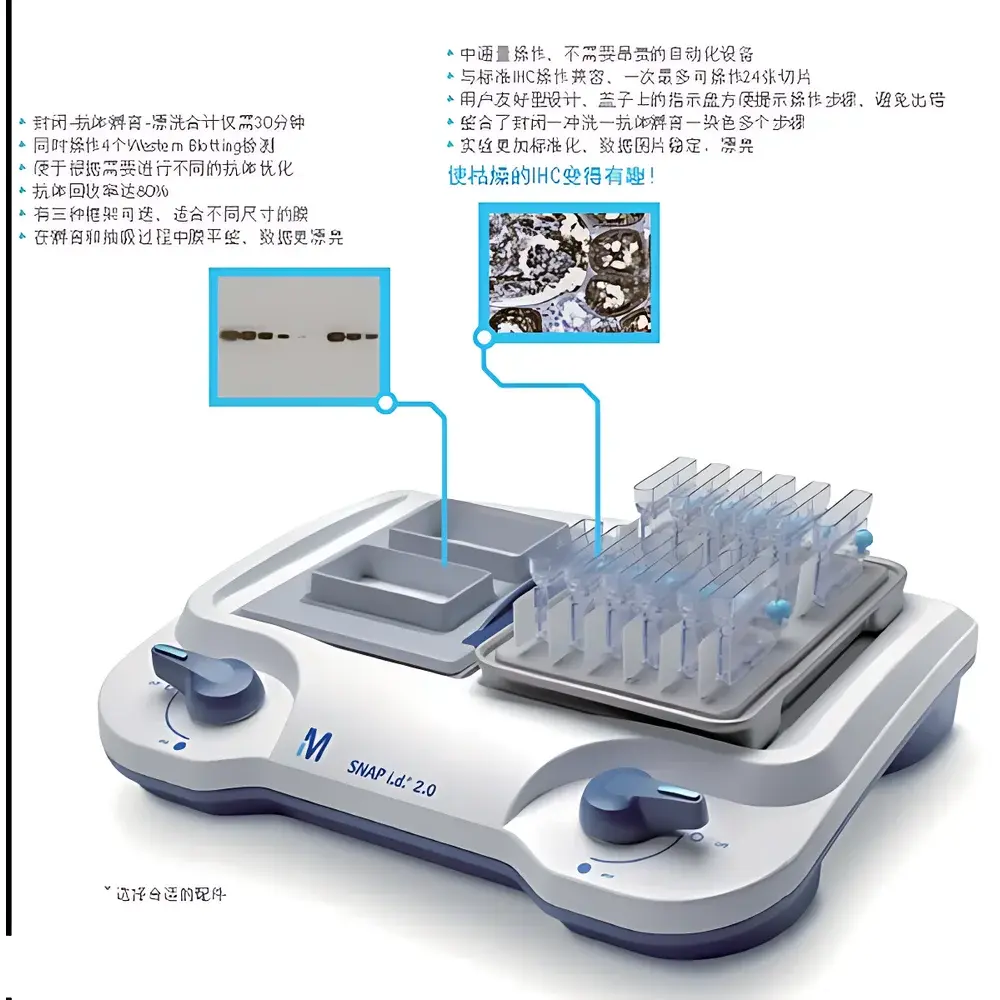
- Vacuum-actuated parallel processing: Two independent blotting cassettes operate simultaneously, each accommodating up to three membranes—enabling concurrent optimization of six conditions per run.
- Modular cassette system: Interchangeable single-, dual-, and triple-slot cassettes allow flexible experimental scaling without hardware modification.
- Integrated vacuum regulation: Built-in pressure control eliminates dependency on external vacuum regulators; ensures stable, repeatable flow rates across varying membrane types and thicknesses.
- Chemical-resistant vacuum pump: Supplied with dual-voltage compatibility (115 V/60 Hz or 220 V/50 Hz), rated for continuous use with common Western blotting reagents including methanol, SDS, Tween-20, and alkaline phosphatase substrates.
- Accessory ecosystem: Includes antibody recovery trays for reagent reuse, air-removal roller tools to prevent bubble formation during membrane assembly, stainless-steel forceps for filter handling, and 1 L filtration flasks with #8 perforated stoppers (5/pack).
Sample Compatibility & Compliance
The SNAP i.d. 2.0 maintains full compatibility with standard upstream transfer methods—including wet, semi-dry, and rapid electroblotting systems—and downstream detection modalities such as chemiluminescence, fluorescence, and colorimetric substrate development. It supports all commercially available nitrocellulose and PVDF membranes (0.2 µm and 0.45 µm pore sizes), as well as pre-cut or custom-cut formats within cassette dimensional limits. From a regulatory standpoint, the system’s deterministic fluid delivery profile supports traceable protocol execution—facilitating alignment with ISO/IEC 17025 method validation requirements and internal SOP documentation. While not inherently 21 CFR Part 11-compliant, its operational consistency enhances audit readiness when paired with laboratory information management systems (LIMS) that log operator inputs, timing parameters, and cassette configurations.
Software & Data Management
The SNAP i.d. 2.0 is a hardware-only platform with no embedded microprocessor or digital interface. All operational parameters—including vacuum duration, cycle count, and reagent volume—are manually defined by the user prior to initiation. This analog design intentionally avoids firmware dependencies, ensuring long-term functional stability and eliminating software obsolescence risks. Protocol documentation, however, benefits from structured recording: users are advised to log cassette type, membrane lot number, antibody dilutions, vacuum pressure settings (if externally monitored), and incubation timestamps in electronic lab notebooks (ELNs) compliant with ALCOA+ principles (Attributable, Legible, Contemporaneous, Original, Accurate, Complete, Consistent, Enduring, Available). Optional integration with third-party ELN platforms (e.g., LabArchives, Benchling) enables automated metadata tagging for QC traceability.
Applications
This system is routinely deployed in academic, pharmaceutical, and contract research laboratories where throughput, comparability, and signal-to-noise fidelity are critical. Typical use cases include: high-throughput antibody validation across multiple target proteins; side-by-side comparison of phosphorylation states under varying kinase inhibitor treatments; multiplexed detection using stripped/reprobed membranes; optimization of low-abundance antigen detection protocols; and training environments requiring standardized, operator-independent results. Its capacity to process six membranes in parallel also supports statistical replication strategies—such as biological triplicates × two technical repeats—within a single 30-minute processing window, thereby improving statistical power without extending bench time.
FAQ
Does the SNAP i.d. 2.0 require a computer or proprietary software to operate?
No. It is a standalone electromechanical device with no digital control unit, firmware, or connectivity interfaces.
Can I use my existing antibodies and detection reagents with this system?
Yes. The system imposes no chemical restrictions and is compatible with all standard Western blotting reagents, including HRP- and AP-conjugated secondary antibodies, ECL substrates, fluorescent dyes, and chromogenic substrates.
Is the vacuum pump included with the base system?
Yes. A chemically resistant, dual-voltage vacuum pump is supplied as part of the standard configuration.
What maintenance is required for long-term reliability?
Routine cleaning of the vacuum manifold and cassette gaskets with 70% ethanol; periodic inspection of pump oil level (if oil-lubricated model); and replacement of worn stoppers or filtration flasks based on usage frequency.
How does the SNAP i.d. 2.0 compare to traditional rocking-based incubation?
Vacuum-driven flow achieves significantly higher mass transfer rates, reduces non-specific binding through controlled wash stringency, and minimizes edge effects—resulting in improved band sharpness, lower background, and enhanced dynamic range in densitometric analysis.




