
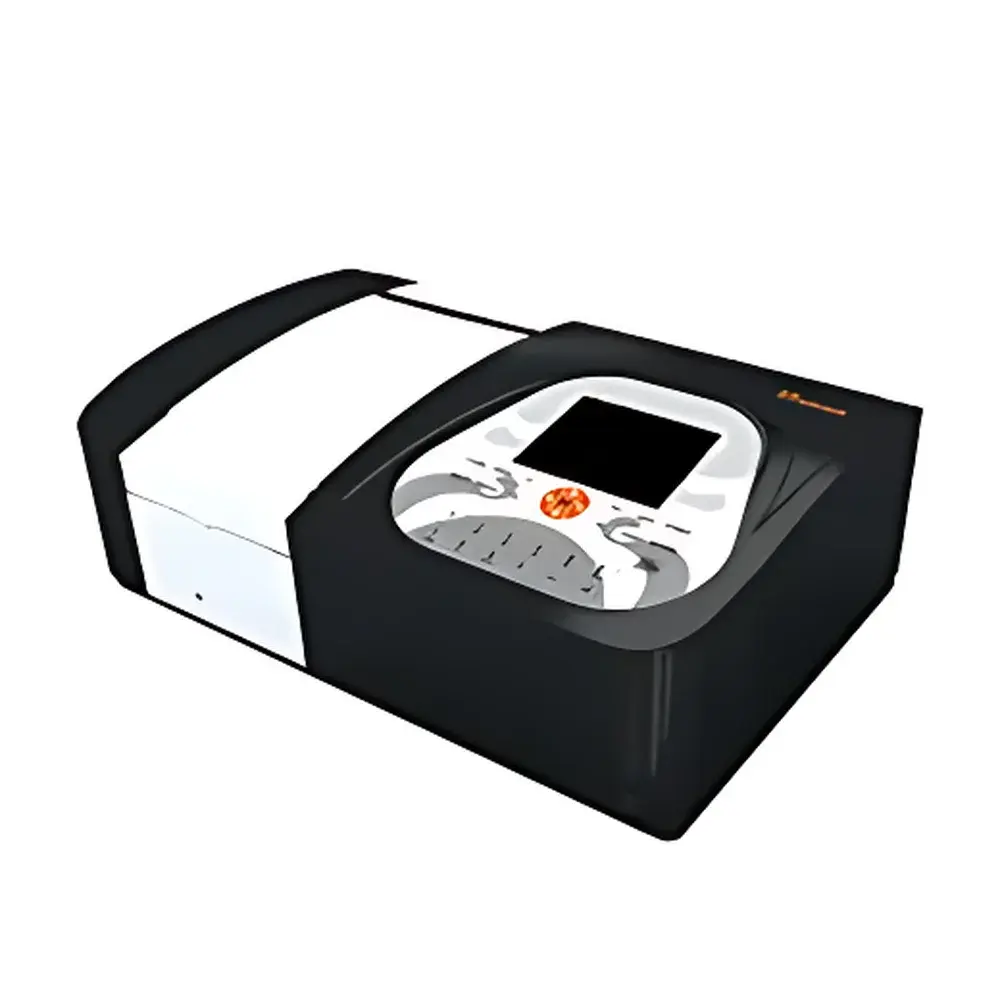
Hanon i8 Dual-Beam Ultraviolet-Visible Spectrophotometer
| Brand | Hanon |
|---|---|
| Origin | Shandong, China |
| Model | i8 |
| Optical System | Dual-beam |
| Detector | Photodiode Array (PDA) |
| Wavelength Range | 190–1100 nm |
| Wavelength Accuracy | ±0.1 nm (at D₂ line, 656.1 nm), ±0.3 nm across full range |
| Wavelength Repeatability | ≤0.1 nm |
| Spectral Bandwidth | 1.8 nm |
| Stray Light | ≤0.03% T |
| Photometric Accuracy | ±0.2% T |
| Photometric Repeatability | ≤0.15% T |
| Baseline Flatness | ±0.001 A |
| Drift | ≤0.0004 A/h (at 500 nm) |
| Noise | ≤0.0005 A |
| Photometric Range | 0–200% T, –4.0 to +4.0 A, 0–9999 C |
| Wavelength Setting | Automatic |
| Scan Speed | High/Medium/Low selectable |
| Data Interface | USB |
| Display | 320 × 240 pixel LCD |
| Light Sources | Imported tungsten and deuterium lamps |
| Detector Type | Imported silicon photodiode |
| Power Supply | AC 220 V/50 Hz or 110 V/60 Hz |
| Dimensions | 625 × 430 × 210 mm |
| Weight | 28 kg |
Overview
The Hanon i8 Dual-Beam Ultraviolet-Visible Spectrophotometer is a precision optical instrument engineered for high-fidelity absorbance, transmittance, and concentration measurements across the ultraviolet, visible, and near-infrared spectral regions (190–1100 nm). It operates on the fundamental principle of Beer–Lambert law-based absorption spectroscopy, utilizing a true dual-beam optical architecture to continuously compare sample and reference beam intensities in real time. This configuration inherently compensates for source intensity drift, lamp aging, and electronic fluctuations—enabling superior photometric stability and long-term measurement reproducibility. The i8 integrates a thermally stabilized deuterium lamp (UV) and tungsten-halogen lamp (VIS-NIR), coupled with a high-resolution monochromator and imported silicon photodiode detector, delivering robust performance under routine laboratory conditions. Its rigid, suspended optical bench design—reinforced with thickened baseplate construction—minimizes mechanical deformation and vibration-induced misalignment, ensuring consistent optical path integrity over extended operational cycles.
Key Features
- Dual-beam optical system with real-time reference beam compensation for enhanced baseline stability and reduced drift
- High-precision 24-bit analog-to-digital conversion enabling low-noise signal acquisition (≤0.0005 A RMS)
- Automated wavelength scanning with three user-selectable speed modes (high/medium/low) for optimized resolution–throughput trade-offs
- Thermally isolated lamp housing and active thermal management to maintain spectral output consistency
- Imported deuterium and tungsten-halogen light sources, certified for >1,000-hour service life and spectral purity
- Robust mechanical architecture featuring vibration-damping optical suspension and reinforced cast-aluminum chassis
- Large-format 320 × 240 pixel backlit LCD display supporting full local operation without PC dependency
- Comprehensive onboard functionality: photometric mode, quantitative analysis, kinetic studies, multi-wavelength assays, DNA/protein A260/A280 ratio calculation, and spectral scanning
Sample Compatibility & Compliance
The i8 accommodates standard 10-mm square cuvettes (glass, quartz, or plastic), as well as optional microvolume adapters and flow-cell configurations for specialized applications. It supports both single-beam and dual-beam measurement protocols, fully compliant with ISO 6425:2020 (spectrophotometer performance verification) and aligned with ASTM E275–22 guidelines for UV-Vis instrument qualification. While not pre-certified for 21 CFR Part 11, its data logging architecture—including timestamped measurement records, operator ID fields, and audit-trail-capable USB export—facilitates integration into GLP/GMP environments when paired with validated third-party LIMS or ELN software. All optical components meet IEC 61000-4 electromagnetic compatibility standards; electrical safety complies with IEC 61010-1.
Software & Data Management
The i8 is compatible with Hanon’s proprietary SpectraLab Pro software (Windows 10/11), which provides advanced spectral processing including baseline correction, peak identification, derivative spectroscopy, and custom calibration curve generation. Raw data are exported in CSV and ASCII formats via USB interface, supporting direct import into MATLAB, Origin, or Python-based analytical workflows. The software enforces user-level access control (administrator/operator modes), supports method templates with parameter locking, and logs all critical events—including lamp usage hours, calibration timestamps, and firmware revision history—for traceability. Data files include embedded metadata (wavelength accuracy verification points, slit width, scan speed, date/time, operator ID), fulfilling minimum ALCOA+ principles for raw data integrity.
Applications
- Quantitative determination of nucleic acid and protein concentrations using standardized A260, A280, and A230 protocols per USP and ISO 15702
- Pharmaceutical assay validation and dissolution testing in accordance with USP and EP 2.2.25
- Environmental water quality analysis (e.g., nitrate, phosphate, COD estimation) per EPA Methods 353.2 and 365.1
- Quality control of dyes, pigments, and colorants in textile and paint manufacturing (CIE Lab space correlation)
- Kinetic enzyme assays (e.g., LDH, ALP) requiring high temporal resolution and low photometric noise
- Educational laboratories for teaching fundamental spectroscopic concepts including Lambert–Beer law deviations, solvent effects, and chromophore identification
FAQ
What is the typical warm-up time required before achieving photometric stability?
Approximately 30 minutes is recommended for full thermal equilibration of both lamps and optical bench, after which drift remains ≤0.0004 A/h at 500 nm.
Can the i8 perform spectral scans below 190 nm?
No—its lower limit is defined by atmospheric oxygen absorption and the transmission cutoff of the standard quartz cuvette; vacuum or purged-path accessories are not supported.
Is the photodiode array detector interchangeable with a PMT?
No—the i8 uses a fixed silicon photodiode detector optimized for broad-band detection; it does not support PMT or CCD upgrade paths.
Does the instrument support automatic cuvette recognition or barcode scanning?
No—cuvette position and type must be manually selected in software; no hardware-level auto-sensing is integrated.
How often should wavelength accuracy be verified?
Per ISO 6425, verification using holmium oxide or didymium filters is recommended prior to each analytical batch or daily in regulated environments.





