
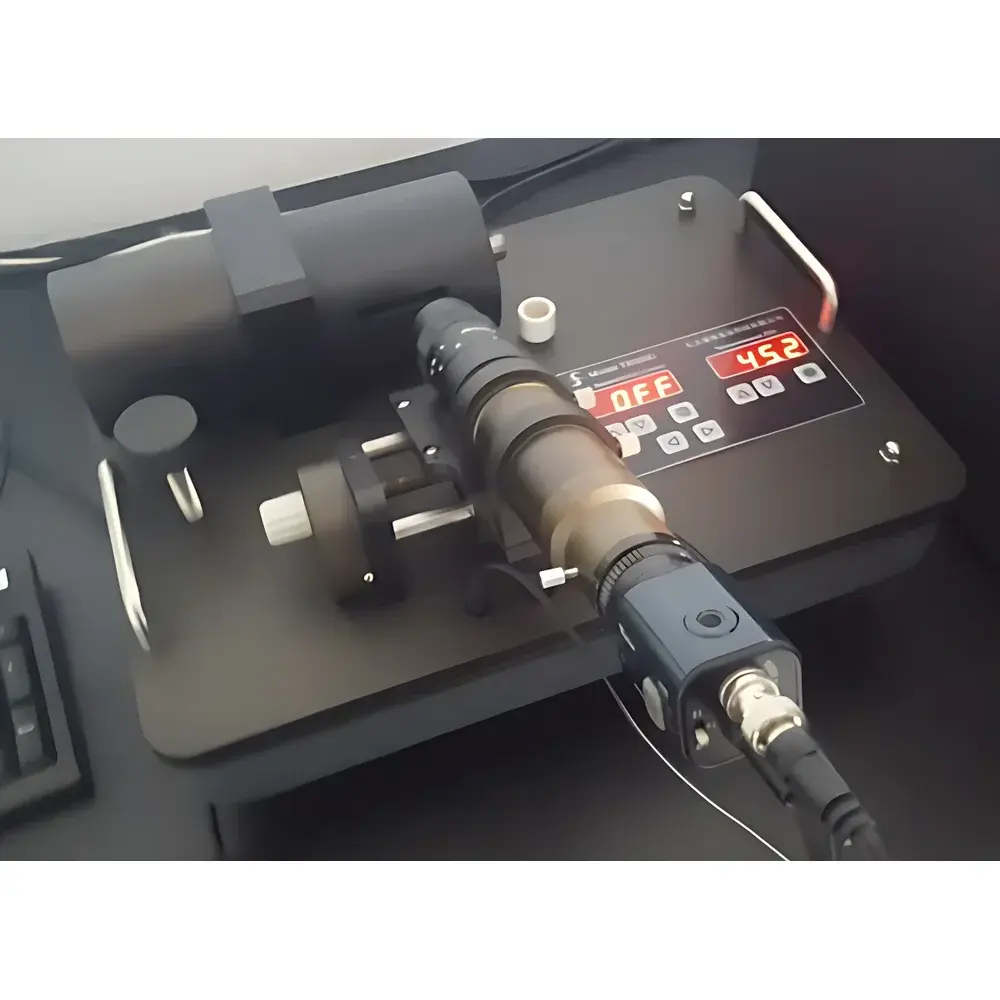
HARKE TX-500C Full-Range Rotating Drop Tensiometer / Interfacial Tensiometer
| Brand | HARKE |
|---|---|
| Origin | Beijing, China |
| Manufacturer Type | Direct Manufacturer |
| Origin Category | Domestic (China) |
| Model | TX-500C |
| Measurement Range | 1×10⁻⁶–100 mN/m |
| Measurement Resolution | 0.001 mm (optical readout), 0.01 mN/m (tension output) |
| Measurement Accuracy | ±0.01 mN/m |
| Rotational Speed Range | 1000–10,000 rpm |
| Speed Control Accuracy | ≤0.1% |
| Temperature Control Range | RT+5°C to 80°C (internal heating) or 0–100°C (external bath) |
| Temperature Accuracy | ±0.1°C |
| Optical Zoom | 6.5× optical + 2× digital zoom |
| Video Resolution | 768×576 px |
| Frame Rate | 30 fps |
| Image Acquisition | Dedicated frame grabber card |
| Interfaces | RS-232, USB, RCA video, 220V/50Hz or 110V/60Hz |
Overview
The HARKE TX-500C Full-Range Rotating Drop Tensiometer is a precision instrument engineered for the quantitative determination of ultra-low interfacial and surface tensions—down to 1×10⁻⁶ mN/m—using the rotating drop method, a well-established technique grounded in hydrodynamic equilibrium theory. In this method, a denser droplet of one liquid phase is suspended within a less-dense continuous phase inside a horizontally rotating quartz capillary tube. Under controlled centrifugal force, the droplet deforms into an elongated shape; its aspect ratio (length-to-diameter) is directly related to the interfacial tension between the two phases via the Vonnegut–Bancroft equation. The TX-500C implements this principle with high mechanical stability, real-time optical tracking, and automated image analysis—enabling robust, operator-independent measurements critical for formulation development, enhanced oil recovery (EOR) screening, and colloidal stability assessment.
Key Features
- Ultra-low tension capability: Validated measurement range from 1×10⁻⁶ to 100 mN/m—suitable for surfactant-poor systems, microemulsions, and polymer-stabilized interfaces.
- High-precision rotational control: Brushless synchronous motor delivering 1000–10,000 rpm with ≤0.1% speed stability—ensuring reproducible shear history and equilibrium droplet geometry.
- Integrated thermal management: Internal Peltier-based heating (RT+5°C to 80°C) or external thermostatic bath compatibility (0–100°C), with ±0.1°C temperature accuracy and digital PID regulation.
- Advanced video-optical system: 6.5× motorized optical zoom, 2× software-assisted digital zoom, and 4× compression detection algorithm for enhanced edge contrast at sub-pixel resolution.
- Real-time image acquisition: 30 fps capture at 768×576 pixel resolution via dedicated frame grabber card; RCA analog video input ensures low-latency transmission (150 MB/s throughput).
- Dual-mode operation: Fully functional as a standalone unit (front-panel controls) or computer-integrated system (USB/RS-232); simultaneous remote setting of temperature, rotation speed, and exposure parameters.
- Twelve synchronized preview windows on-screen allow concurrent monitoring of multiple droplet profiles, significantly reducing measurement variance and eliminating manual caliper-based reading errors.
Sample Compatibility & Compliance
The TX-500C accommodates standard quartz capillaries (2 mm and 6 mm inner diameter), compatible with aqueous, organic, and mixed-phase systems—including crude oil/water, polymer/solvent, and nanoparticle-laden dispersions. Its design conforms to ASTM D971 (Standard Test Method for Interfacial Tension of Oil Against Water by the Ring Method—adapted for rotating drop interpretation), ISO 6295 (Petroleum products — Determination of interfacial tension), and supports GLP-compliant workflows through timestamped image logging, audit-trail-enabled parameter change records, and exportable raw data files (CSV, BMP, AVI). While not FDA-certified as a medical device, its data integrity features—including user-access logs and immutable measurement metadata—align with 21 CFR Part 11 expectations for regulated R&D environments.
Software & Data Management
The proprietary acquisition and analysis software provides full instrument control, real-time droplet contour fitting using Sobel-edge detection and ellipse regression algorithms, and automatic tension calculation per IUPAC-recommended formulations. Users may define custom measurement protocols—including timed image sequences, multi-speed ramping, and temperature-step experiments—with results automatically plotted as tension vs. time, concentration, or temperature curves. All images are tagged with experimental metadata (timestamp, speed, temperature, calibration ID) and linked to a searchable SQLite database. Export formats include CSV (numerical data), PDF (report templates), and lossless BMP/AVI (for third-party validation or publication-grade figure generation).
Applications
- Enhanced oil recovery (EOR): Screening of ultralow-interfacial-tension (ULIFT) surfactant formulations for tertiary recovery processes.
- Colloid and interface science: Quantification of adsorption kinetics, critical micelle concentration (CMC), and surfactant efficiency in complex media.
- Pharmaceutical formulation: Stability assessment of nanoemulsions, liposomes, and self-emulsifying drug delivery systems (SEDDS).
- Coatings and inks: Evaluation of wetting behavior, pigment dispersion stability, and resin–solvent compatibility.
- Agricultural chemistry: Optimization of adjuvant–pesticide interactions and spray droplet retention on hydrophobic leaf surfaces.
- Academic research: Fundamental studies of Langmuir monolayers, polyelectrolyte adsorption, and stimuli-responsive interfacial rheology.
FAQ
What is the minimum detectable interfacial tension value supported by the TX-500C?
The instrument achieves reliable quantification down to 1×10⁻⁶ mN/m under optimized conditions (e.g., high-density contrast, low-viscosity systems, stable thermal environment).
Can the TX-500C measure dynamic interfacial tension?
Yes—via time-resolved image capture at up to 30 fps, enabling kinetic analysis of surfactant adsorption over seconds to minutes.
Is calibration traceable to national standards?
Calibration uses certified reference fluids (e.g., pure water/air, n-decane/water) and geometric verification with NIST-traceable micrometers; full calibration reports are user-generatable.
Does the system support automated batch processing?
The software includes scripting functionality (TCL-based) for unattended sequential runs across multiple samples or parameter sets.
What maintenance is required for long-term operational reliability?
Routine cleaning of quartz capillaries and optical path components; annual verification of motor speed accuracy and temperature sensor drift is recommended.



