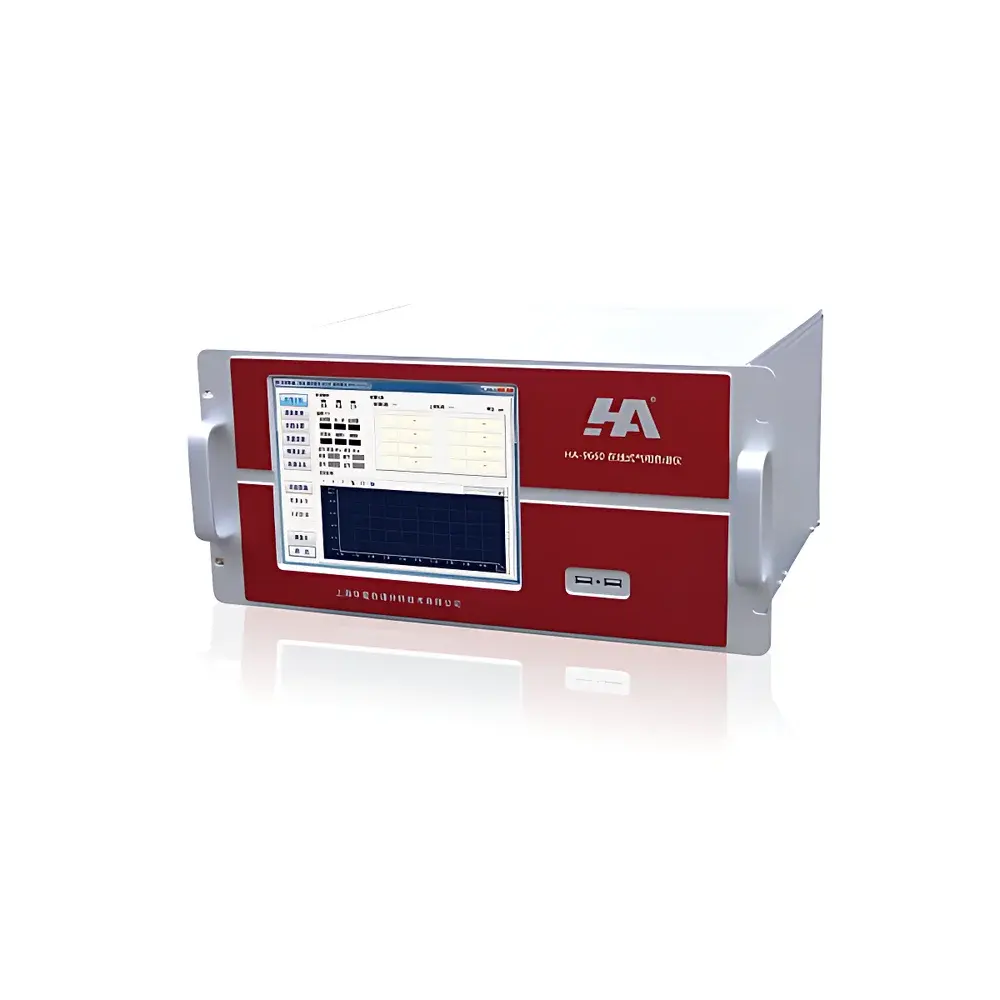
HuaiAi GC-9560-HTP Online Gas Chromatograph for High-Temperature/High-Pressure Reaction Monitoring
| Brand | HuaiAi |
|---|---|
| Origin | Shanghai, China |
| Manufacturer Type | Direct Manufacturer |
| Origin Category | Domestic (PRC) |
| Model | GC-9560-HTP |
| Pricing | Upon Request |
Overview
The HuaiAi GC-9560-HTP is an industrial-grade online gas chromatograph engineered for real-time, unattended compositional analysis of effluent streams from catalytic and photochemical reaction systems operating under elevated temperature and pressure conditions. It employs capillary gas chromatography with flame ionization detection (FID) or thermal conductivity detection (TCD), configured for continuous process monitoring via automated sampling loops and high-temperature valving. Unlike conventional benchtop GCs, the GC-9560-HTP integrates a fully heated fluidic path—from sample inlet through switching valves to column oven—ensuring quantitative transfer of thermally labile and condensable species without phase separation or adsorption loss. Its design conforms to the operational constraints of heterogeneous catalysis research: maximum sample temperature ≤ 300 °C and system backpressure ≤ 400 psi (2.7 MPa), enabling reliable analysis of multiphase (vapor–liquid equilibrium) reaction mixtures that would otherwise fractionate or condense in ambient-line systems.
Key Features
- Fully heated, insulated sample pathway including VACLO-sourced electrically heated 10-port (or 6-port) rotary valve, maintaining uniform temperature control across all fluid-contact surfaces up to 300 °C
- Integrated back-pressure regulation to preserve sample composition integrity during transfer from reactor to analyzer, eliminating pressure-induced phase shifts
- 24/7 autonomous operation with programmable sampling intervals, sequence-based method scheduling, and fault-tolerant restart logic
- Remote configuration and method management via Ethernet-connected PC interface; no manual front-panel operation required
- Robust mechanical architecture designed for laboratory and pilot-plant environments, compliant with IEC 61000-6-2 (immunity) and IEC 61000-6-3 (emission) standards
Sample Compatibility & Compliance
The GC-9560-HTP accommodates gaseous and volatile liquid-phase analytes typical in catalytic reaction monitoring—including H₂, CO, CO₂, CH₄, C₂H₄, C₂H₆, methanol, ethanol, formaldehyde, and light hydrocarbons—without pre-separation or cryogenic trapping. It supports direct coupling to fixed-bed, slurry-phase, and photo-reactors equipped with heated transfer lines. The system meets fundamental requirements for GLP-compliant data acquisition when paired with audit-trail-enabled software (e.g., optional HuaiAi ChromoData Suite v3.x). While not certified to ISO/IEC 17025 for accredited testing, its hardware architecture aligns with ASTM D1945 (analysis of natural gas), ASTM D1946 (analysis of fuel gases), and USP chromatographic system suitability criteria for retention time stability and peak symmetry.
Software & Data Management
Control and data acquisition are managed through HuaiAi’s proprietary ChromoData software, installed on a Windows-based host PC. The interface supports method creation with multi-step temperature programming, valve timing sequences, detector parameter optimization, and integration event definition. Raw chromatograms and processed results (area%, concentration, retention time) are stored in vendor-neutral CSV and CDF formats. Audit trail functionality records user logins, method modifications, calibration events, and run start/stop timestamps—supporting basic 21 CFR Part 11 compliance when deployed with Windows domain authentication and file-level write protection. Data export is compatible with LIMS integration via OPC UA or REST API adapters (optional add-on module).
Applications
- Continuous monitoring of Fischer–Tropsch, methanol synthesis, ammonia oxidation, and water–gas shift reactions
- In situ evaluation of photocatalytic CO₂ reduction and H₂ evolution kinetics
- Real-time tracking of selectivity drift and deactivation profiles during long-duration catalyst stability tests
- Process validation in microreactor and flow chemistry platforms requiring sub-minute temporal resolution
- Support for DOE-funded projects in sustainable chemistry where trace-level quantification (ppm-level detection limits achievable with FID) and repeatability (RSD < 1.5% for major components over 72 h) are critical
FAQ
Can the GC-9560-HTP analyze samples containing both permanent gases and condensable organics simultaneously?
Yes. Its fully heated sample loop, valve, and transfer lines prevent condensation of C₁–C₅ hydrocarbons and oxygenates at temperatures up to 300 °C, preserving vapor–liquid equilibrium during injection.
Is external cooling or cryogenic trapping required for low-boiling compounds like hydrogen or nitrogen?
No. The system relies on optimized column selection (e.g., PLOT Al₂O₃/KCl) and precise oven temperature ramping—not cold traps—to resolve light gases while maintaining compatibility with high-boiling co-analytes.
How is calibration maintained during extended unattended operation?
Calibration verification is performed automatically at user-defined intervals using internal standard addition or periodic standard gas injections; drift correction algorithms adjust retention time windows and response factors based on reference peaks.
Does the system support integration with DCS or PLC-based plant control systems?
Yes. Analog 4–20 mA outputs and Modbus TCP protocol support are available as factory-installed options for real-time transmission of key component concentrations to distributed control systems.
Related Products