
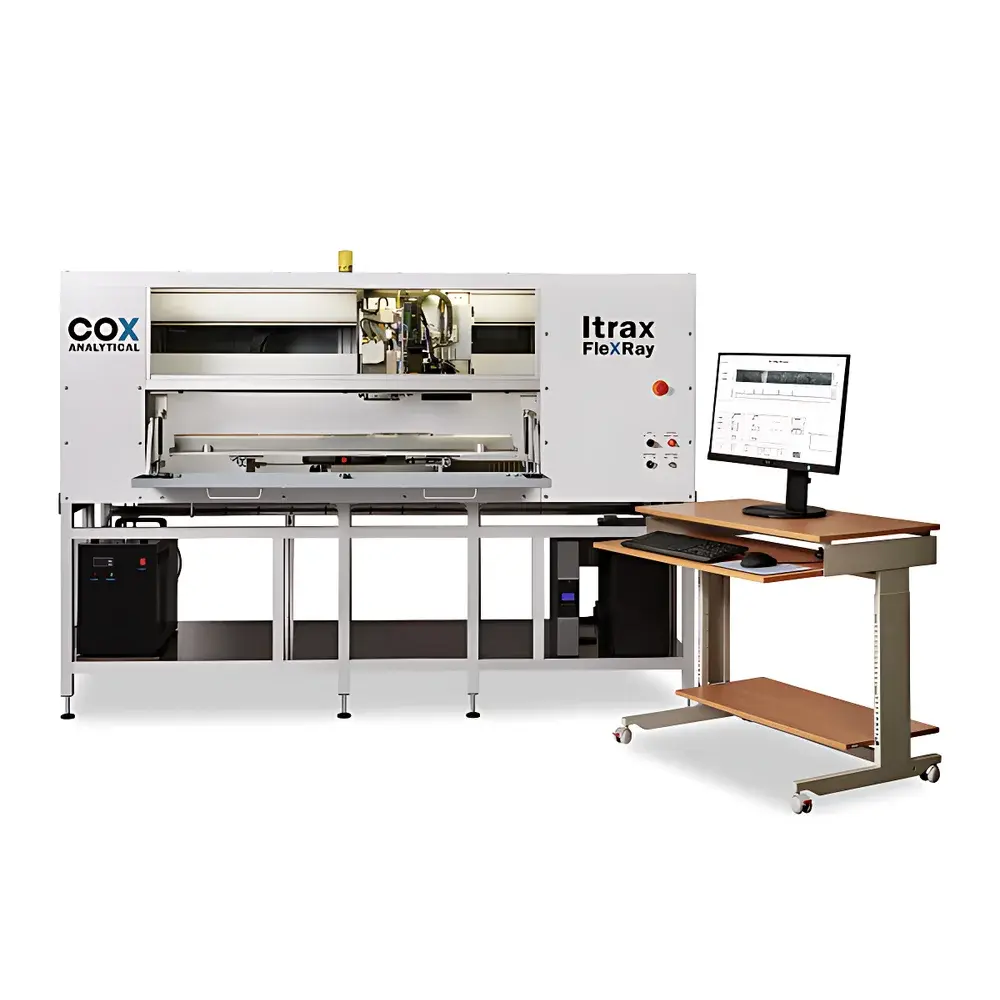
Itrax XRF FleXRay Core Scanner by COX Analytical Systems
| Brand | COX Analytical Systems |
|---|---|
| Origin | Sweden |
| Model | Itrax XRF FleXRay |
| Form Factor | Benchtop/Floor-Standing |
| Application Domain | Geological & Mining Core Analysis |
| Elemental Range | Na–U |
| Detection Principle | Energy-Dispersive X-Ray Fluorescence (ED-XRF) |
| Optical Resolution | High-Resolution RGB Imaging System |
| Surface Topography Compensation | Integrated Laser Distance Sensor (8 mm Fixed Working Distance) |
| Data Acquisition Speed | 0.2 s per measurement point |
| Sensitivity | Sub-ppm for heavy and transition metals |
| Calibration Approach | Pre-loaded Standard Reference Material Libraries |
| Compliance Context | Designed for GLP-compliant sediment core laboratories |
Overview
The Itrax XRF FleXRay Core Scanner, engineered by COX Analytical Systems in Sweden, is a high-performance, non-contact, non-destructive scanning system designed specifically for quantitative elemental profiling of geological cores and sediment archives. It employs energy-dispersive X-ray fluorescence (ED-XRF) spectroscopy as its primary analytical principle, enabling simultaneous multi-element detection across the full range from sodium (Na) to uranium (U) in a single scan pass. Unlike conventional sequential or voltage-stepped XRF systems, the FleXRay utilizes an optimized X-ray waveguide optics architecture to deliver focused, high-intensity excitation onto the sample surface—ensuring consistent photon flux and minimizing geometric attenuation effects. This design is especially critical for wet, unconsolidated, or highly variable-density samples such as marine sediment cores, lacustrine deposits, glacial varves, and peat columns. The integrated laser distance sensor continuously monitors topographic variation along the core surface, dynamically adjusting detector positioning to maintain a fixed 8 mm working distance—thereby eliminating signal drift caused by surface irregularities or water film thickness changes. As a result, the system delivers reproducible, depth-resolved geochemical data with spatial resolution down to 0.1 mm (adjustable), suitable for high-resolution paleoenvironmental reconstruction.
Key Features
- Simultaneous ED-XRF detection of elements from Na to U without voltage switching or repeated scans
- X-ray waveguide optics delivering stable, collimated excitation beam for enhanced signal-to-noise ratio
- High-resolution RGB optical imaging system co-registered with XRF data for visual stratigraphic correlation
- Laser-based topographic mapping ensures consistent 8 mm source–detector–sample geometry across uneven or water-saturated surfaces
- Integrated magnetic susceptibility sensor for complementary physical property profiling
- UV–Vis reflectance module option for organic pigment and iron oxide speciation analysis
- Pre-loaded reference libraries for rapid semi-quantitative calibration using NIST-traceable standards
- Benchtop or floor-standing configuration with modular rail system accommodating cores up to 1.8 m in length
Sample Compatibility & Compliance
The Itrax XRF FleXRay accommodates a broad spectrum of geological sample formats: split drill cores (standard 60–100 mm diameter), slabbed whole-round sections, discrete sediment slices, linear sediment traps, and U-tube preserved deposits. Its non-contact operation eliminates sample preparation requirements—no drying, coating, or pressing is necessary, preserving original porewater chemistry and redox-sensitive species. The system complies with laboratory practices supporting Good Laboratory Practice (GLP) frameworks and is routinely deployed in ISO/IEC 17025-accredited geoscience facilities. While not inherently FDA 21 CFR Part 11 compliant, its software architecture supports audit-trail-enabled user access control, electronic signature integration, and raw data immutability when configured within validated IT environments. All elemental quantification workflows adhere to ISO 18551 (XRF for geological materials) and ASTM D7692 (standard guide for XRF analysis of sediments).
Software & Data Management
The proprietary Itrax software suite provides synchronized visualization of optical imagery, topographic height profiles, XRF elemental maps, magnetic susceptibility traces, and optional UV–Vis spectral overlays—all time-aligned and spatially registered to sub-millimeter precision. Data export follows FAIR principles: ASCII (.txt), HDF5, and GeoTIFF formats are natively supported, enabling direct ingestion into QGIS, R (via ‘itrax’ package), Python (pandas/h5py), and MATLAB. Batch processing scripts allow automated normalization (e.g., Al-normalization, Fe-ratioing), background subtraction, and LOI-corrected quantification. Raw spectra are stored with full metadata (tube voltage/current, dwell time, ambient temperature, humidity, detector dead time), ensuring full traceability for inter-laboratory comparison and long-term archive integrity.
Applications
- Marine and lacustrine paleoclimatology: Ti/Ca, Fe/Mn, Sr/Ba ratios as proxies for terrigenous input, redox conditions, and carbonate productivity
- Varve chronology and ice-core tie-point validation through high-temporal-resolution Ca, K, and Cl layering
- Anthropogenic metal contamination tracing (Pb, Zn, Cu, As) in urban lake sediments and estuarine records
- Volcanic ash layer identification via Ti–Zr–Nb signatures in tephrochronology studies
- Peatland biogeochemistry: S/Fe ratios indicating sulfate reduction dynamics and organic matter preservation
- Tree-ring elemental mapping for dendrochemistry-based environmental stress reconstruction
FAQ
Does the Itrax XRF FleXRay require vacuum or helium purge for light element detection?
No. The system operates under ambient air and achieves reliable Na–Mg detection using optimized tube filtration and detector window transmission characteristics—no gas purge is required.
Can it quantify absolute concentrations without matrix-matched standards?
It provides robust semi-quantitative results using fundamental parameter (FP) algorithms and pre-loaded reference libraries. For certified quantification, empirical calibration with site-specific standards is recommended per ISO 18551 Annex B.
Is the laser topography function essential for accurate XRF on wet cores?
Yes. Maintaining constant 8 mm geometry is critical for count-rate stability—especially where surface water films exceed 1 mm thickness. Omitting topographic correction introduces >15% relative error in Mn and Fe intensities.
What is the minimum detectable mass fraction for heavy metals in marine clay?
Under standard 0.2 s dwell time and 1 mm step size, detection limits range from 1–5 ppm for Pb, Zn, and Ni in low-background matrices, verified against IAEA-434 and NIST 2709a reference materials.
How is data security handled during multi-user institutional deployment?
Role-based access control (RBAC), encrypted project databases, and configurable audit logs meet institutional IT security policies. Optional integration with LDAP/Active Directory is available.




