
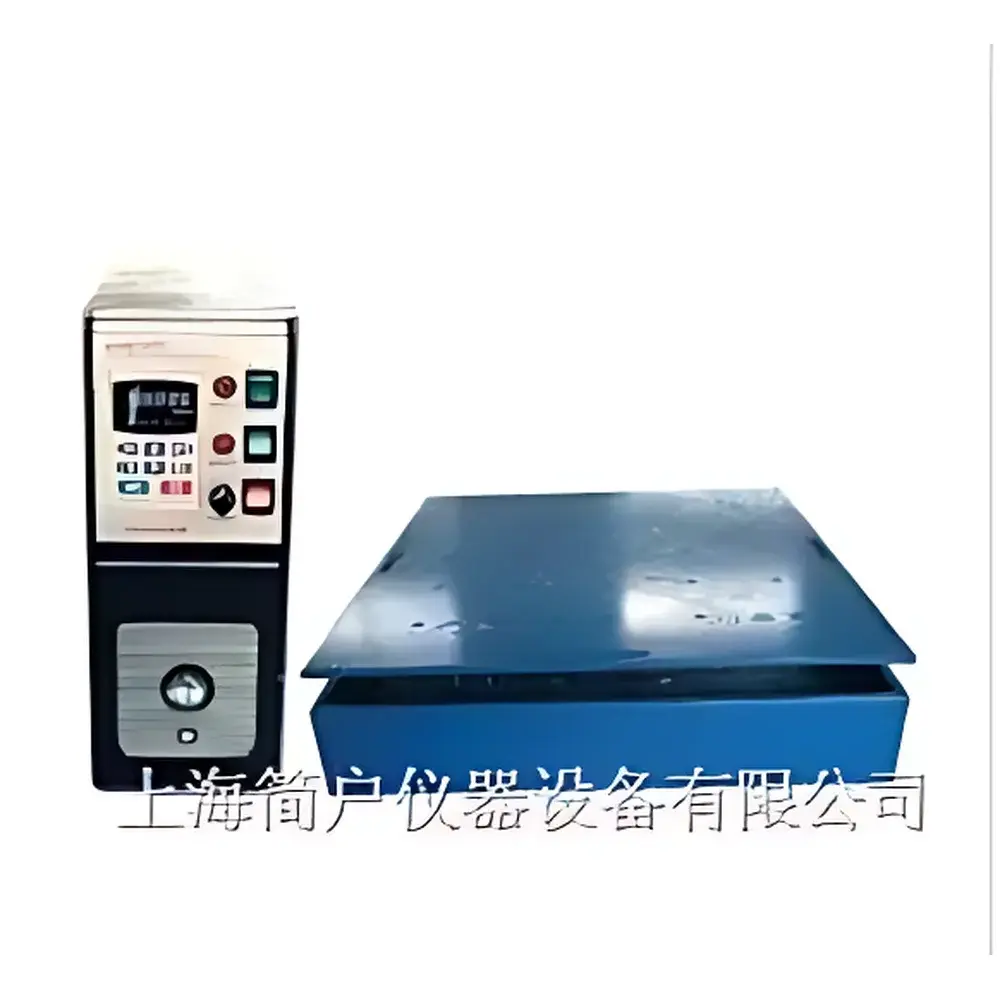
Jianhu JDZD Series Low-Frequency Electrodynamic Vibration Shaker
| Origin | China |
|---|---|
| Manufacturer Type | Authorized Distributor |
| Model | JDZD-L / JDZD-H / JDZD-LH / JDZD-F / JDZD-HF / JDZD-TF |
| Frequency Range | 1–400 Hz |
| Scan Range | 1–400 Hz |
| Max. Load Capacity | 100 kg |
| Peak-to-Peak Amplitude | 0–5 mm |
| Max. Acceleration | 20 g |
| Vibration Axes | Vertical, Horizontal, or Dual-Axis (Vertical + Horizontal) |
| Waveform | Sinusoidal |
| Control Modes | Sine, Amplitude Modulation (AM), Sweep (Linear & Logarithmic), Programmable Profile, Octave Tracking, Time-Controlled Sequencing |
| Power Rating | 2.2 kW |
| Table Size | 50 cm × 50 cm |
| Input Voltage | 220 V ±20% |
| Compliance | GB/T 2423.10, IEC 60068-2-6 (Fc), JJG 189–1997, GB/T 13309–1991 |
Overview
The Jianhu JDZD Series Low-Frequency Electrodynamic Vibration Shaker is an engineered test system designed for controlled mechanical excitation of products and components under sinusoidal vibration conditions. Based on electromagnetic force generation (Lorentz principle), the shaker delivers repeatable, traceable acceleration profiles across a broad low-to-mid frequency spectrum (1–400 Hz), enabling simulation of real-world transport, handling, and operational vibration environments. Its dual-axis capability—supporting independent or synchronized vertical, horizontal, or combined excitation—provides flexibility in replicating multi-directional stress states encountered during logistics, assembly, or field use. The system is not intended for random or shock testing; rather, it serves as a deterministic platform for qualification per standardized sine vibration protocols.
Key Features
- Electrodynamic actuator with high-force-to-mass ratio, delivering up to 20 g peak acceleration at full load (100 kg).
- Programmable controller supporting multiple excitation modes: fixed-frequency sine, amplitude-modulated (AM) sweeps, linear/logarithmic frequency sweeps, octave-based tracking, and time-segmented profile execution.
- Dual-axis configuration options (vertical-only, horizontal-only, or simultaneous vertical + horizontal) with independent or phase-locked control logic.
- Robust 50 cm × 50 cm aluminum alloy test table with T-slots for secure fixture mounting and dynamic load distribution.
- Integrated digital display and front-panel interface for real-time monitoring of frequency, amplitude (p-p), acceleration, and elapsed test time.
- 2.2 kW class D amplifier with thermal overload protection, voltage regulation tolerance (±20% @ 220 V), and EMI-filtered input stage compliant with industrial power environments.
- Adjustable peak-to-peak displacement range (0–5 mm) maintained within ±5% linearity across the specified frequency band.
Sample Compatibility & Compliance
The JDZD shaker accommodates test specimens up to 100 kg mass with center-of-gravity height ≤ 30 cm above the table surface. Fixture design must ensure rigid coupling and avoid resonant amplification below 400 Hz. The system conforms to internationally recognized environmental test standards including IEC 60068-2-6 (Fc) for sinusoidal vibration, GB/T 2423.10 (China’s equivalent of IEC 60068-2-6), JJG 189–1997 (national metrological verification regulation for vibration shakers), and GB/T 13309–1991 (vibration testing methodology for mechanical products). It supports test plan implementation aligned with quality management frameworks such as ISO 9001, IATF 16949 (automotive), and IPC-J-STD-002 (electronics assembly reliability).
Software & Data Management
While the base JDZD model operates via embedded firmware with local parameter programming, optional PC-based control software (sold separately) enables advanced functionality: waveform library import/export, multi-step test sequencing, real-time data logging (frequency, acceleration, displacement, time), CSV report generation, and pass/fail threshold annotation. Audit trails—including operator ID, timestamp, parameter set version, and calibration status—are retained per GLP/GMP-aligned data integrity practices. Exported datasets are compatible with MATLAB, Python (NumPy/Pandas), and common statistical analysis platforms for post-test spectral evaluation and failure mode correlation.
Applications
This vibration shaker is routinely deployed in R&D laboratories and QC departments for: structural integrity screening of consumer electronics enclosures; fatigue assessment of automotive ECUs and connectors; validation of packaging stack stability during simulated truck transport; durability verification of medical device housings per IEC 60601-1 clause 9.4.2; and baseline resonance mapping of optomechanical assemblies prior to shock qualification. It is especially suited for industries requiring compliance-driven, repeatable sine testing—not high-frequency random vibration or transient shock simulation.
FAQ
What standards does the JDZD series explicitly support?
It meets the technical requirements of GB/T 2423.10, IEC 60068-2-6 (Fc), JJG 189–1997, and GB/T 13309–1991 for sinusoidal vibration testing.
Can the shaker perform random vibration tests?
No—this is a dedicated electrodynamic sine shaker. Random vibration requires separate hardware (e.g., hydraulic or enhanced electrodynamic shakers with broadband controllers) and is outside the JDZD’s design scope.
Is dual-axis operation truly simultaneous and phase-coherent?
Yes—vertical and horizontal excitations can be synchronized with user-defined phase offsets (0° to 360°) or operated independently using separate control channels.
What is the recommended maintenance interval for the actuator and amplifier?
Visual inspection and cooling system cleaning every 500 operating hours; annual calibration verification against NIST-traceable accelerometers per JJG 189–1997 guidelines.
Does the system include built-in data storage or export capability?
Basic models log only runtime parameters on the front panel display; full data capture and export require optional PC connectivity and licensed control software.



