
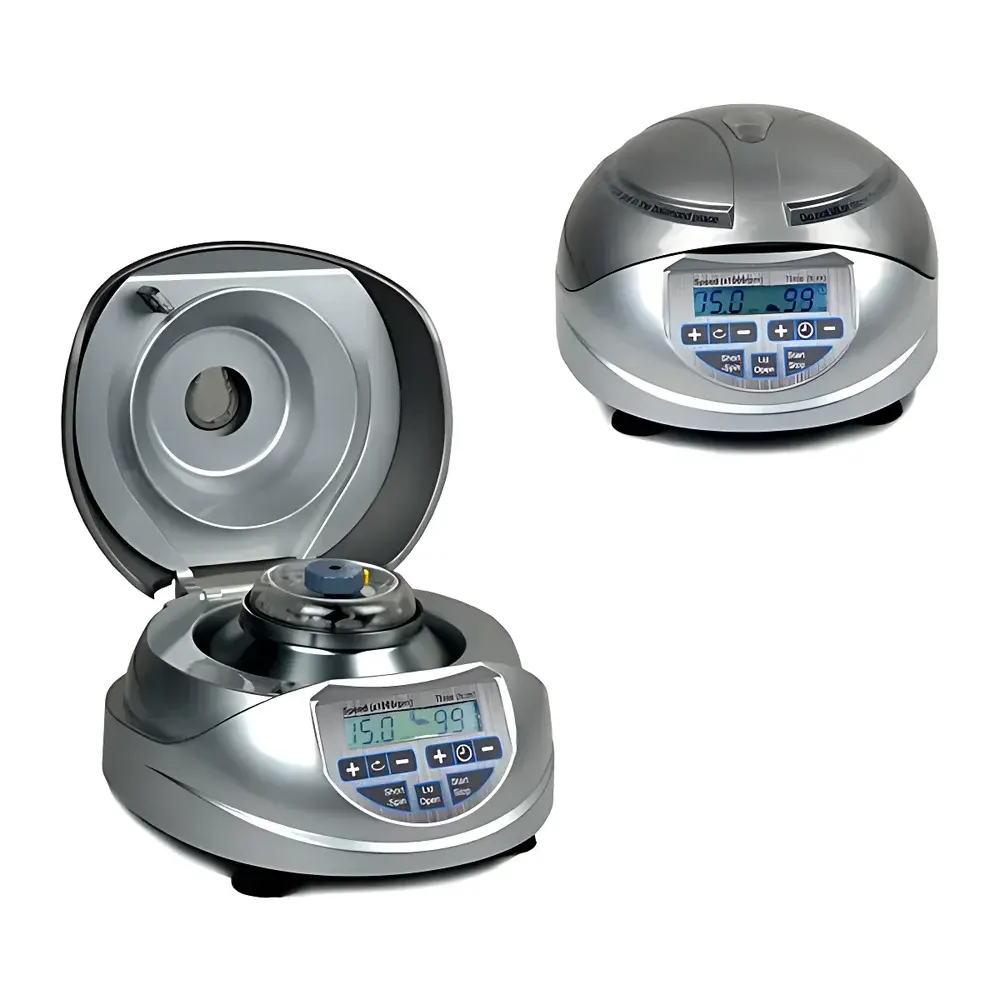
Jiayuan MC-15 Micro High-Speed Centrifuge
| Brand | Jiayuan |
|---|---|
| Origin | Beijing, China |
| Manufacturer Type | Authorized Distributor |
| Country of Origin | China |
| Model | MC-15 |
| Price Range | USD 1–699 |
| Centrifugation Class | Biomolecular Separation |
| Maximum Capacity | 12 × 2 mL tubes |
| Maximum Speed | 15,000 rpm |
| Dimensions | 240 mm × 220 mm × 145 mm |
| Weight (incl. rotor) | 4.7 kg |
| Acceleration Time to Max Speed | <13 s |
| Deceleration Time from Max Speed | <12 s |
| Rotor Material | Anodized Aluminum Alloy |
| Display | Backlit LCD |
| Power Supply | 110–120 V / 220–230 V, 50–60 Hz |
| Power Consumption | 105 W |
| Safety Features | Lid Interlock, Overspeed Protection, Overtemperature Monitoring, Real-time Diagnostics |
| Special Functions | Short-Cycle “Pulse” Mode, rpm/RCF Conversion, Audible End-of-Run Alert, Temperature-Stable Airflow Management |
Overview
The Jiayuan MC-15 Micro High-Speed Centrifuge is an engineered solution for routine biomolecular separation tasks in compact laboratory environments—including academic research labs, QC/QA facilities, clinical diagnostics units, and biotech startups. Designed around a brushless frequency-controlled motor and precision-machined aluminum rotor assembly, the MC-15 delivers consistent performance at speeds up to 15,000 rpm (RCF max: 14,100 × g), optimized for pelleting nucleic acids, precipitating proteins, clarifying cell lysates, and concentrating viral particles or exosomes. Its compact footprint (240 × 220 × 145 mm) enables seamless integration onto crowded benchtops or inside biosafety cabinets—without compromising mechanical stability or thermal control. Unlike entry-level microcentrifuges relying on passive cooling, the MC-15 employs an active three-channel airflow system that maintains rotor temperature rise below 6 °C after 10 minutes at maximum speed—critical for preserving enzymatic activity and RNA integrity during extended spin cycles.
Key Features
- Brushless frequency-converter motor ensures rapid acceleration (<13 s to 15,000 rpm) and controlled deceleration (<12 s), minimizing sample disturbance and extending motor service life.
- Anodized aluminum rotor rated for repeated autoclaving (121 °C, 20 min, saturated steam), resistant to common solvents including ethanol, isopropanol, and diluted acids/bases.
- Backlit LCD interface displays real-time rpm, RCF, remaining time, and operational status—supporting intuitive parameter entry with 100 rpm/100 × g step resolution.
- Dedicated “PULSE” button enables transient centrifugation without pre-programming—ideal for quick pellet collection prior to aspiration or supernatant removal.
- Integrated lid interlock mechanism physically prevents door opening during rotation and requires manual release post-run, complying with IEC 61010-2-020 safety requirements for centrifugal equipment.
- Comprehensive electronic protection suite includes overspeed cutoff, thermal shutdown (>45 °C internal ambient), and continuous self-diagnostic monitoring of motor current, rotor imbalance, and power supply stability.
Sample Compatibility & Compliance
The MC-15 accommodates standard 0.2–2.0 mL microcentrifuge tubes (including PCR strips and skirted 0.5 mL tubes with optional adapters). Its rotor geometry supports balanced loading across all 12 positions—no minimum tube requirement—and tolerates minor mass asymmetry (<0.1 g per position) without triggering error states. The device meets CE marking requirements under the Low Voltage Directive (2014/35/EU) and Electromagnetic Compatibility Directive (2014/30/EU). While not certified for ISO 13485 or FDA 21 CFR Part 11 out-of-the-box, its audit-ready operation log (timestamped start/stop events, speed/RCF settings, and fault codes) supports GLP/GMP-aligned documentation workflows when integrated with lab information management systems (LIMS).
Software & Data Management
The MC-15 operates as a standalone instrument with no proprietary software dependency. All parameters are set directly via front-panel controls; runtime data—including total run count, cumulative operating hours, and last 10 fault logs—are stored non-volatilely and accessible through diagnostic mode. For traceability-critical applications, users may manually record settings and outcomes in electronic lab notebooks (ELNs) compliant with ALCOA+ principles. Optional RS-232 or USB-to-serial interfaces (available upon request) enable external logging via third-party acquisition software compatible with Windows/Linux platforms.
Applications
- Routine nucleic acid purification (plasmid preps, PCR clean-up, gel extraction)
- Protein precipitation and desalting using ammonium sulfate or acetone
- Cellular fractionation—cytosolic vs. membrane-associated protein isolation
- Virus concentration from tissue culture supernatants (e.g., lentivirus, AAV)
- Exosome isolation via differential ultracentrifugation (as first-step spin at 10,000–15,000 × g)
- Microfiltration support for HPLC sample preparation and solvent exchange
FAQ
Is the MC-15 suitable for use with infectious or biohazardous samples?
Yes—when operated inside a certified Class II biosafety cabinet and paired with sealed tube caps or O-ring–equipped rotors (sold separately), it meets BSL-2 containment guidelines for low-risk pathogens.
Can the rotor be sterilized in an autoclave?
Yes—the anodized aluminum rotor is validated for up to 500 cycles of steam sterilization at 121 °C, 20 minutes, 103 kPa.
Does the centrifuge support RCF-to-rpm conversion during operation?
Yes—the LCD display toggles between rpm and ×g values in real time, and the conversion uses the calibrated rotor radius (72 mm) per ISO 21501-4.
What maintenance is required beyond routine cleaning?
No scheduled lubrication or calibration is needed. Users should inspect the rotor for pitting or stress cracks annually and verify lid latch function before each use.
Is technical support available outside China?
Yes—Jiayuan partners with regional distributors in North America, EMEA, and APAC who provide multilingual documentation, application guidance, and warranty service under local terms.



