
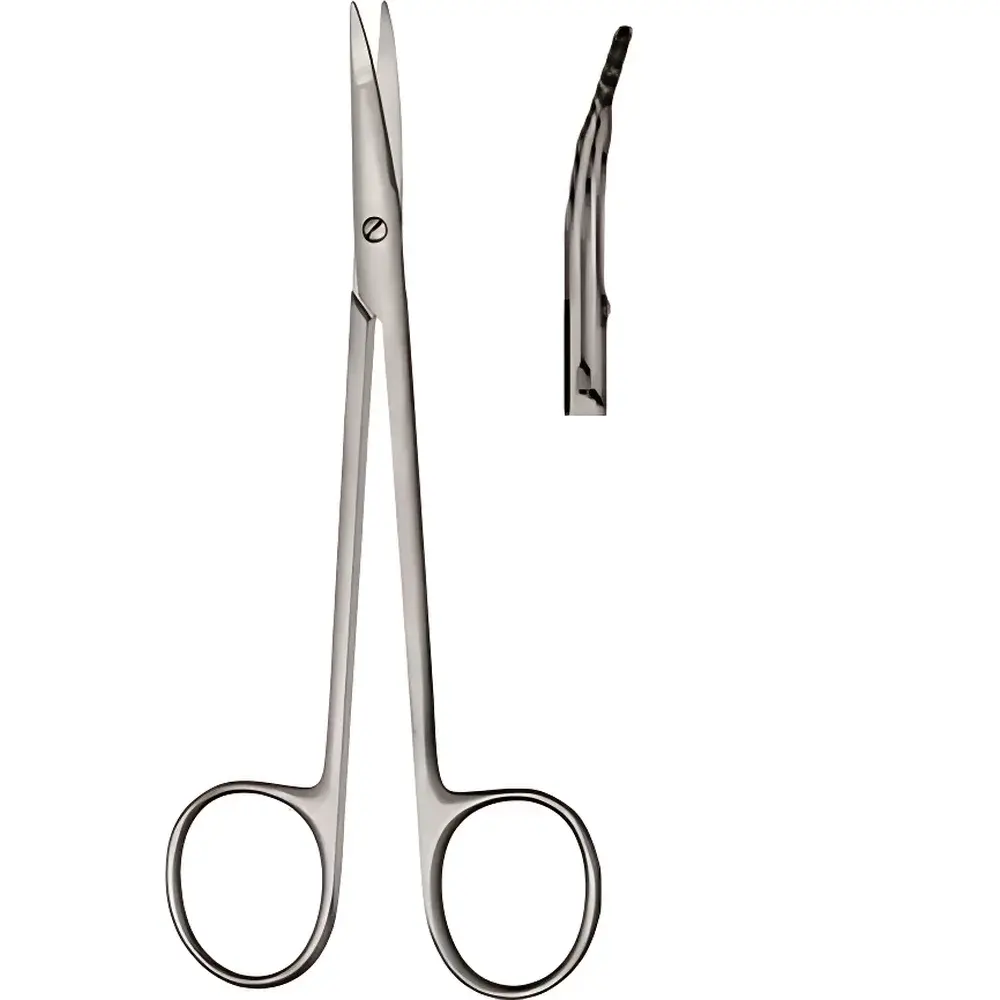
KILNER Precision Anatomy Scissors – Curved Blunt-Blunt, 12.5 cm
| Brand | RWD |
|---|---|
| Origin | Shenzhen, China |
| Manufacturer Type | Direct Manufacturer |
| Country of Origin | China |
| Model | S13019-12 |
| Pricing | Upon Request |
Overview
The KILNER Precision Anatomy Scissors – Curved Blunt-Blunt (Model S13019-12) is a high-fidelity surgical instrument engineered for delicate dissection and tissue handling in preclinical research, pathology laboratories, and academic teaching environments. Designed under strict adherence to ISO 7740-1:2021 (Surgical Instruments — Requirements and Test Methods for Scissors), these scissors employ a precision-ground, stainless steel (AISI 420 or equivalent) blade geometry optimized for controlled cutting without tissue trauma. The curved, fully blunt-tipped configuration minimizes puncture risk during layered dissection—particularly valuable in neuroanatomy, embryology, and soft-tissue isolation where preservation of underlying structures is critical. Unlike straight-blade variants, the 12.5 cm overall length with ergonomic finger-ring handles provides enhanced tactile feedback and improved access to deep or confined anatomical sites while maintaining optimal leverage-to-control ratio.
Key Features
- Curved blade profile with dual blunt tips ensures non-penetrating tissue separation and reduces accidental perforation of vessels or membranes.
- 12.5 cm total length balances maneuverability and mechanical advantage—ideal for both fine microdissection and standard gross anatomy procedures.
- Monobloc construction with seamless hinge joint eliminates crevices that could harbor biological residues, supporting rigorous autoclave sterilization (up to 134 °C, 2 bar, 18 min per EN 285).
- Electropolished surface finish meets ISO 13485 requirements for implantable-device-grade biocompatibility and corrosion resistance (tested per ASTM F2129).
- Finger-ring handles feature laser-etched RWD branding and model identification (S13019-12) for traceability in GLP-compliant lab documentation systems.
Sample Compatibility & Compliance
These scissors are routinely employed in rodent, avian, and amphibian dissection protocols, as well as in human cadaveric training and histopathological specimen preparation. Their design conforms to widely adopted institutional biosafety standards for sharps handling, including CDC/NIH Guidelines for Biosafety in Microbiological and Biomedical Laboratories (BMBL, 6th Ed.). While not intended for clinical use on living human patients, the instrument satisfies ASTM F1872-22 (Standard Specification for Surgical Scissors Used in Veterinary and Research Applications) and supports compliance with Good Laboratory Practice (GLP) principles under OECD Series on Principles of Good Laboratory Practice. Sterilization validation data are available upon request for integration into facility-specific validation protocols.
Software & Data Management
As a manual, non-electronic instrument, the KILNER Anatomy Scissors requires no embedded firmware, software drivers, or connectivity interfaces. However, its model-specific identification (S13019-12) enables seamless integration into laboratory asset management systems—including those compliant with ISO/IEC 17025:2017 (General Requirements for the Competence of Testing and Calibration Laboratories). Institutions utilizing digital inventory platforms (e.g., LabVantage, Quartzy, or custom LIMS) may assign unique QR-coded labels for real-time tracking of usage cycles, sterilization logs, and maintenance history—supporting audit readiness for AAALAC International accreditation or internal QA reviews.
Applications
- Dissection of neural tracts and cranial nerves in murine brain mapping studies.
- Isolation of embryonic tissues (e.g., E12.5 mouse limb buds) without compromising extracellular matrix integrity.
- Preparation of intact organ slices (e.g., hippocampal or cortical sections) for ex vivo electrophysiology.
- Cadaveric dissection training in undergraduate and graduate anatomy curricula.
- Excision of subcutaneous tumors in oncology xenograft models, minimizing hemorrhage and stromal disruption.
FAQ
Are these scissors suitable for sterile human surgical use?
No. These instruments are manufactured and validated exclusively for research, teaching, and veterinary applications—not for clinical use on living human subjects.
What sterilization methods are validated for this model?
Autoclaving at 134 °C for 18 minutes (prevacuum cycle) is fully validated; ethylene oxide (EtO) and hydrogen peroxide plasma (Sterrad®) are also compatible per manufacturer specifications.
Does RWD provide calibration or maintenance documentation?
While no calibration is required for mechanical scissors, RWD supplies a Certificate of Conformance (CoC) with each batch, including material certification (EN 10088-1), surface finish verification, and dimensional inspection reports.
Can replacement blades be ordered separately?
No. The monobloc construction ensures structural integrity and sterility assurance; the entire unit is replaced after extended use or visible wear per institutional biosafety policy.
Is this model compliant with EU MDR 2017/745?
This product is classified as a Class I non-sterile, non-measuring research instrument under MDR Annex VIII and bears appropriate CE marking for laboratory use only—not as a medical device for patient treatment.
Related Products





