
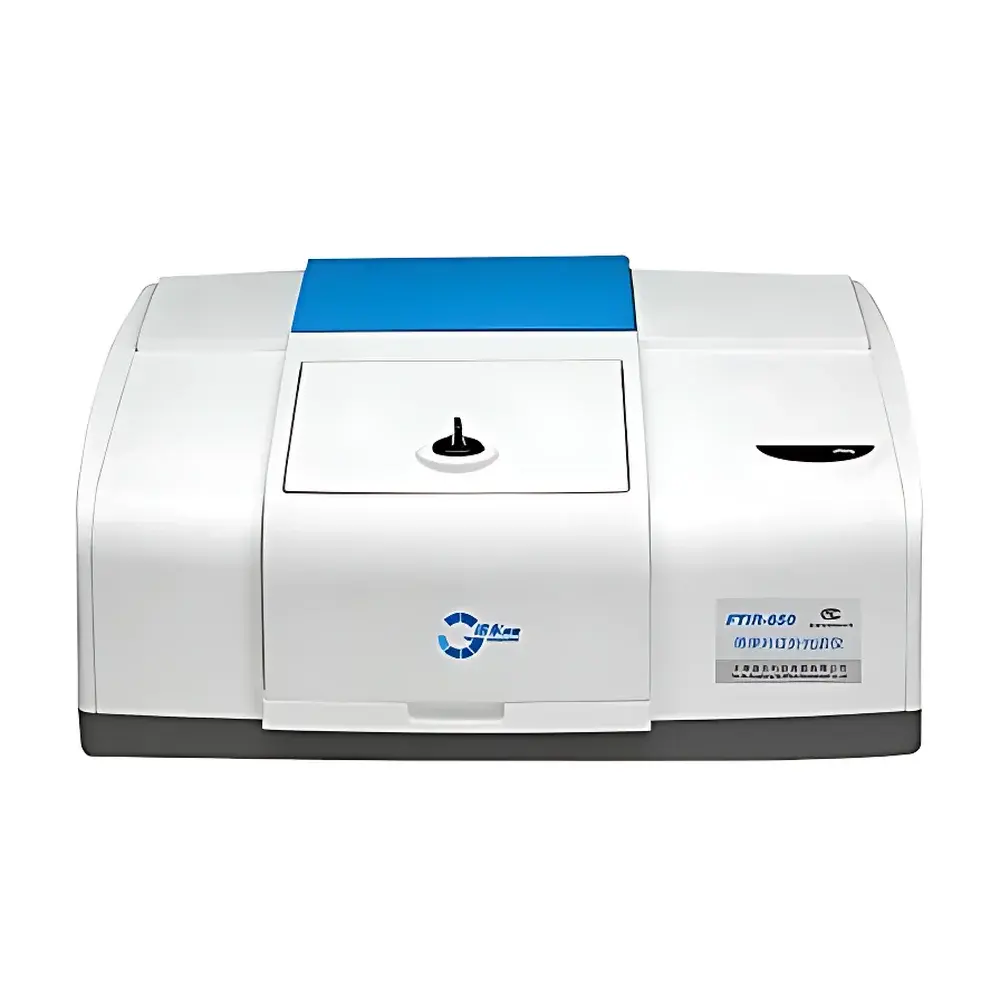
KJ GROUP FTIR-650 / FTIR-650G Fourier Transform Infrared Spectrometer
| Brand | KJ GROUP |
|---|---|
| Origin | Liaoning, China |
| Manufacturer Type | Authorized Distributor |
| Country of Origin | China |
| Model | FTIR-650 / FTIR-650G |
| Power Supply | AC 220 V / 50 Hz |
| Spectral Range | 4000–400 cm⁻¹ (FTIR-650) / 7800–350 cm⁻¹ (FTIR-650G) |
| Spectral Resolution | <1.5 cm⁻¹ (FTIR-650) / <1.0 cm⁻¹ (FTIR-650G) |
| Detector | Imported High-Sensitivity DLATGS |
| Beamsplitter | Ge-coated KBr substrate with humidity-resistant coating |
| Signal-to-Noise Ratio | 15,000:1 (P-P, 4 cm⁻¹, 1-min scan, 2100 cm⁻¹) / 30,000:1 (FTIR-650G) |
| Scan Speed | Software-selectable |
| Light Source | Long-life, high-intensity air-cooled IR source |
| Data Interface | USB 2.0 |
| Operating System Support | Windows XP, Windows 7 |
| Dimensions | 450 × 350 × 210 mm |
| Weight | 14 kg |
Overview
The KJ GROUP FTIR-650 and FTIR-650G are benchtop Fourier Transform Infrared (FTIR) spectrometers engineered for precision molecular identification and structural analysis in regulated and research laboratory environments. Based on Michelson interferometry, these instruments acquire full mid-infrared spectra by measuring the interference pattern (interferogram) generated when broadband infrared radiation is split, reflected, recombined, and detected. The resulting time-domain signal is mathematically transformed via Fast Fourier Transform (FFT) into a frequency-domain spectrum—enabling quantitative and qualitative characterization of chemical bonds through their fundamental vibrational absorption bands. Designed to meet international performance benchmarks, both models deliver high optical throughput, thermal stability, and long-term spectral reproducibility—making them suitable for routine QC testing, method development, and advanced materials characterization across pharmaceutical, polymer, petrochemical, environmental, and forensic applications.
Key Features
- Monolithic Optical Bench Architecture: Precision-molded aluminum optical platform with integrated corner cube mirrors and fixed alignment—eliminating post-installation mechanical drift and ensuring long-term wavenumber accuracy and intensity stability.
- High-Fidelity Detection System: Equipped with imported deuterated triglycine sulfate (DLATGS) detectors optimized for room-temperature operation, coupled with 24-bit analog-to-digital conversion for enhanced dynamic range and low-noise spectral acquisition.
- Enhanced Interferometer Design: Gold-coated corner cubes fabricated as single-piece assemblies—delivering superior reflectivity (>97% across 4000–400 cm⁻¹), angular orthogonality tolerance <2 arcsec, and immunity to adhesive aging or thermal hysteresis.
- Integrated Environmental Monitoring: Sealed interferometer housing with colorimetric humidity indicator—providing visual dryness status without opening the instrument; desiccant replacement performed externally via dedicated access port.
- Modular Sampling Flexibility: Large-volume sample compartment (≥120 mm × 120 mm × 80 mm) compatible with standardized accessories including diamond ATR, gas cells (path lengths 0.1–10 cm), liquid transmission cells, polarizers, and specular reflectance stages.
- Regulatory-Ready Software Framework: Embedded spectral acquisition and processing software compliant with multi-level user authentication (Operator, Supervisor, Administrator), audit trail logging, electronic signature support, and configurable data retention policies aligned with GLP and FDA 21 CFR Part 11 requirements.
Sample Compatibility & Compliance
The FTIR-650/650G supports solid, liquid, and gaseous samples using transmission, attenuated total reflectance (ATR), diffuse reflectance (DRIFTS), and photoacoustic detection modalities. It conforms to key analytical standards including ASTM E1421 (Practice for Describing and Measuring Performance of FTIR Spectrometers), ISO 18383 (Plastics — Identification by FTIR), USP (Infrared Absorption Spectrophotometry), and EP 2.2.24 (Infrared Spectrophotometry). All systems undergo factory calibration traceable to NIST-traceable polystyrene film reference standards. Optional IQ/OQ/PQ documentation packages—including installation qualification (IQ), operational qualification (OQ), and performance qualification (PQ)—are available to support GMP-compliant deployment and regulatory audits.
Software & Data Management
Bundled KJ-FTIR Pro software provides real-time spectral acquisition, baseline correction, peak integration, library searching (with built-in >10,000-compound commercial and custom spectral databases), multivariate analysis (PCA, PLS), and report generation in PDF or XML formats. Raw interferograms and processed spectra are stored in standardized JCAMP-DX v6 format. The software architecture implements role-based access control, timestamped audit trails for all critical actions (e.g., parameter changes, calibration events, data deletion), and encrypted local database storage. Export functions support LIMS integration via CSV, ASCII, and SDMX-compliant outputs. Remote diagnostics and firmware updates are supported over secure HTTPS channels.
Applications
- Pharmaceutical: Identification of active pharmaceutical ingredients (APIs), excipient compatibility studies, polymorph screening, and cleaning validation residue analysis.
- Polymers & Composites: Quantification of copolymer composition, oxidation index measurement, filler dispersion analysis, and degradation kinetics monitoring.
- Petrochemical: Hydrocarbon group-type analysis (HTA), sulfur compound profiling, and lubricant additive verification per ASTM D2425 and D7213.
- Environmental: Microplastic identification in water/sediment matrices, airborne particulate functional group mapping, and VOC speciation in stack emissions.
- Forensics & Security: Trace evidence comparison (paint chips, fibers, adhesives), counterfeit drug detection, and explosive residue screening.
- Academic Research: Reaction monitoring in situ via flow cells, surface adsorption studies using reflection-absorption geometry, and thin-film thickness determination via interference fringe analysis.
FAQ
What is the difference between the FTIR-650 and FTIR-650G models?
The FTIR-650G extends the spectral range to 7800–350 cm⁻¹ (vs. 4000–400 cm⁻¹ for the FTIR-650), enabling detection of high-energy overtones and combination bands—particularly useful for near-IR region analysis of C–H, O–H, and N–H stretching vibrations.
Is the instrument compliant with 21 CFR Part 11?
Yes—the standard software includes electronic signature capability, audit trail generation, and user privilege management required for Part 11 compliance; configuration and validation documentation is provided upon request.
Can the system be integrated into an automated lab environment?
Yes—USB 2.0 interface supports SCPI command set for remote control via LabVIEW, Python (PyVISA), or MATLAB; optional Ethernet-to-USB gateway enables networked instrument management.
What maintenance is required beyond desiccant replacement?
No optical realignment or detector cooling is needed; routine maintenance is limited to periodic external mirror cleaning (using spectroscopic-grade methanol) and annual verification against certified reference standards.
Does KJ GROUP provide IQ/OQ/PQ services?
Yes—certified field application engineers perform on-site installation qualification, operational qualification, and performance qualification per ISO/IEC 17025 guidelines, with full documentation delivered in English.



