
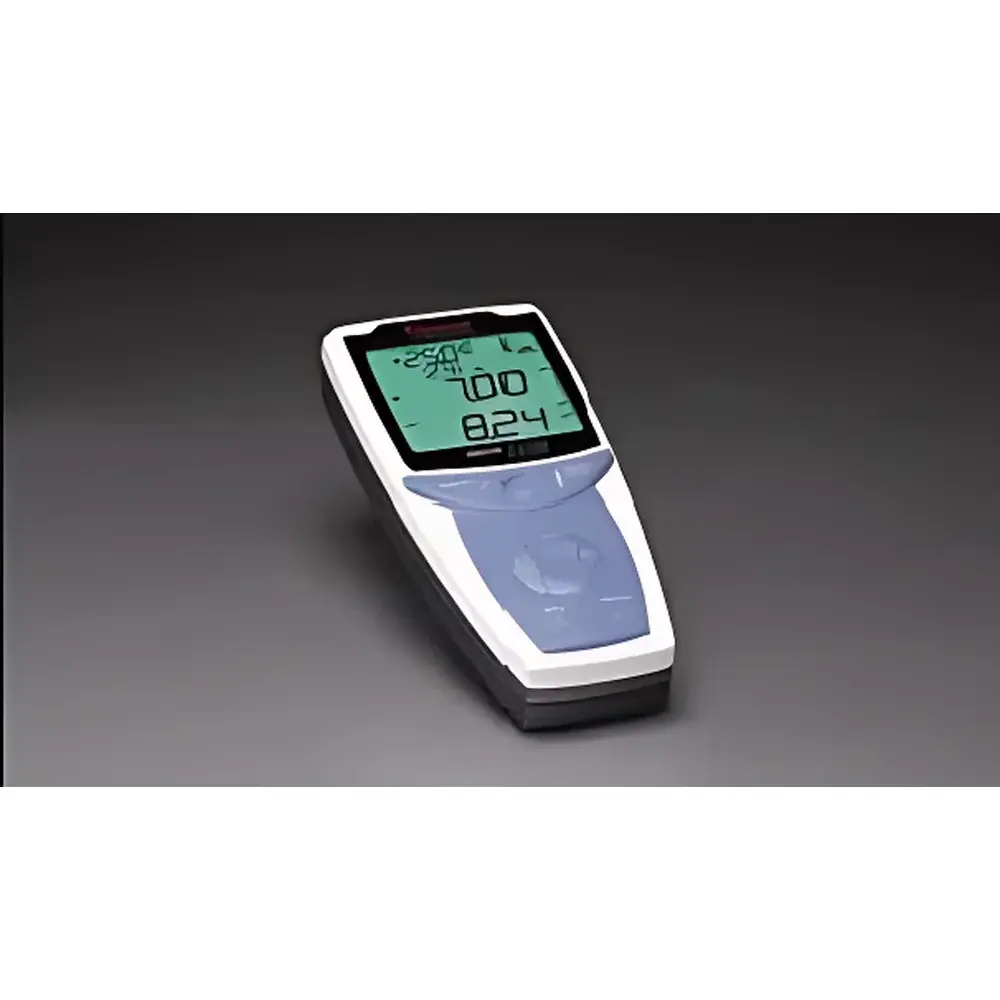
Thermo Scientific Orion 3-Star 320P-01 Precision Portable pH Meter
| pH Range | –2.000 to 19.999 |
|---|---|
| pH Resolution | 0.1 / 0.01 / 0.001 |
| pH Accuracy | ±0.001 |
| Calibration Points | 1–5 (US/NIST, DIN, Custom) |
| mV Range | ±1999.9 |
| mV Resolution | 0.1 |
| mV Accuracy | ±0.1 mV or ±0.05% (whichever is greater) |
| Temperature Range | –5 to 105 °C |
| Temp Resolution | 0.1 °C (–5 to 99.9 °C), 1.0 °C (>99.9 °C) |
| Temp Accuracy | ±0.1 °C |
| Temp Compensation | Auto/Manual |
| Display | Backlit LCD |
| Electrode Interfaces | pH–BNC, Temp–miniDIN, Stirrer–phone jack (benchtop only) |
| Communication | Bidirectional RS232, optional USB cable |
| Data Storage | 200 GLP-compliant entries |
| Calibration History | Last 10 calibrations |
| Method Storage | 10 password-protected methods |
| Self-Test | Yes |
| Firmware Upgrade | Network-enabled |
| Power | 4×AA batteries + optional universal AC adapter (benchtop) |
| Certifications | CE, CSA, UL, TÜV, FCC Class A |
| Operating Environment | 5–45 °C, 5–85% RH |
| IP Rating | Portable—IP67 |
Overview
The Thermo Scientific Orion 3-Star 320P-01 Precision Portable pH Meter is an engineered electrochemical measurement system designed for field-deployable and laboratory-grade pH, mV, and temperature analysis. Built on a robust potentiometric architecture, it measures hydrogen ion activity via high-impedance voltage detection across a glass pH electrode and reference junction—compliant with fundamental electrochemical principles defined in ASTM D1293 and ISO 10523. Its extended pH range (–2.000 to 19.999) supports demanding applications including highly acidic industrial effluents, alkaline caustic solutions, and seawater matrices where conventional meters exhibit drift or saturation. The instrument integrates dual-mode temperature compensation—automatic via integrated thermistor or manual entry—and employs Nernstian slope validation during calibration to ensure thermodynamic consistency across environmental gradients.
Key Features
- Multi-point calibration intelligence: Supports up to five-point calibration using US/NIST, DIN, or user-defined buffers—enabling rigorous traceability and minimizing systematic error across wide pH spans.
- Smart Stability™ and Smart Averaging™ algorithms: Dynamically adjusts measurement acquisition based on signal noise and drift rate, reducing stabilization time by up to 40% while improving repeatability (RSD < 0.15% under controlled conditions).
- Dedicated EH (ORP) mode: Reports redox potential directly referenced to the Standard Hydrogen Electrode (SHE), with automatic correction for solution temperature and electrode offset—critical for corrosion monitoring, disinfection efficacy assessment, and anaerobic digestion control.
- Full GLP compliance architecture: Stores 200 timestamped, operator-ID-tagged measurements with full audit trail; retains the last 10 calibration logs—including buffer IDs, slopes, offsets, and date/time stamps—for regulatory review.
- IP67-rated portable enclosure: Sealed against dust ingress and submersion up to 1 m for 30 minutes—validated per IEC 60529—making it suitable for wastewater sampling, coastal surveys, and remote environmental monitoring without protective housings.
- Secure multi-user operation: Ten password-protected method configurations allow lab managers to predefine electrode types, calibration protocols, units, and display formats—ensuring procedural consistency across shifts and operators.
Sample Compatibility & Compliance
The 320P-01 is validated for aqueous and semi-aqueous samples with conductivity ≥50 µS/cm. It accommodates standard BNC-compatible pH electrodes—including the included Orion 9107BNMD Triode combination electrode—and supports miniDIN temperature probes for simultaneous thermal compensation. All measurements adhere to Good Laboratory Practice (GLP) and Good Manufacturing Practice (GMP) documentation requirements. Optional FDA 21 CFR Part 11-compliant software (Orion Star Com) provides electronic signatures, role-based access control, and immutable audit logs—meeting inspection readiness criteria for pharmaceutical water testing (USP ) and environmental reporting (EPA Method 150.1).
Software & Data Management
Data transfer occurs via bidirectional RS232 or optional USB interface, compatible with Thermo Scientific Orion Star Com PC software. This platform enables batch export to CSV or PDF, automated report generation with embedded calibration certificates, and firmware updates over local networks. All stored data include metadata: sample ID, operator code, electrode serial number, ambient temperature/humidity, and GPS coordinates (when paired with Bluetooth-enabled external modules). Internal memory retains integrity during battery replacement or power interruption—verified under IEC 61000-4-2 ESD immunity testing.
Applications
- Regulatory environmental monitoring of surface water, groundwater, and wastewater per EPA and EU WFD directives
- In-process pH control in bioreactors, chemical synthesis, and food & beverage production lines
- Marine and estuarine research requiring stable readings in high-salinity, low-temperature environments
- Educational laboratories performing Nernst equation validation and buffer capacity experiments
- Field verification of online pH analyzers in municipal water treatment plants
FAQ
Does the 320P-01 support automatic temperature compensation with all electrode types?
Yes—when used with integrated temperature sensors (e.g., ATC pins in Orion Triode electrodes) or external miniDIN probes. Manual input is available if sensorless electrodes are deployed.
Can calibration data be exported for third-party LIMS integration?
Yes—calibration logs and measurement records export in CSV format with ISO 8601 timestamps and SI-unit annotations, supporting direct ingestion into LabVantage, STARLIMS, and LabWare platforms.
Is the IP67 rating maintained when the battery compartment is opened?
No—the IP67 seal is only guaranteed when the battery cover is fully latched and gasket intact. Routine visual inspection of the silicone gasket is recommended per maintenance schedule.
What is the expected service life of the included 9107BNMD electrode under typical field use?
With proper storage in KCl solution and weekly cleaning per Orion Technical Bulletin TB-1001, median operational life exceeds 18 months in non-aggressive matrices (e.g., freshwater, buffered solutions).
How does the instrument handle electrode drift during extended field deployments?
The Self-Test function verifies internal circuitry and reference junction integrity at startup; Smart Stability™ continuously monitors signal variance and alerts users when drift exceeds configurable thresholds (default: 0.002 pH/min over 60 s).






