
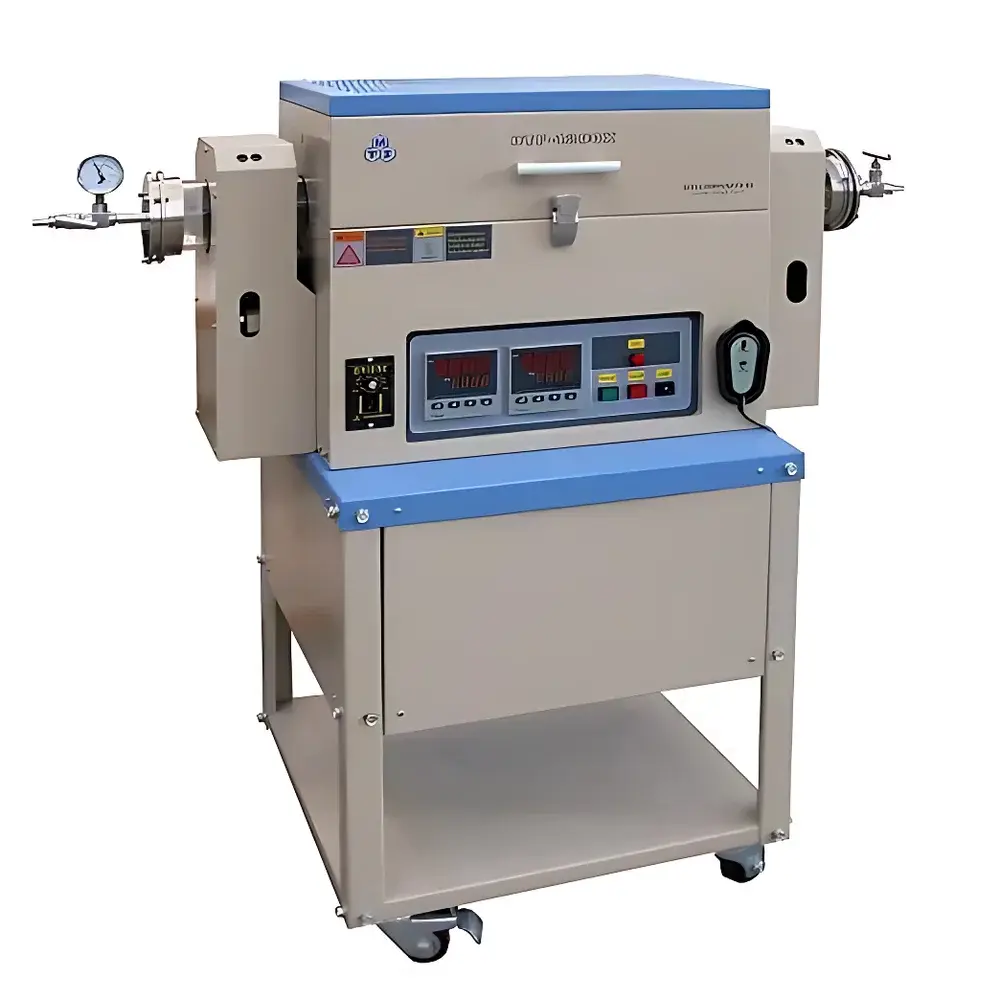
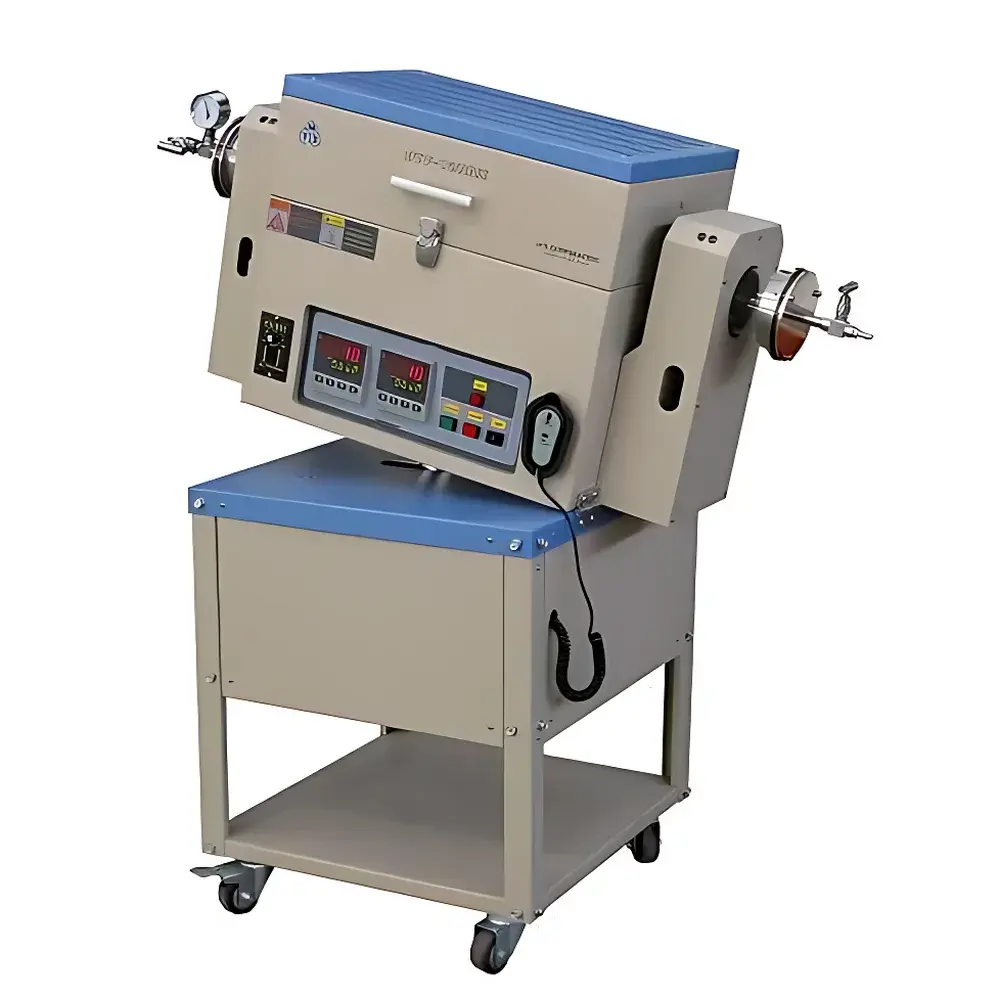
KJ GROUP OTF-1200X-4-R-II Dual-Zone Tilted Rotating Tube Furnace
| Brand | KJ GROUP |
|---|---|
| Origin | Liaoning, China |
| Manufacturer Type | Authorized Distributor |
| Country of Origin | China |
| Model | OTF-1200X-4-R-II |
| Power Supply | AC 220 V, 50/60 Hz, 4 kW |
| Maximum Temperature | 1200 °C (≤1 h), Continuous Operation at 1100 °C |
| Dual-Zone Heating Length | 2 × 200 mm |
| Uniform Temperature Zone | 150 mm |
| Tube Rotation Speed | 0–10 rpm |
| Tilt Angle Range | 0–30° |
| Quartz Tube Dimensions | Total 1200 mm |
| Vacuum Level | ≤10⁻² torr |
| Temperature Control Accuracy | ±1 °C |
| Batch Capacity | 2 kg per run |
| Chamber Cooling | Forced-air dual-shell cooling system |
| Compliance | CE certified |
Overview
The KJ GROUP OTF-1200X-4-R-II is a precision-engineered dual-zone tilted rotating tube furnace designed for controlled thermal processing of advanced functional materials under inert, reducing, or reactive gas atmospheres. Its operational principle integrates simultaneous axial rotation and programmable tilting to ensure uniform material exposure to thermal gradients—critical for homogenizing solid-state reactions in cathode and anode precursor synthesis. Unlike static tube furnaces, this system employs Couette-type rotational dynamics within the quartz reaction tube, where internal lifters (integrated alumina-coated baffles) induce continuous tumbling and cascading motion. This mechanism significantly enhances interparticle contact, heat transfer efficiency, and compositional uniformity—particularly essential in multi-step calcination of layered oxide cathodes (e.g., LiNiₓMnᵧCo_zO₂) and olivine-type phosphates (e.g., LiFePO₄). The furnace supports both batch-mode synthesis and continuous-feed CVD-compatible operation via standardized gas inlets and vacuum-rated sealing interfaces.
Key Features
- Dual independent heating zones (each 200 mm long), enabling precise thermal profiling across extended reaction lengths—ideal for staged annealing protocols requiring distinct ramp/hold segments.
- Motor-driven tilt adjustment (0–30°) with mechanical lock, facilitating optimized powder flow dynamics and preventing agglomeration during high-viscosity intermediate phases.
- High-purity alumina fiber insulation with 1750 °C-rated reflective alumina coating on inner chamber walls, achieving thermal efficiency >75% and minimizing radial temperature deviation (<±3 °C across uniform zone).
- Forced-air dual-shell cooling architecture ensures rapid quenching capability and extends furnace service life by maintaining outer shell surface temperature <60 °C during 1100 °C operation.
- Top-hinged clamshell design allows full access to quartz tube without disassembling flanges—reducing maintenance downtime and contamination risk during tube replacement or cleaning.
- CE-certified electrical safety architecture with grounded chassis, overtemperature cutoff, and real-time current monitoring compliant with IEC 61000-6-4 electromagnetic compatibility standards.
Sample Compatibility & Compliance
The OTF-1200X-4-R-II accommodates powdered, granular, and pelletized samples up to 2 kg per cycle, including air-sensitive precursors handled under glovebox-integrated loading protocols. Compatible crucible materials include high-purity quartz, alumina, and silicon carbide—validated for use with lithium-containing compounds, transition metal nitrates, and organic chelating agents. The system meets ISO 9001 manufacturing traceability requirements and supports GLP-compliant documentation through optional audit-trail-enabled controllers. Vacuum integrity (≤10⁻² torr) satisfies ASTM E595 outgassing thresholds for space-grade material qualification. Gas inlet/outlet ports conform to Swagelok® SS-4-6 and Tygon® LFL standards, permitting integration into ISO Class 5 cleanroom CVD lines.
Software & Data Management
Equipped with a PID-based digital temperature controller (model SR-800 series) featuring RS485 Modbus RTU interface, the furnace enables remote setpoint programming, ramp/soak scheduling, and real-time data logging at 1-second intervals. Optional PC software (KJ-LabView Suite v3.2) provides CSV export, multi-curve overlay, and deviation alarm configuration—fully compatible with LIMS environments. All temperature profiles are timestamped and stored with operator ID, meeting FDA 21 CFR Part 11 requirements when paired with electronic signature modules and role-based access control.
Applications
- Solid-state synthesis of lithium-ion battery cathodes (NMC, NCA, LFP) with improved crystallinity and stoichiometric fidelity.
- Controlled oxidation of metal-organic frameworks (MOFs) into porous metal oxides for catalysis.
- Carbothermal reduction of metal oxides in graphite-rich atmospheres for anode material development.
- Thermal decomposition studies of polymer-derived ceramics under dynamic gas flow conditions.
- Pre-sintering of ceramic green bodies prior to HIP or SPS consolidation.
FAQ
What is the maximum recommended continuous operating temperature?
The furnace is rated for continuous operation at 1100 °C; short-term excursions to 1200 °C are permitted for ≤60 minutes per cycle.
Can the two heating zones operate at different temperatures simultaneously?
Yes—each zone has independent thermocouple feedback and PID tuning, supporting gradient thermal treatments such as zone-melting or sequential phase formation.
Is the quartz tube included with standard delivery?
Yes—one custom-shaped fused quartz tube (1200 mm total length, stepped diameter profile) is supplied with each unit.
What vacuum pump compatibility is required to achieve 10⁻² torr?
A two-stage rotary vane pump (e.g., Edwards RV8) with cold trap is sufficient; for lower base pressures, a turbomolecular pump may be integrated via KF-25 flange adapter.
Does the system support inert gas purging during cooldown?
Yes—the dual gas inlets allow concurrent introduction of Ar/N₂ during rotation-assisted cooling, preventing re-oxidation of reduced-phase materials.



