

Turner Designs C-sense Underwater pCO₂ Sensor
| Brand | Turner Designs |
|---|---|
| Origin | USA |
| Model | C-sense |
| Measurement Principle | Non-dispersive infrared (NDIR) absorption |
| Full-scale Ranges | 1000 ppm, 2000 ppm, 4000 ppm (interchangeable probes) |
| Accuracy | ±3% of full scale |
| Operating Depth | Up to 600 m |
| Temperature Range (Water) | −2 to 35 °C |
| Temperature Range (Air) | −20 to 50 °C |
| Output | 0–5 V DC analog (4-pin interface) |
| Power Supply | 6–12 V DC |
| Current Draw | 80 mA @ 6 VDC (100 mA during warm-up) |
| Dimensions | 20.3 cm × 5 cm (L × D) |
| Weight | 0.43 kg |
| Housing Material | Marine-grade stainless steel with anti-fouling copper shroud |
| Optical Design | Non-diffusing, temperature-compensated NDIR cell |
| Power Consumption | Low-power architecture optimized for long-term autonomous deployment |
Overview
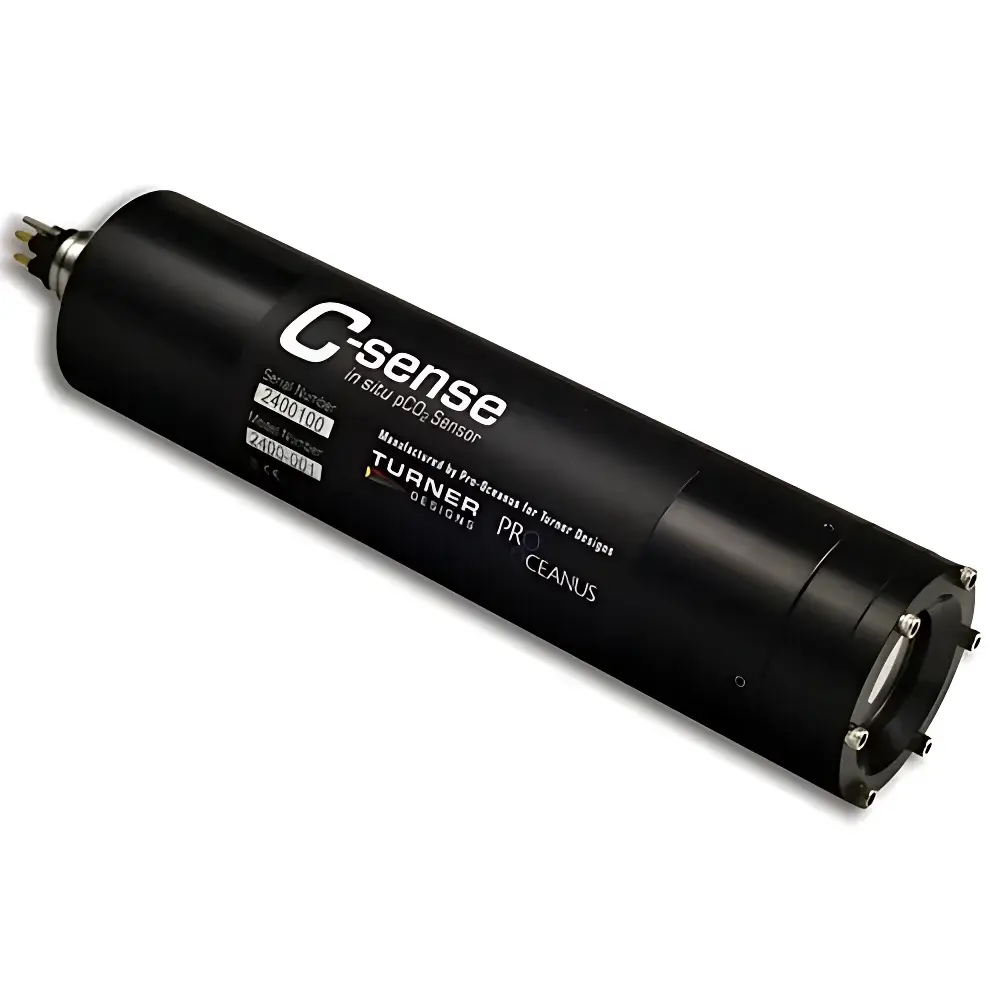
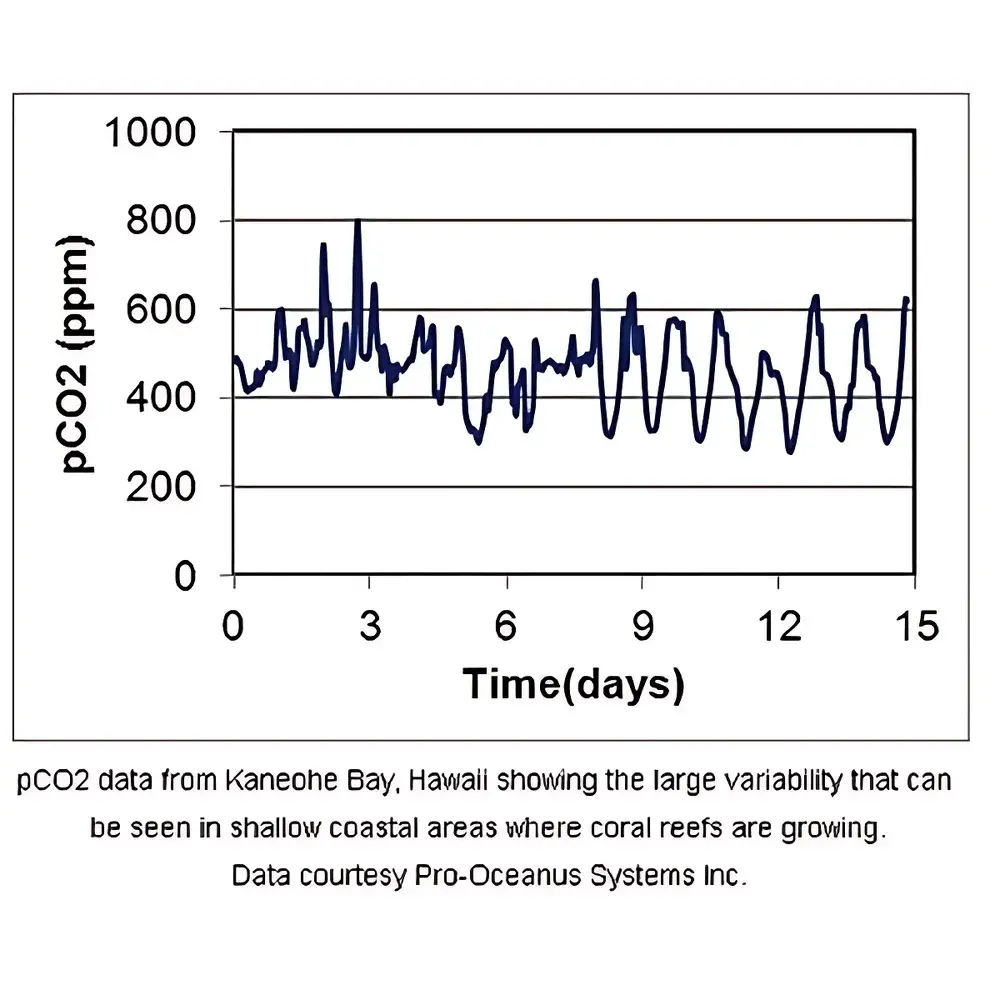
The Turner Designs C-sense Underwater pCO₂ Sensor is a compact, submersible optical sensor engineered for continuous, in-situ measurement of partial pressure of carbon dioxide (pCO₂) in aquatic environments. Utilizing non-dispersive infrared (NDIR) absorption spectroscopy, the C-sense detects CO₂ concentration by measuring the attenuation of specific infrared wavelengths (centered near 4.26 µm) as they pass through a dedicated gas-permeable membrane and internal optical path. Unlike traditional electrochemical or Severinghaus-type sensors, the C-sense eliminates drift-prone pH electrodes and liquid electrolytes—relying instead on a solid-state, temperature-compensated optical cell with no moving parts or consumables. Its design prioritizes long-term stability in dynamic marine and freshwater systems, including coral reef lagoons, estuarine zones, aquaculture tanks, and wastewater effluents. Field deployments in Kaneohe Bay, Hawaii, have demonstrated multi-month data continuity under biofouling-prone conditions—validating its suitability for ecological carbon flux studies and coastal ocean acidification monitoring.
Key Features
- Triple-range capability: Interchangeable probe modules support full-scale ranges of 1000 ppm, 2000 ppm, and 4000 ppm—enabling application-specific calibration without hardware replacement.
- Deep-water rated housing: Pressure-tolerant construction certified for continuous operation at depths up to 600 meters, with O-ring-sealed titanium or stainless-steel end caps.
- Anti-fouling copper shroud: Electrochemically integrated copper surface inhibits macrofouling (e.g., barnacles, tubeworms) and microbial biofilm accumulation without leaching biocides.
- Thermal compensation algorithm: Onboard thermistor network corrects for temperature-induced NDIR signal drift across −2 to 35 °C water temperatures.
- Low-power analog interface: 0–5 V DC output (4-pin connector) compatible with standard data loggers (e.g., Campbell Scientific CR1000X, Onset HOBO U24), requiring only 80 mA at 6 VDC during steady-state operation.
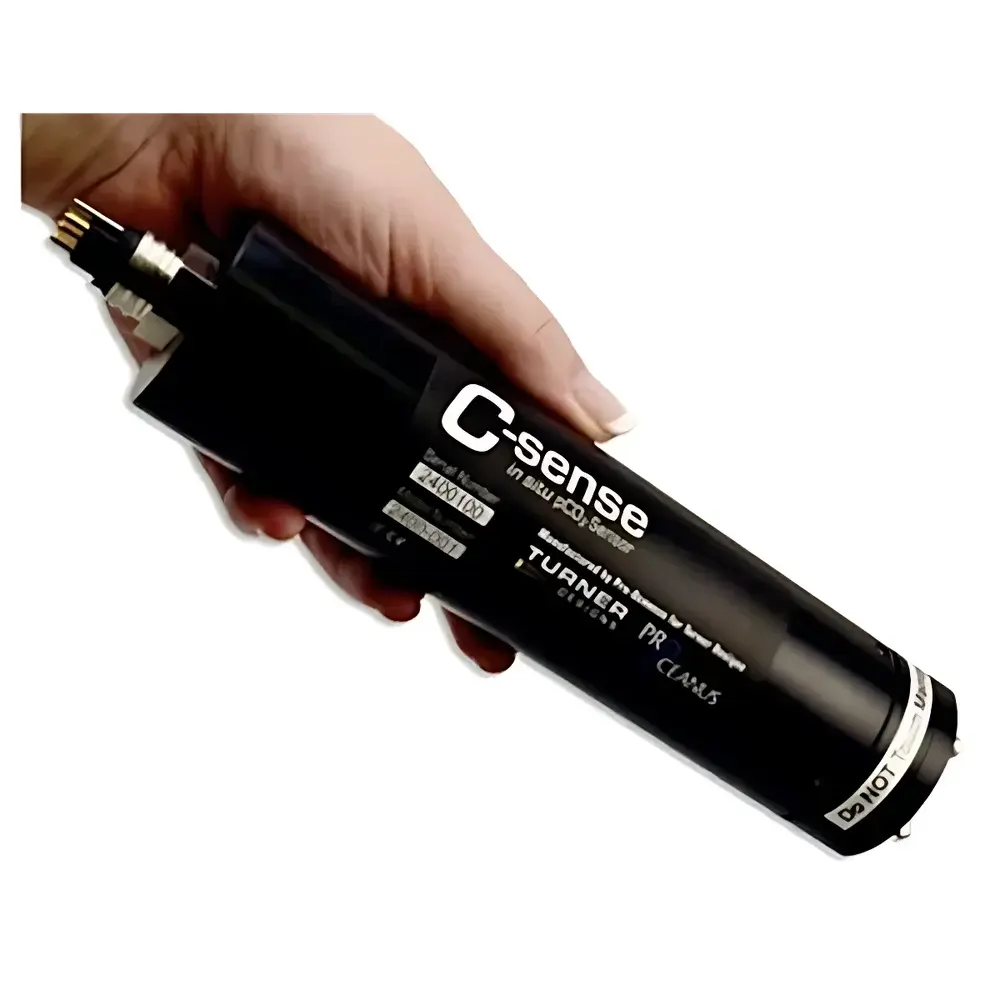
- Compact form factor: Cylindrical geometry (20.3 cm length × 5 cm diameter, 0.43 kg) minimizes hydrodynamic drag and enables integration into moorings, AUVs, ROVs, and profiling platforms.
Sample Compatibility & Compliance
The C-sense operates exclusively in liquid-phase environments where dissolved CO₂ equilibrates across a silicone rubber or polypropylene gas-permeable membrane. It is validated for use in seawater (salinity 0–40 PSU), brackish water, freshwater, and oil-in-water emulsions—provided turbidity remains below 100 NTU and suspended solids do not physically occlude the membrane surface. The sensor complies with ISO 10523 (water quality — determination of pH) for ancillary temperature reporting and meets mechanical requirements outlined in IEC 60529 (IP68 ingress protection). While not intrinsically certified for hazardous locations, its low-voltage DC operation and sealed optical path render it suitable for Class I, Division 2 marine environments per NEC Article 501. Data integrity aligns with GLP principles: timestamped analog outputs support traceable calibration logs, and field validation protocols follow ASTM D5116 (Standard Guide for Laboratory Assessment of Organic Chemicals in Environmental Media).
Software & Data Management
The C-sense delivers raw analog voltage output requiring external digitization and linearization via manufacturer-provided calibration coefficients (slope/offset per range). Turner Designs supplies comprehensive documentation—including NIST-traceable calibration certificates, membrane replacement SOPs, and temperature compensation lookup tables—for integration into custom LabVIEW, Python (PySerial), or MATLAB acquisition workflows. When paired with compliant data loggers, the system supports audit-ready metadata tagging (e.g., depth, temperature, deployment ID) and can be configured for automated zero/span verification using optional gas-permeable reference chambers. Though the sensor itself lacks onboard memory or digital communication (e.g., RS-485, SDI-12), its analog simplicity ensures compatibility with legacy infrastructure and facilitates compliance with FDA 21 CFR Part 11 when deployed within validated environmental monitoring networks featuring electronic signature and change-control workflows.
Applications
- Ocean acidification research: Long-term pCO₂ time-series in coral reef ecosystems (e.g., Kaneohe Bay, Hawaii) to quantify diel carbonate chemistry variability and calcification thresholds.
- Aquaculture process control: Real-time CO₂ monitoring in recirculating aquaculture systems (RAS) to prevent hypercapnia in sensitive finfish and larval shellfish.
- Carbon capture and storage (CCS) verification: Subsurface plume tracking near subsea injection sites via moored or towed pCO₂ arrays.
- Wastewater treatment optimization: pCO₂ trending across aerobic/anoxic zones to infer nitrification/denitrification efficiency and alkalinity demand.
- Biological carbon cycling: Coupled measurements with dissolved O₂ and pH sensors to resolve net ecosystem production (NEP) in estuaries and coastal wetlands.
- Algal biofuel cultivation: Feedback control of CO₂ sparging rates in photobioreactors based on real-time aqueous pCO₂ feedback.
FAQ
How often does the gas-permeable membrane require replacement?
Typical membrane service life is 6–12 months in clean seawater; replacement frequency increases in high-turbidity or organically enriched environments. Turner Designs provides OEM membranes and torque-spec’d installation tools.
Can the C-sense be used in oil-contaminated water?
Yes—the silicone-based membrane exhibits chemical resistance to hydrocarbons, and the copper shroud prevents adhesion of oil-associated biofilms. However, prolonged immersion in free-phase oil may reduce response time and requires post-deployment cleaning per Section 7.2 of the User Manual.
Is temperature compensation applied internally or externally?
Compensation is performed internally using a calibrated thermistor embedded adjacent to the optical cell; output voltage reflects pCO₂ corrected to 25 °C equivalent, eliminating need for post-acquisition thermal correction.
What is the warm-up time to operational stability?
Electrical stabilization occurs within 30 seconds; full thermal and optical equilibrium (±0.5% FS repeatability) is achieved within 5 minutes of power-on under ambient conditions.
Does the sensor meet regulatory requirements for environmental reporting?
While the C-sense itself is not EPA-certified as a standalone method, its performance characteristics satisfy QA/QC criteria in EPA Method 300.0 (for carbonate system parameter derivation) and are routinely accepted in NOAA PMEL and GOA-ON network submissions when deployed per documented SOPs and traceable calibration chains.







