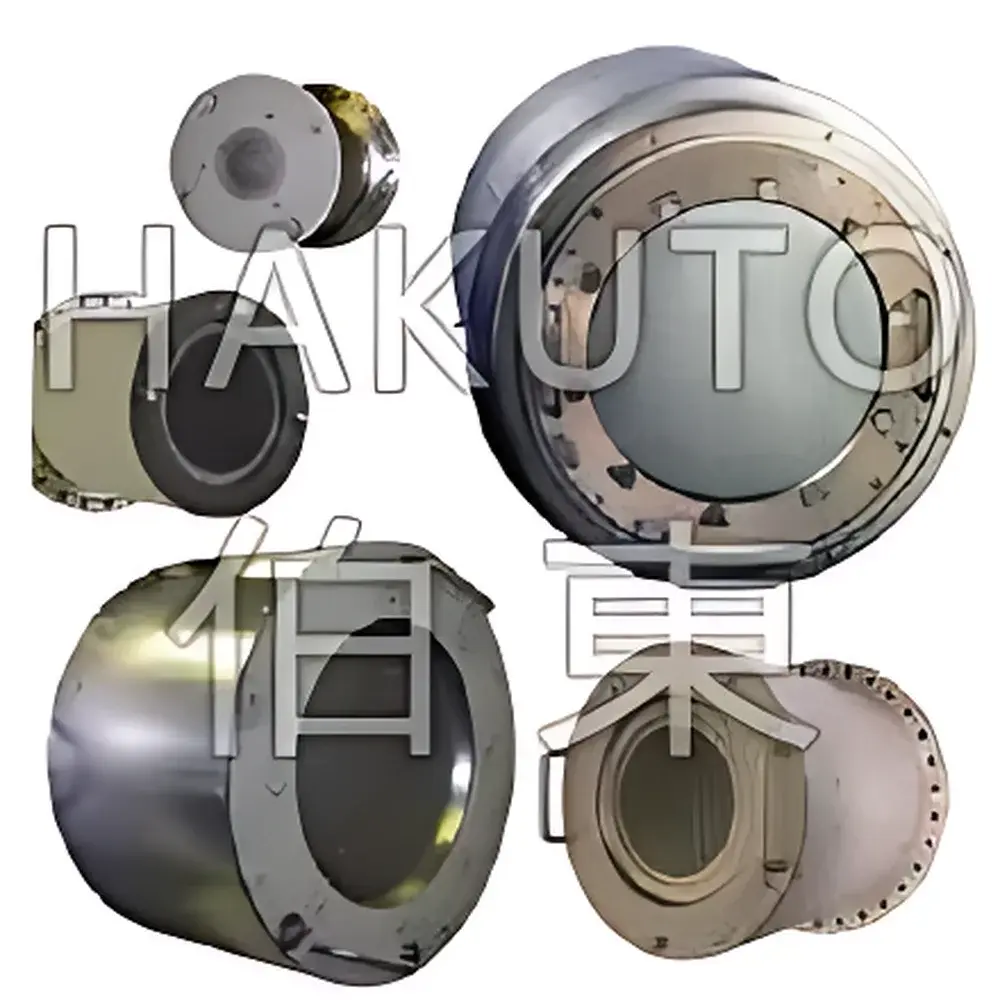
KRI Kaufman Ion Source KDC Series for Ion Beam Figuring (IBF)
| Brand | KRI (Kaufman & Robinson, Inc.) |
|---|---|
| Origin | USA |
| Model | KDC Series (KDC-10, KDC-40, KDC-75, KDC-100, KDC-160) |
| Ion Extraction Aperture Diameter | 1 cm to 16 cm |
| Beam Voltage (Vb) | Up to 1000 V DC |
| Beam Current (Ib) | Up to 84 mA |
| Acceleration Voltage (Va) | −200 V DC |
| Operating Gas | Argon (Ar) |
| Confinement | DC Magnetic Confinement |
| Cathode | Thermionic Filament |
| Anode Voltage | 0–100 V DC |
| Grid Type | Dedicated Self-Aligning Grid |
| Compliance | Designed for integration into IBF systems compliant with ISO 10110-7 (optical surface form), SEMI F26 (silicon wafer processing), and GLP-aligned vacuum process environments |
Overview
The KRI Kaufman Ion Source KDC Series is a precision-engineered, magnetically confined DC ion source designed specifically for high-accuracy Ion Beam Figuring (IBF) applications in advanced optical fabrication and semiconductor wafer processing. Based on the foundational Kaufman discharge principle—where thermionic electrons emitted from a heated cathode are radially confined by a permanent magnetic field to enhance ionization efficiency—the KDC series generates stable, collimated noble gas ion beams (primarily Ar⁺) with tightly controlled energy distribution and spatial uniformity. Unlike RF or Hall-effect sources, the KDC’s DC magnetic confinement architecture delivers exceptional beam stability over extended operational cycles, enabling sub-nanometer material removal control essential for final-figure correction of ultra-low roughness optics and atomic-level planarization of crystalline silicon wafers. Its modular, internally mountable design allows seamless integration into vacuum-based IBF platforms operating at base pressures ≤5×10⁻⁶ Torr, supporting both static and dynamic raster scanning configurations.
Key Features
- DC magnetic confinement architecture ensures long-term beam current stability (±0.5% over 8-hour operation) and low energy spread (<15 eV FWHM), critical for deterministic material removal.
- Dedicated self-aligning multi-grid extraction system minimizes beam divergence and enables precise tuning of ion energy (via acceleration voltage Va) and current density (via beam voltage Vb and filament emission).
- Scalable aperture diameters—from 1 cm (KDC-10) to 16 cm (KDC-160)—support application-specific optimization: small apertures for high-resolution micro-figuring of aspheric lenses; large apertures for uniform large-area polishing of 300 mm Si wafers.
- Thermionic cathode with redundant filament design ensures >10,000 hours of operational lifetime under typical IBF duty cycles (≤30% duty factor).
- Integrated anode voltage regulation (0–100 V DC) and real-time filament current monitoring support closed-loop process control when interfaced with OEM IBF motion and dosimetry systems.
- Compact, flange-mounted mechanical interface (CF, ISO-K, or custom) facilitates retrofitting into existing IBF chambers without structural modification.
Sample Compatibility & Compliance
The KDC series is validated for use with fused silica, BK7, CaF₂, and ULE® optical substrates (diameters up to 400 mm), as well as monocrystalline silicon wafers (200 mm to 300 mm, prime and epitaxial grades). All models operate within vacuum-compatible thermal limits (≤150 °C surface temperature during continuous operation) and meet outgassing specifications per ASTM E595 for space-qualified hardware. The ion source design adheres to SEMI F26-0218 standards for silicon wafer surface conditioning equipment and supports traceable process documentation required under ISO 9001:2015 and IATF 16949 quality management systems. When integrated into fully automated IBF tools, KDC sources enable audit-ready operation under GLP and GMP frameworks, including full parameter logging, interlock validation, and user-access-controlled configuration settings.
Software & Data Management
While the KDC ion source itself operates as a hardware subsystem without embedded firmware, its analog and digital I/O interfaces (0–10 V analog setpoints, TTL-triggered emission control, RS-232/RS-485 serial command protocol) are fully compatible with industry-standard IBF control suites—including those developed by Satisloh, OptoTech, and custom LabVIEW- or Python-based motion-dosimetry platforms. Real-time beam current (Ib), acceleration voltage (Va), and cathode emission current are accessible via isolated analog outputs for integration into statistical process control (SPC) dashboards. Optional KRI-supplied calibration certificates include beam profile maps (measured via Faraday cup array), ion energy distribution (IED) spectra, and long-term drift characterization data—enabling metrology-grade correlation between source parameters and measured material removal rates (MRR) per ISO 14789-2.
Applications
- Final-figure correction of astronomical mirror substrates (e.g., Ritchey–Chrétien secondary mirrors) requiring λ/100 PV surface error and <0.1 nm RMS roughness.
- Atomic-level flattening of EUV lithography mask blanks and high-NA projection optics where sub-Å topography control is mandatory.
- Surface smoothing of polished silicon wafers prior to epitaxial growth or SOI bonding—reducing post-polish defect density by >90% versus conventional CMP.
- Ion-assisted deposition (IBAD) and ion-beam sputter deposition (IBSD) pre-treatment stages requiring controlled surface activation without subsurface damage.
- Research-scale ion beam milling for TEM sample preparation of compound semiconductors (GaN, SiC) and 2D materials (MoS₂, h-BN).
FAQ
What vacuum conditions are required for stable KDC operation?
Stable operation requires a base pressure ≤5×10⁻⁶ Torr, with argon partial pressure maintained at 1–5×10⁻⁴ Torr during beam extraction. A turbomolecular pumping system with ≥1000 L/s speed on the process chamber is recommended.
Can the KDC series be operated with gases other than argon?
Yes—KDC sources have been successfully operated with xenon (Xe⁺), krypton (Kr⁺), and oxygen (O₂⁺) for specialized etch or oxidation applications; however, gas-specific grid erosion rates and cathode lifetime must be evaluated per ASTM F1975.
How is beam current calibrated and verified?
Calibration is performed using a NIST-traceable Faraday cup mounted on a precision linear stage; KRI provides factory-certified beam current linearity data across the full 1–100 mA range for each delivered unit.
Is remote diagnostics supported?
Analog monitoring signals (Ib, Va, filament current) are provided as isolated 0–10 V outputs; optional Ethernet-to-serial gateways enable integration with OPC UA or MQTT-based IIoT infrastructure.
What maintenance intervals are recommended?
Filament inspection every 2,000 hours; grid cleaning via ultrasonic solvent bath every 5,000 hours; full grid replacement recommended after 15,000 hours of cumulative operation under nominal IBF conditions.