
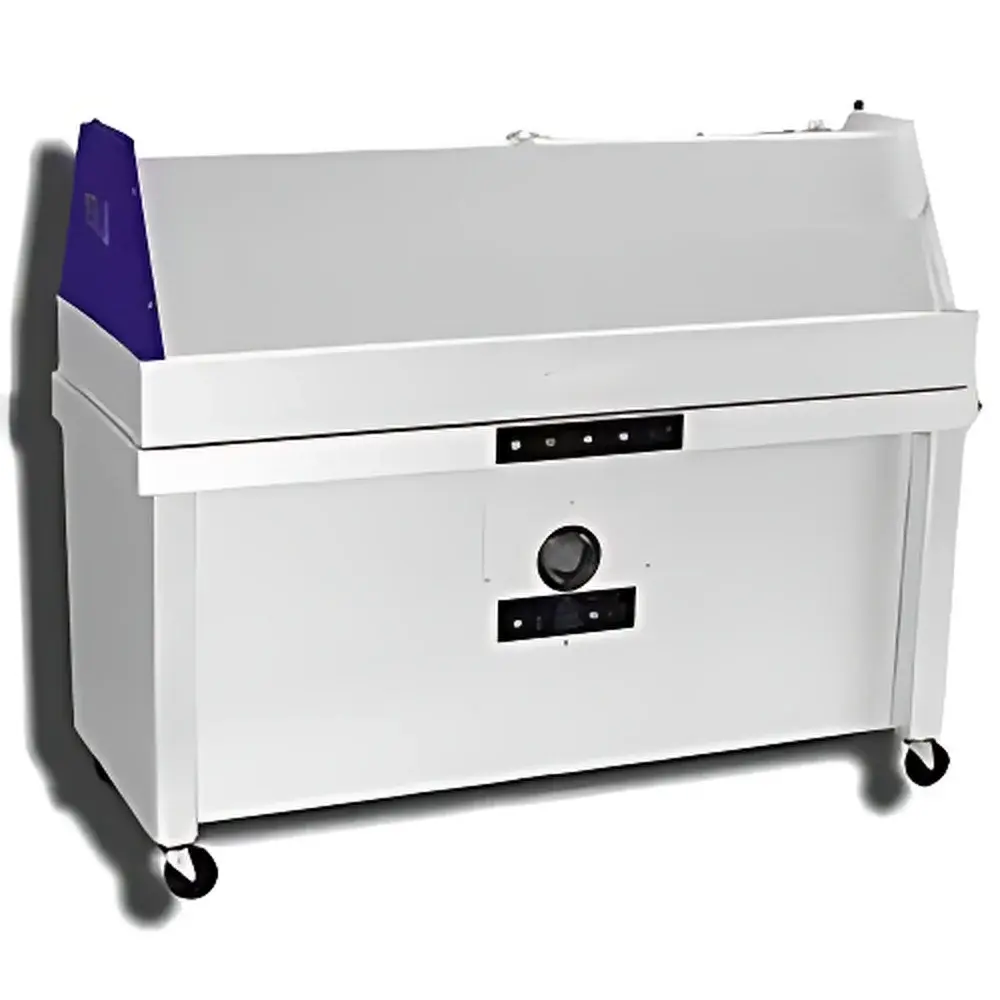
Q-Lab QCT Condensation Test Chamber
| Brand | Q-LAB |
|---|---|
| Origin | USA |
| Manufacturer Type | Authorized Distributor |
| Origin Category | Imported |
| Model | Q-Lab QCT |
| Pricing | Upon Request |
Overview
The Q-Lab QCT Condensation Test Chamber is an engineered environmental test system designed to replicate and accelerate the damaging effects of natural dew formation on materials exposed outdoors. Unlike conventional humidity chambers that rely on saturated air or steam injection, the QCT employs a precisely controlled 100% condensing humidity environment—generated exclusively through surface cooling and ambient air contact—mimicking the physicochemical conditions of nocturnal dew deposition. Dew forms when a substrate cools below the dew point of surrounding air, causing water vapor to condense as pure, oxygen-saturated liquid. This “active moisture” drives electrochemical corrosion in metals, hydrolytic degradation in polymers, blistering in coatings, and microbial growth on organic substrates. Field studies indicate that many outdoor materials experience dew exposure for approximately 12 hours per day—making condensation a dominant aging factor often overlooked in standard UV or thermal cycling tests. The QCT operates without humidifiers, boilers, or deionized water systems; its distilled-quality condensate is formed via evaporative purification during the condensation cycle, requiring only standard tap water supply.
Key Features
- 100% condensing humidity generation via air-cooled sample surfaces—no steam generators, ultrasonic misters, or complex humidification subsystems
- Temperature range: ambient +5°C to 70°C, enabling precise control of condensate temperature and dew-point differential
- Programmable exposure cycles: continuous condensation, alternating wet/dry phases, or user-defined thermal-humidity profiles
- Zero-impact footprint: heat and moisture output comparable to a single human occupant—no dedicated exhaust ducting or HVAC load compensation required
- Direct-access sample tray design permits real-time inspection and substitution of specimens without interrupting test continuity or chamber equilibrium
- Compact benchtop form factor (W×D×H: 610 × 610 × 660 mm) suitable for laboratories, quality control rooms, and production floor environments
Sample Compatibility & Compliance
The QCT accommodates flat-panel specimens up to 150 mm × 300 mm × 25 mm (thickness), including coated metals, painted panels, wood composites, elastomers, and architectural finishes. Its operational methodology aligns with internationally recognized standards for condensation resistance evaluation, including ASTM D4585 (“Standard Practice for Determining Resistance of Organic Coatings to Condensation Humidity”), ISO 6270-1 (“Paints and Varnishes — Condensation Resistance Testing — Part 1: Continuous Condensation Method”), and BS 3900-F9 (“Methods of Test for Paints — Determination of Resistance to Moisture — Condensation Method”). These standards mandate controlled surface cooling, defined temperature differentials between chamber air and specimen, and unambiguous documentation of condensate formation dynamics—all inherently satisfied by the QCT’s thermoelectric cooling architecture and closed-loop thermal management.
Software & Data Management
The QCT operates via an integrated microprocessor controller with non-volatile memory for cycle storage and event logging. All exposure parameters—including setpoint temperature, dwell time, cycle count, and real-time chamber temperature—are timestamped and retained for post-test traceability. While the base model does not include PC connectivity or cloud-based reporting, its control logic supports GLP-compliant recordkeeping: users may export logs manually via USB interface (optional accessory) and archive them alongside test reports in accordance with 21 CFR Part 11 requirements for electronic records. Audit trails are maintained for all parameter modifications, ensuring full accountability during internal QA audits or regulatory inspections.
Applications
- Evaluation of blister resistance in screen-printed inks at 55°C over extended durations (≥7 days)
- Assessment of oil-based rust inhibitors under accelerated condensation at 38°C for 120-hour exposures
- Monitoring surface energy shifts on cold-rolled and galvanized steel substrates at hourly intervals
- Testing moisture-induced delamination and mold susceptibility in wood veneer finishes
- Correlation studies between QCT-generated condensation damage and field-exposed reference panels per ISO 11341
- Pre-screening of coating formulations prior to full-scale QUV or Q-SUN outdoor correlation trials
FAQ
Does the QCT require deionized or distilled water?
No. Tap water is sufficient—the condensation process inherently purifies water through phase-change distillation, eliminating dissolved ions and particulates.
Can freeze-thaw cycles be performed within the QCT?
The QCT itself does not provide freezing capability; however, specimens can be manually transferred from the condensing chamber to a freezer while still wet, then reinserted—enabling standardized freeze-thaw protocols per ASTM D6603.
Is the QCT compliant with ISO/IEC 17025 calibration requirements?
Yes. Temperature sensors are NIST-traceable and factory-calibrated; users may perform periodic verification using accredited external probes per ISO/IEC 17025 Clause 6.5.
What maintenance is required for long-term reliability?
Routine cleaning of the condenser coil and water reservoir every 90 days; annual inspection of thermal interface integrity between cooling plate and sample holder.
How does the QCT differ from a standard humidity chamber?
Standard chambers maintain relative humidity via humidification; the QCT generates pure condensate via controlled surface cooling—producing chemically active, oxygen-rich water films rather than bulk humid air.



