
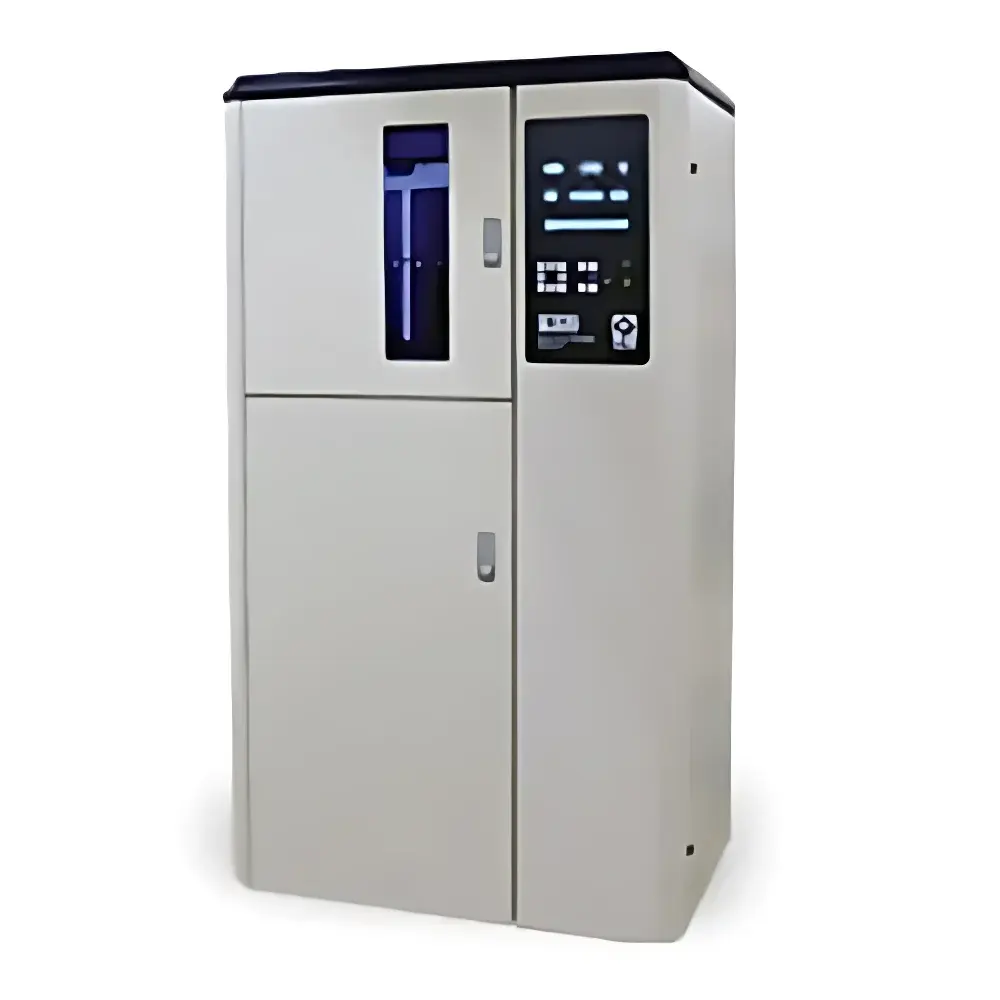
Q-LAB Q-SUN B02 Rotating Drum Xenon Arc Weathering Test Chamber
| Brand | Q-LAB |
|---|---|
| Origin | USA |
| Manufacturer Type | Authorized Distributor |
| Product Origin | Imported |
| Model | Q-LAB B02 |
| Xenon Lamp Power | 1800 W (air-cooled) |
| Irradiance Range | ≤1800 W/m² |
| Light Exposure Duration | 1–9999 h (continuously adjustable) |
| Humidity Control | Integrated RH system (range per ISO 105-B02 and AATCC TM16 specifications) |
| Sample Capacity | 31 AATCC specimens (46 × 264 mm each), total exposure area: 1882 cm² |
| Lamp Life | ~1500 hours |
| Calibration Compliance | NIST-traceable, ISO/IEC 17025 accredited (A2LA Cert. #2382-01, #2383-02, #2383-03) |
Overview
The Q-LAB Q-SUN B02 Rotating Drum Xenon Arc Weathering Test Chamber is a purpose-built instrument engineered for precise, repeatable colorfastness and light stability evaluation in textile and dyed material testing. It operates on the principle of xenon arc irradiation—simulating full-spectrum sunlight (290–800 nm) with spectral power distribution closely aligned to terrestrial solar radiation under standard atmospheric conditions. Its rotating drum configuration ensures uniform angular exposure across all specimens, minimizing positional bias and enhancing inter-sample reproducibility. Designed specifically to meet the stringent geometric and operational requirements of ISO 105-B02 (Textiles — Tests for colour fastness — Part B02: Colour fastness to artificial light: Xenon arc fading lamp test), the B02 chamber delivers traceable, standards-compliant accelerated aging under controlled irradiance, temperature, and relative humidity. Though superseded in production by the more versatile Q-SUN Xe-2 platform, the B02 remains widely deployed in global textile laboratories for legacy method compliance and regulatory audit continuity.
Key Features
- Air-cooled 1800 W xenon arc lamp assembly—eliminates water cooling infrastructure, reducing installation complexity, maintenance frequency, and long-term operational cost.
- Rotating drum sample holder with 16 fixture positions; accommodates up to 31 AATCC-standard specimens (46 × 264 mm), yielding a total exposed surface area of 1882 cm².
- Modular optical filtration system comprising an outer high-borosilicate quartz cylinder and dual-layer internal filter sets: Window-B/SL (per AATCC TM16) or Window-IR (per ISO 105-B02 and ISO 4892-2), enabling precise spectral cutoff and thermal load management.
- Integrated black panel temperature sensor (insulated or non-insulated variants available), calibrated using the CT202 reference thermometer—traceable to NIST and compliant with ISO 105-B02 temperature monitoring protocols.
- SunEye irradiance sensor with selectable spectral response (420 nm or 300–400 nm TUV), calibrated via CR20 handheld radiometer—ensuring consistent irradiance control within ±5% of setpoint over time.
- User-accessible lamp and filter replacement: lamp access from top panel; single connector disconnect, two retaining screws, and quick-release housing enable lamp exchange in under 5 minutes without tools.
Sample Compatibility & Compliance
The Q-SUN B02 supports standardized textile mounting configurations per multiple international frameworks: ISO 105-B02 (Methods 1 and 2), AATCC TM16-3, and ISO 4892-2. Compatible accessories include full-height and half-height textile masks (XR-11168-K, XR-11316-K, XR-11369-K, XR-11376-K), frame-type holders (XR-11273-K, XR-11315-K), blue wool reference specimen holders (XR-11368-K), and paper-based AATCC masks (XR-11229-K). All fixtures maintain strict dimensional conformity to standard test protocols. The chamber’s environmental control system meets humidity stability requirements defined in ISO 105-B02 (typically 65 ± 5% RH during irradiation cycles) and supports optional condensation cycles per ASTM G154 or ISO 4892-3 when configured with auxiliary moisture delivery. Full compliance documentation—including calibration certificates, filter spectral transmission reports, and lamp spectral output data—is supplied with each unit and archived per GLP/GMP record retention guidelines.
Software & Data Management
The Q-SUN B02 operates via front-panel digital interface with dedicated firmware optimized for textile-specific test sequences. While lacking networked software, its embedded controller logs real-time irradiance (W/m²), black panel temperature (°C), chamber RH (%), and elapsed exposure time (h) with timestamped event markers. All parameters are stored internally for post-test download via USB interface. Calibration records—including SunEye sensor verification and black panel thermistor validation—are managed through Q-Lab’s standardized recalibration procedure (LW-6008), which mandates annual return to Q-Lab’s ISO/IEC 17025-accredited calibration laboratory. Traceability to NIST standards is maintained across all measurement chains, satisfying FDA 21 CFR Part 11 audit readiness requirements for electronic records when paired with appropriate lab SOPs and metadata logging practices.
Applications
Primary applications include colorfastness assessment of woven and knitted textiles, dye intermediates, printing inks, automotive interior fabrics, and coated synthetic fibers. The B02 is routinely employed in QC/QA labs supporting ISO 9001-certified manufacturing, third-party certification bodies validating OEKO-TEX® Standard 100 claims, and R&D departments developing UV-stabilized polymer blends. Its reproducible irradiance profile supports comparative ranking of pigment performance, evaluation of photostabilizer efficacy, and correlation studies with outdoor exposure sites (e.g., Arizona or Florida natural weathering racks). Due to its fixed spectral filtering architecture and drum geometry, it is especially valued for method equivalence testing where historical data continuity is essential—such as long-term supplier qualification programs governed by ISO/TS 16949 or IATF 16949.
FAQ
What standards does the Q-SUN B02 explicitly support?
ISO 105-B02 (all variants), AATCC TM16-3, and ISO 4892-2. It does not support cyclic UV/condensation protocols (e.g., ASTM G154) without hardware modification.
Is the B02 still manufactured by Q-Lab?
No—production ceased in 2019. Q-Lab now offers the Q-SUN Xe-2 as its current-generation rotating drum xenon chamber with expanded spectral flexibility and software connectivity.
Can the B02 be upgraded to Xe-2 functionality?
No. The B02 and Xe-2 share no interchangeable components beyond consumables (lamps, filters); upgrade requires full system replacement.
How often must the irradiance sensor be recalibrated?
Annually, using the CR20 calibrator and returning the sensor to Q-Lab’s A2LA-accredited lab—traceable to NIST primary standards.
What is the recommended maintenance interval for RH sensors?
Relative humidity and ambient air temperature sensors should be replaced annually; they are not field-calibratable due to inherent drift characteristics.



