
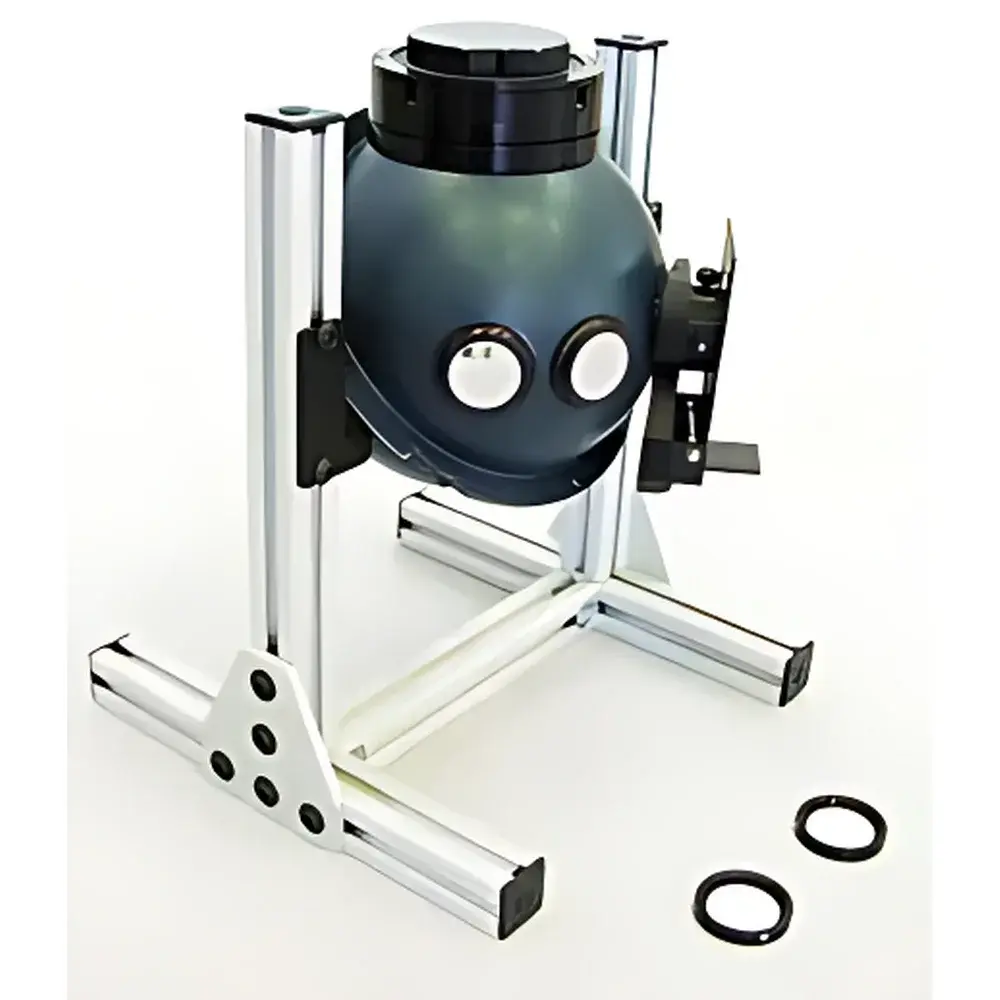
Labsphere RT-060-SF / RT-060-IG and RTC-060-SF / RTC-060-IG Reflectance & Transmittance Integrating Spheres
| Brand | Labsphere |
|---|---|
| Origin | USA |
| Model | RT-060-SF, RT-060-IG, RTC-060-SF, RTC-060-IG |
| Coating Options | Spectraflect® (300–2400 nm), Infragold® (0.7–20 µm) |
| Port Configuration | Five 1-inch ports (RT) |
| Detector Port | 0.5-inch (top-mounted for RT, bottom-mounted for RTC) |
| Mirror Trap | Integrated specular beam trap |
| Sample Mounting | Adjustable center-stage (RTC), dual 1-inch sample holders (RT), optional jaw-type / clamp-type / slot-type fixtures |
| Compliance | Designed for ASTM E1331, ISO 9050, CIE No. 15, USP <857>, and GLP/GMP-aligned measurement workflows |
Overview
The Labsphere RT- and RTC-series integrating spheres are precision optical measurement platforms engineered for absolute reflectance and transmittance characterization of solid, liquid, and particulate samples across ultraviolet, visible, and near-to-mid infrared spectral ranges. Based on the fundamental principle of diffuse light integration—where incident radiation is uniformly scattered by a highly reflective, Lambertian inner coating—the spheres enable high-reproducibility photometric quantification under controlled geometric conditions. The RT configuration supports standard 9°/d (diffuse) and 9°/h (hemispherical) measurement geometries per ASTM E1331 and ISO 9050, while the RTC variant extends capability to variable-angle incidence studies, enabling angular-resolved bidirectional reflectance distribution function (BRDF) and bidirectional transmittance distribution function (BTDF) analysis. Internal coatings—Spectraflect® (300–2400 nm) and Infragold® (0.7–20 µm)—are spectrally optimized to maintain >98% diffuse reflectance over their respective bands, minimizing wavelength-dependent bias and ensuring traceable calibration against NIST-traceable standards.
Key Features
- Modular port architecture: Five precisely machined 1-inch ports (RT series) or three 1-inch + two 1.25-inch ports (RTC series) accommodate collimated source input, reference beam routing, sample insertion, and auxiliary diagnostics.
- Dual-coating compatibility: Interchangeable Spectraflect® (UV-VIS-NIR) and Infragold® (NIR-MIR) coatings allow seamless spectral domain adaptation without hardware replacement.
- Specular component management: Integrated mirror trap eliminates specularly reflected energy from the detection path, enabling true diffuse-only reflectance measurement in compliance with ISO 9050 Annex B.
- Center-stage flexibility (RTC only): Motorizable or manually adjustable center-mount platform supports angular rotation from 0° to 85° incidence, with ±0.1° mechanical resolution and repeatable positioning for BRDF mapping.
- Minimized vignetting design: Knife-edge port geometry and low-profile baffles maximize effective wall coverage (>92% visible surface area), ensuring high sphere efficiency (η > 0.95) and minimal measurement uncertainty due to port loss.
- Detector field-of-view control: Removable 0.5-inch aperture shields limit detector acceptance angle to <5°, suppressing stray light and improving signal-to-noise ratio in low-flux applications.
Sample Compatibility & Compliance
These spheres accommodate rigid solids (e.g., coated glass, polymer films, anodized metals), flexible thin films (PET, ITO, OLED substrates), turbid liquids (suspensions, emulsions), and powdered media (pigments, pharmaceutical excipients). Jaw-type, clamp-type, and slot-type sample holders support dimensional ranges from 1″ × 2″ × 0.38″ (rigid) to 1.5″ × 2″ × 0.125″ (flexible) and 12.5 mm² volumetric containers for loose materials. All configurations comply with ASTM E1331 (reflectance/transmittance of opaque/transparent materials), ISO 9050 (optical properties of glazing), CIE Publication 15 (colorimetry), and USP (spectrophotometric absorbance validation). Data acquisition workflows align with FDA 21 CFR Part 11 requirements when paired with validated software, supporting audit trails, electronic signatures, and instrument qualification documentation (IQ/OQ/PQ).
Software & Data Management
When integrated with Labsphere’s TruCal™ or third-party spectrometers (e.g., Ocean Insight, Avantes, Hamamatsu), the spheres interface via USB/RS-232 or Ethernet protocols. Measurement sequences—including dark correction, reference normalization, multi-angle sweeps, and spectral averaging—are programmable through Python API or LabVIEW drivers. Raw data export supports CSV, HDF5, and XML formats, preserving metadata such as coating type, port configuration, detector gain, and timestamped calibration history. For regulated environments, optional 21 CFR Part 11-compliant software modules provide role-based access control, immutable audit logs, and electronic record retention aligned with GLP and GMP quality systems.
Applications
- Optical coating R&D: Quantifying anti-reflective, high-reflective, and dichroic film performance across AOI and wavelength.
- Display & lighting QA: Measuring luminous transmittance of touchscreens, OLED encapsulation layers, and diffuser plates.
- Pharmaceutical packaging: Validating UV barrier efficacy of blister foils and amber vials per USP .
- Photovoltaic materials: Characterizing spectral absorptance and haze factor of AR-coated solar glass and textured silicon wafers.
- Remote sensing calibration: Providing stable, spatially uniform sources for satellite sensor ground-truth validation.
- Academic spectroscopy: Supporting teaching labs in radiometry, color science, and scattering theory with reproducible, geometry-defined measurements.
FAQ
What is the difference between RT and RTC sphere configurations?
The RT series supports fixed-angle (9°) illumination with selectable diffuse or hemispherical collection; the RTC adds a motorized or manual center-stage for continuous angular variation of incident light, enabling BRDF/BTDF mapping.
Can the same sphere be used for both UV-VIS and NIR-MIR measurements?
No—coating selection is wavelength-specific. Spectraflect® must be used for 300–2400 nm; Infragold® is required for 0.7–20 µm. Physical re-coating is necessary to switch spectral domains.
How is stray light minimized during measurement?
Through knife-edge port geometry, low-profile internal baffles, detector field-limiting apertures, and the integrated specular trap—all designed to reduce non-integrated path contributions to <0.3% of total signal.
Is NIST-traceable calibration included with purchase?
Labsphere provides factory calibration certificates with each sphere, referencing NIST-traceable reflectance standards (e.g., SRM 2036) at specified wavelengths; full calibration kits (including standards and holder fixtures) are available as optional accessories.
What sample thickness limitations apply for transmittance measurements?
No inherent thickness limit exists; however, optical density must remain within the dynamic range of the detection system. For highly absorbing or scattering samples, signal-to-noise optimization may require integration time adjustment or detector gain calibration.





