
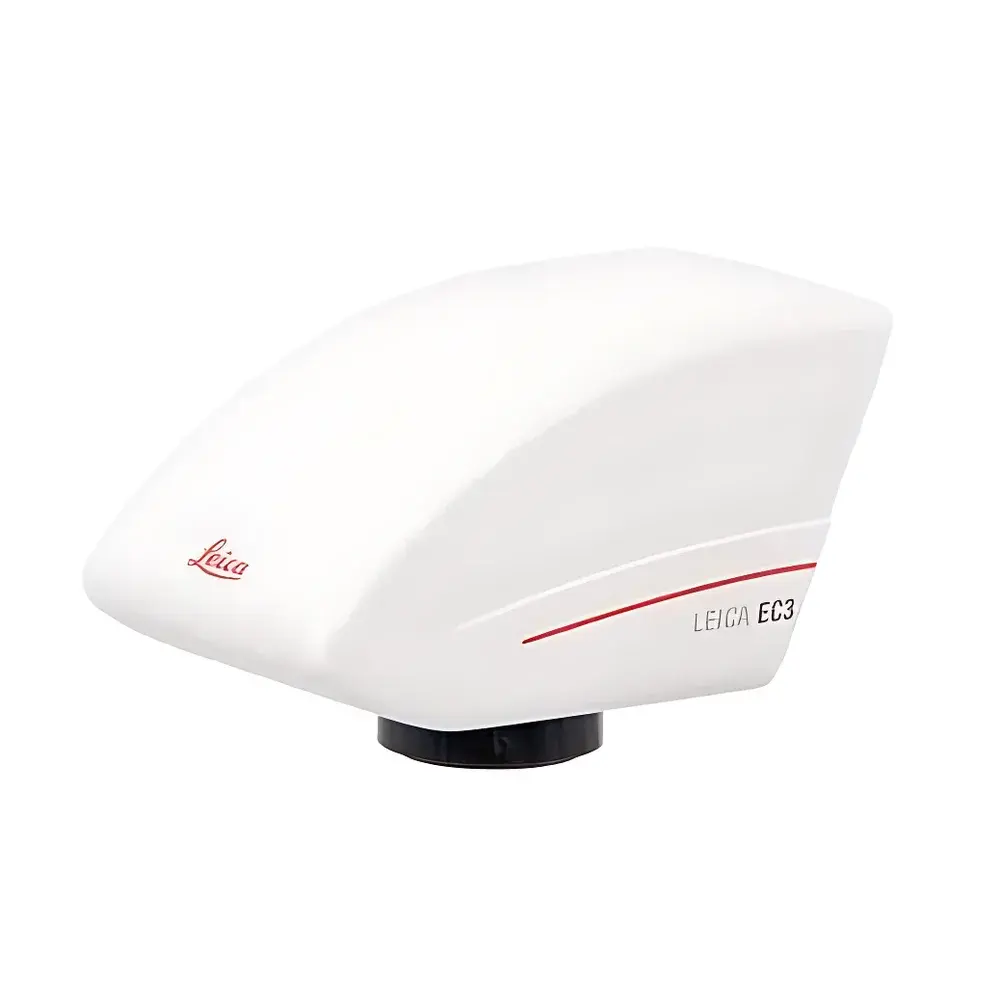
Leica EC3 Microscope Camera
| Brand | Leica |
|---|---|
| Origin | Germany |
| Model | EC3 |
| Sensor Resolution | 3.1 MP (Color CMOS) |
| Frame Rate | Up to 15 fps (progressive scan) |
| Interface | USB 2.0 |
| Mount | C-mount |
| Software Compatibility | Leica Application Suite (LAS) X, Windows/macOS |
| Target Use | Educational microscopy, routine light microscopy documentation |
Overview
The Leica EC3 Microscope Camera is a purpose-engineered digital imaging solution designed for integration with upright, inverted, and stereo microscopes equipped with standard C-mount adapters. Built upon a high-sensitivity 3.1-megapixel color CMOS sensor, the EC3 delivers consistent, low-noise image acquisition under variable illumination conditions typical of teaching laboratories and entry-level research environments. Its optical design follows the principles of direct-coupled digital imaging—capturing light transmitted or reflected through microscope optics without intermediate film or analog conversion—ensuring faithful color reproduction and spatial fidelity across magnifications from 4× to 100×. The camera operates on a progressive-scan architecture, eliminating interlacing artifacts and enabling real-time visualization at up to 15 frames per second—a critical capability for dynamic focus adjustment, stage navigation, and live demonstration during undergraduate histology, microbiology, or materials science instruction.
Key Features
- 3.1-megapixel color CMOS sensor optimized for visible-light spectrum (400–700 nm), delivering balanced chromatic response and minimal fixed-pattern noise
- Real-time progressive-scan output at 15 fps at full resolution, supporting responsive focusing and rapid sample surveying
- Integrated auto-exposure, auto-gamma, auto-saturation, and auto-black level controls—reducing operator dependency while maintaining repeatability across users
- C-mount mechanical interface compliant with ISO 8039 standards, ensuring compatibility with Leica DM, DMI, DMIL, S-series, and M-series microscopes, as well as third-party systems featuring standardized C-mount ports
- USB 2.0 interface with plug-and-play functionality on Windows 10/11 and macOS 12+; no external power supply required—powered entirely via bus
- On-screen annotation tools including text overlays, scale bars (calibratable in µm or mm), crosshairs, and ROI markers—enabling immediate preparation of didactic materials and lab reports
Sample Compatibility & Compliance
The EC3 supports transmission brightfield, phase contrast, and basic polarized light imaging modalities when paired with appropriate microscope configurations. It is routinely deployed in GLP-aligned teaching labs where traceability and consistency are prioritized over quantitative metrology. While not certified for FDA 21 CFR Part 11 compliance out-of-the-box, its integration with Leica LAS X software enables audit-trail-enabled acquisition logs—including timestamped metadata (exposure time, gain, white balance settings), user ID tagging, and image hash generation—supporting institutional requirements for educational record integrity. The device complies with CE marking directives (2014/30/EU EMC and 2011/65/EU RoHS), and meets IEC 61000-6-3 emission limits for laboratory-grade electronic instrumentation.
Software & Data Management
The EC3 is natively supported by Leica Application Suite (LAS) X v3.7+, offering intuitive workflow-driven acquisition, multi-channel overlay (for sequential RGB capture), batch export (TIFF, JPEG, PNG, BMP), and embedded calibration management. All acquired images retain EXIF-like metadata—including objective magnification, microscope model, date/time stamp, and sensor exposure parameters—facilitating reproducible documentation across academic cohorts. Exported datasets are compatible with common third-party analysis platforms such as ImageJ/Fiji, MATLAB Image Processing Toolbox, and Python-based OpenCV pipelines. No proprietary codec or locked file format is used; raw pixel data is accessible in 8-bit or 12-bit linear mode depending on host software configuration.
Applications
- Undergraduate life sciences education: histological section analysis, blood smear evaluation, protozoan motility observation, and plant tissue morphology
- Veterinary and agricultural training labs: parasite identification, grain structure assessment, and seed viability documentation
- Materials science instruction: metallographic grain boundary mapping, polymer phase separation visualization, and thin-film interference pattern recording
- Quality control in technical colleges: solder joint inspection, PCB trace verification, and fiber optic connector end-face analysis
- Remote learning infrastructure: live streaming of microscope feeds via OBS Studio or Zoom screen sharing using USB UVC-class video output mode
FAQ
Is the EC3 compatible with non-Leica microscopes?
Yes—the C-mount interface conforms to ISO 8039 mechanical specifications and is mechanically and optically compatible with most major brands (Olympus, Nikon, Zeiss, Meiji, Motic) provided the microscope includes a standardized trinocular port with C-mount adapter.
Does the EC3 support hardware triggering or external shutter control?
No—this model lacks TTL trigger input or GPIO functionality. It operates exclusively in free-run or software-triggered acquisition mode.
Can I perform quantitative intensity measurements with the EC3?
While the EC3 provides linear 12-bit output in LAS X, it does not include factory-calibrated radiometric correction or NIST-traceable flat-field compensation. Quantitative intensity analysis requires empirical calibration against reference standards and is recommended only for relative comparisons within controlled experimental sets.
What is the maximum cable length supported for stable USB 2.0 operation?
For guaranteed signal integrity and frame-rate stability, use a high-quality shielded USB 2.0 cable ≤ 3 meters in length. Active extension solutions (e.g., powered USB hubs or optical extenders) may be employed beyond this distance but require validation in situ.
Is firmware update capability available?
Firmware updates are distributed exclusively through Leica’s official support portal and applied via LAS X software—no standalone updater is provided. Updates typically address USB enumeration stability, color matrix refinement, and compatibility with newer OS versions.




