
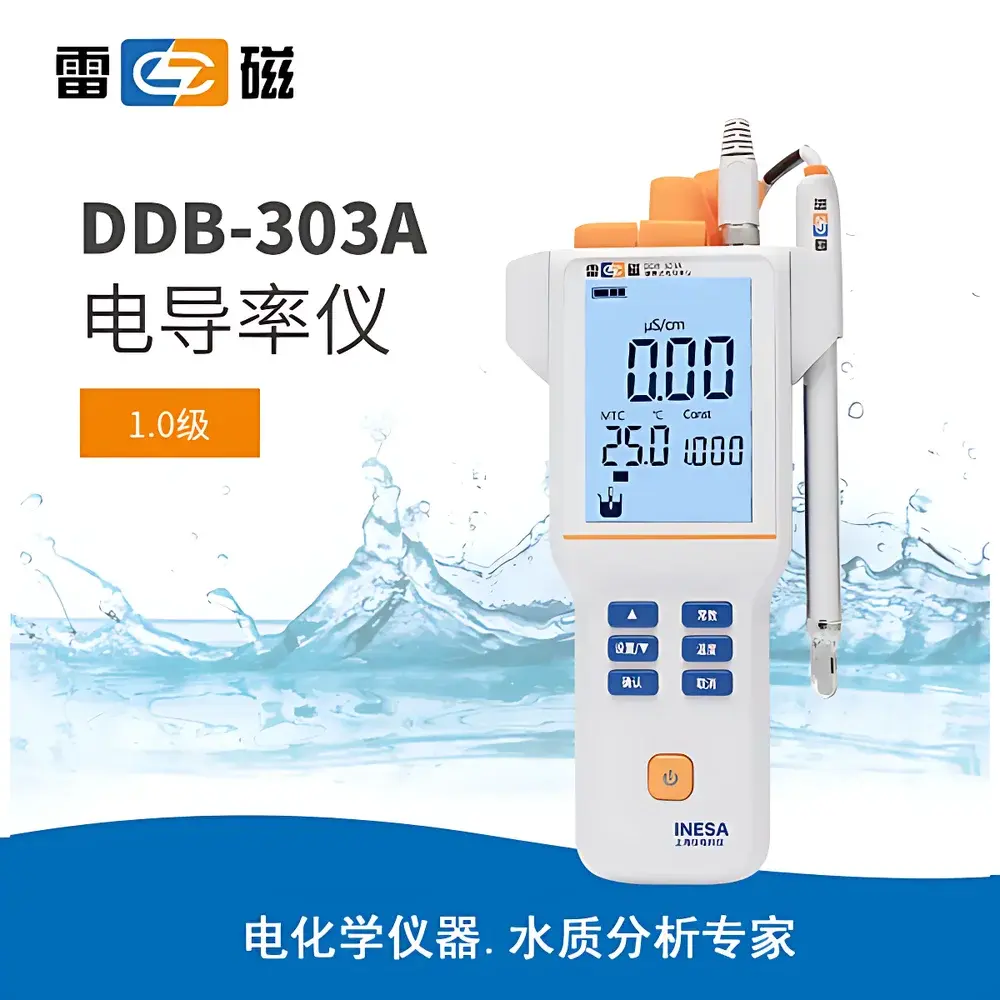
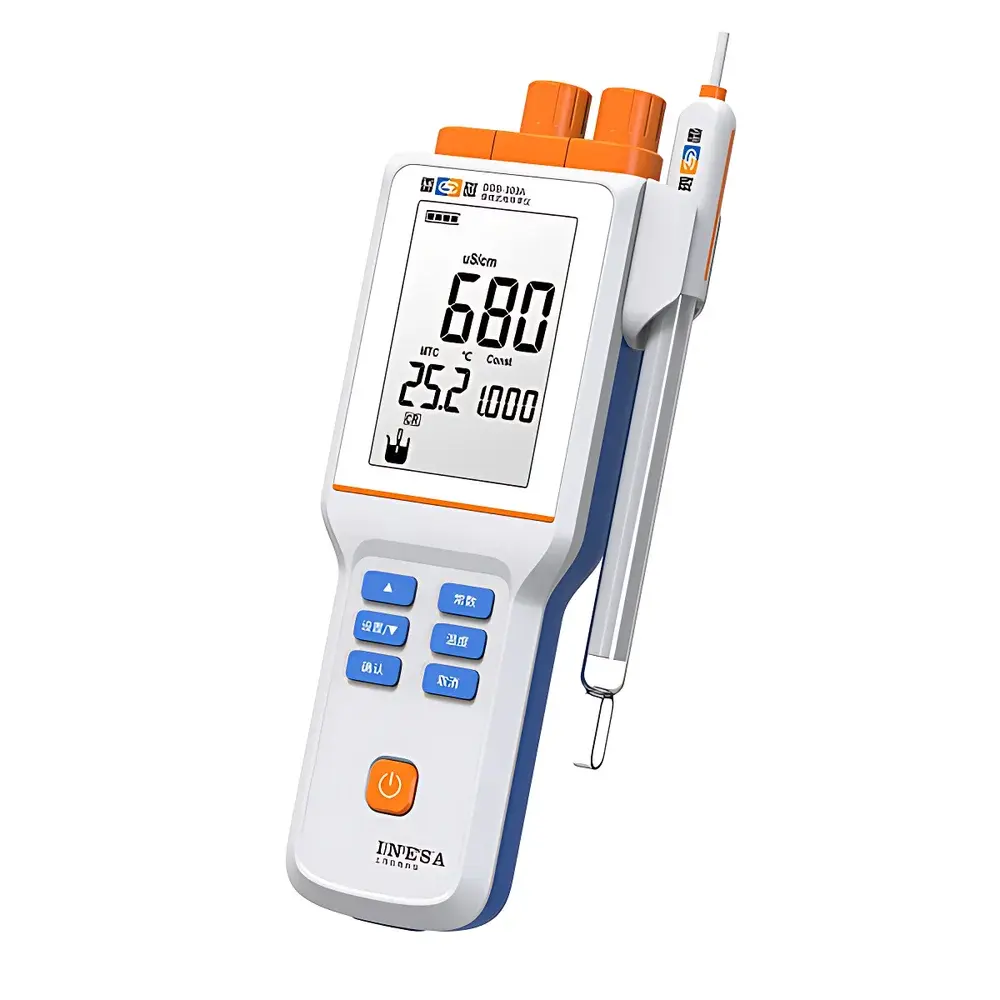
Leici DDB-303A Portable Conductivity Meter
| Brand | Leici |
|---|---|
| Origin | Shanghai, China |
| Manufacturer Type | Authorized Distributor |
| Country of Origin | China |
| Model | DDB-303A |
| Price | USD 205 (FOB Shanghai) |
| Measurement Parameters | Conductivity only |
| Portability | Handheld |
| Intended Use | Field and Lab |
| Conductivity Range | 0.000 µS/cm to 100 mS/cm |
| Accuracy | ±1.0% FS |
| Minimum Resolution | 0.01 µS/cm (auto-ranging) |
Overview
The Leici DDB-303A Portable Conductivity Meter is a compact, field-deployable electrochemical instrument engineered for precise, on-site or benchtop measurement of aqueous solution conductivity. It operates on the principle of two-electrode AC conductometric measurement, applying a low-frequency alternating current across a platinum-based conductance cell to minimize polarization effects and electrode fouling. The device complies with the fundamental metrological requirements of GB/T 6682–2008 (Chinese national standard for water purity classification) and aligns with ISO 7888:2012 (water quality — determination of electrical conductivity). Designed for routine quality control in environmental monitoring, municipal water treatment, aquaculture, educational laboratories, and industrial process support, the DDB-303A delivers traceable, reproducible readings without requiring external calibration hardware or PC tethering during operation.
Key Features
- High-contrast monochrome LCD display with adjustable backlight for low-light and outdoor use
- IP65-rated enclosure ensures dust-tight operation and resistance to low-pressure water jets—suitable for humid environments and field deployment
- Auto-ranging conductivity measurement with dynamic resolution switching: 0.01 µS/cm at low ranges (0–199.9 µS/cm), up to 0.1 mS/cm at high ranges (10–100 mS/cm)
- Manual temperature compensation (MTC) with user-input reference temperature (typically 25 °C) and selectable temperature coefficient (α = 0.0 to 4.0 %/°C)
- Direct electrode constant entry (K = 0.1, 1.0, or 10.0 cm⁻¹) enabling compatibility with standardized or custom-construction conductivity cells
- Intelligent auto-frequency switching (1 kHz / 10 kHz) optimized for conductivity range and sample viscosity—ensures stable readings across ultrapure water and brine solutions
- Integrated stability indicator (dynamic “✓” icon) confirms signal convergence before final value lock
- Rechargeable lithium-ion battery (2000 mAh) providing ≥100 hours of continuous operation; supports USB-C charging from PCs, power banks, or wall adapters (5 V DC input)
- Battery status indicators include low-voltage warning (≤3.2 V) and real-time charging progress feedback
Sample Compatibility & Compliance
The DDB-303A is validated for use with aqueous samples exhibiting total dissolved solids (TDS) concentrations up to 60 g/L and temperatures between 0 °C and 50 °C. It accepts standard DIN-style conductivity electrodes with BNC connectors (e.g., Leici E-201-C, K = 1.0 cm⁻¹). While not certified for hazardous area use (ATEX/IECEx), its robust mechanical design meets IEC 61010-1:2010 safety requirements for portable electrical measuring equipment. Data integrity adheres to GLP principles: all measurements are timestamped and stored locally (up to 500 data points); no audit trail or electronic signature functionality is included, thus it is not compliant with FDA 21 CFR Part 11 for regulated pharmaceutical or clinical labs.
Software & Data Management
The meter stores measurement records internally with date/time stamp, conductivity value, temperature, and electrode constant used. Data export is performed via USB connection using Leici’s proprietary PC utility software (Windows-compatible, no macOS/Linux support). Exported files are saved as CSV format, containing columns for ID, Date, Time, Conductivity (µS/cm or mS/cm), Temp (°C), and K (cm⁻¹). No cloud synchronization, remote firmware update, or API integration is supported. The device does not generate PDF reports or support LIMS connectivity.
Applications
- Environmental fieldwork: river, lake, and groundwater conductivity profiling for salinity assessment and pollution screening
- Drinking water distribution systems: rapid verification of post-treatment conductivity against WHO and EPA guidelines (e.g., <1500 µS/cm for potable water)
- Aquaculture management: real-time monitoring of pond and recirculating aquaculture system (RAS) conductivity to maintain optimal ion balance
- Education and training: undergraduate chemistry and environmental science labs where students require intuitive, low-maintenance instrumentation
- Industrial pre-checks: incoming water testing for boiler feed, cooling tower makeup, or laboratory-grade purified water systems (Type III per ASTM D1193)
FAQ
Does the DDB-303A support automatic temperature compensation (ATC)?
No—it provides manual temperature compensation only. Users must measure sample temperature separately (e.g., with an integrated thermometer or external probe) and enter the value manually.
Is calibration traceable to NIST standards?
Calibration is performed using certified KCl standard solutions (e.g., 1413 µS/cm at 25 °C); however, the instrument itself carries no NIST-traceable certificate. End users are responsible for maintaining calibration records per internal QA protocols.
Can the device measure TDS or salinity directly?
No—the DDB-303A measures only conductivity. TDS and salinity values may be estimated externally using industry-standard conversion factors (e.g., 0.64 × conductivity in µS/cm for NaCl solutions), but these calculations are not embedded in firmware.
What is the warranty and service coverage?
Leici provides a 12-month limited warranty covering material and workmanship defects. Technical support and repair services are available through authorized distributors in APAC regions; no direct factory service is offered outside China.
Is the electrode included calibrated upon delivery?
The supplied E-201-C electrode is factory-conditioned but not individually calibrated. Users must perform a single-point calibration prior to first use using a certified 1413 µS/cm KCl standard.
Related Products




