
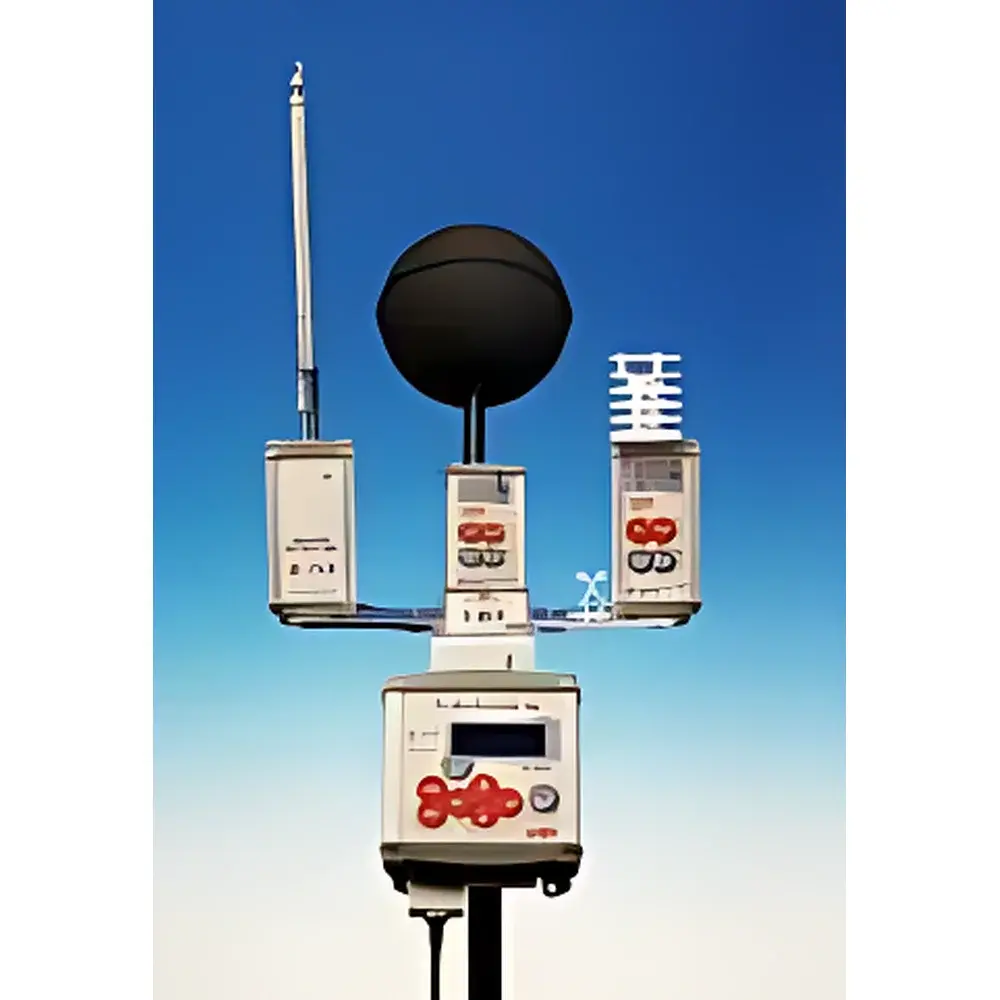
LSI-LASTEM R-Log 7730 Thermal Comfort Monitoring System
| Brand | LSI-LASTEM |
|---|---|
| Origin | Italy |
| Model | R-Log 7730 |
| Sensor Compliance | ISO 7726 |
| Calculated Indices | PMV/PPD, DR, PD, TO, Tr, Pa, TU, AD (Asymmetry Discomfort) |
Overview
The LSI-LASTEM R-Log 7730 Thermal Comfort Monitoring System is a field-deployable, standards-based environmental measurement platform engineered for quantitative assessment of human thermal perception in built and outdoor environments. It operates on the foundational principles of heat exchange physiology and radiative/convective transfer modeling, implementing the steady-state and dynamic thermal sensation frameworks defined in ISO 7730 (Ergonomics of the thermal environment — Analytical determination and interpretation of thermal comfort using calculation of the PMV and PPD indices) and EN 16798-1 (Energy performance of buildings). The system acquires raw physical parameters—black globe temperature (Tg), dry-bulb temperature (Ta), wet-bulb temperature (Tw), relative humidity (RH), and air velocity (v)—via traceable, ISO 7726-compliant sensors, then computes standardized thermal comfort indices including Predicted Mean Vote (PMV), Predicted Percentage of Dissatisfied (PPD), Draft Risk (DR), Dryness Risk (PD), local operative temperature (TO), mean radiant temperature (Tr), water vapor partial pressure (Pa), local turbulence intensity (TU), and asymmetry-induced discomfort (AD). Its dual-mode architecture supports both portable survey deployments and permanent installation within HVAC commissioning or building performance monitoring networks.
Key Features
- Modular sensor architecture compliant with ISO 7726: all primary sensors—including 150 mm black globe thermometers, mechanically ventilated psychrometers, and hot-wire anemometers—are calibrated to metrological traceability standards and optimized for low thermal inertia and minimal radiation error.
- Dual deployment flexibility: battery-powered wireless data logger (up to 72 h operation) with onboard LCD display and real-time index computation; alternatively, fixed installation via RS-485 or Ethernet interface for continuous building-level monitoring.
- Scalable input capacity: accommodates up to 32 simultaneous analog/digital channels; supports over 70 optional sensor modules including CO2, VOC, light intensity (lux), surface temperature (infrared), noise (dB(A)), and surface emissivity probes.
- Integrated thermal comfort engine: firmware implements ISO 7730 algorithms natively, enabling on-device calculation of PMV, PPD, DR, PD, Tr, and TO without dependency on post-processing software.
- Ruggedized industrial design: IP65-rated enclosure, operating temperature range –20 °C to +60 °C, ESD-protected inputs, and anti-condensation housing for humid environments.
Sample Compatibility & Compliance
The R-Log 7730 is validated for use across occupational health, building commissioning, HVAC optimization, and academic ergonomics research. Sensor configurations meet ISO 7726 requirements for spatial resolution, time constant (< 10 s for air velocity, < 30 s for globe temperature), and uncertainty budgets (±0.2 °C for Ta/Tg, ±2% RH, ±5% v). Calculated indices conform to ISO 7730 Annex A and B specifications for metabolic rate (M) and clothing insulation (Icl) input ranges (0.8–4.0 met; 0–2.0 clo). The system supports GLP-aligned data integrity: all measurements are timestamped with UTC-synchronized clocks, and raw sensor values are stored with calibration coefficients embedded in metadata. For regulated environments, audit trails, user access logs, and electronic signature support are available via optional software configuration aligned with FDA 21 CFR Part 11 requirements.
Software & Data Management
R-Log Studio is the dedicated Windows-based application for configuration, visualization, analysis, and reporting. It features ISO 7730 parameter libraries pre-loaded with default physiological models, but allows full user-defined customization of M and Icl per measurement point or time segment—critical for clothing physiology studies and transient thermal exposure analysis. Data import/export supports CSV, Excel (.xlsx), and industry-standard formats including IFC-compatible environmental metadata tags. Reporting templates comply with EN 16798-1 Annex J and ASHRAE Standard 55: automated generation includes annotated time-series plots, spatial heat maps (when multi-point arrays deployed), compliance tables against category A/B/C thresholds, and thermal injury risk summaries (e.g., heat stress WBGT overlay, cold exposure wind chill index). All reports embed digital signatures, version control, and revision history for QA/QC traceability.
Applications
- Building performance verification: validation of HVAC zoning, radiant panel efficacy, and natural ventilation strategies against ISO 7730 and EN 16798-1 thermal comfort criteria.
- Occupational hygiene assessments: evaluation of thermal stress in industrial facilities, transportation cabins, and outdoor workspaces—including high-temperature (foundries, glass manufacturing) and low-temperature (cold storage, refrigerated transport) environments.
- Clothing ergonomics research: synchronized monitoring of microclimate beneath garments (using textile-integrated humidity/temperature sensors) and ambient conditions to quantify evaporative resistance and thermal insulation dynamics under motion.
- Urban microclimate studies: mobile mapping of street-level thermal comfort using GPS-tagged R-Log units mounted on bicycles or vehicles, generating GIS-integrated PMV/PPD contour maps.
- IEQ/IAQ integration: correlation of thermal comfort indices with indoor air quality metrics (CO2, TVOC, PM2.5) to identify synergistic or antagonistic environmental stressors in schools, hospitals, and office buildings.
FAQ
Does the R-Log 7730 support real-time wireless transmission to a central server?
Yes—via optional LTE or Wi-Fi communication modules, enabling remote monitoring and alarm-triggered notifications when PMV or PPD thresholds exceed user-defined limits.
Can it calculate dynamic thermal comfort indices such as SET* or UTCI?
No—the system implements only ISO 7730-compliant steady-state and quasi-steady-state models. Dynamic indices require external computational engines; however, raw sensor data can be exported for third-party processing.
Is calibration documentation provided with each sensor?
Yes—each sensor ships with a UKAS-accredited calibration certificate valid for 12 months, traceable to NIST or PTB standards, including uncertainty budgets and drift correction factors.
How many simultaneous measurement points can be networked in a single installation?
Up to 255 nodes using Modbus TCP or CAN bus topology; synchronization accuracy is maintained within ±100 ms across the network via NTP or PTP protocols.
Is the software validated for GxP-regulated environments?
R-Log Studio offers a 21 CFR Part 11-compliant mode with role-based access control, electronic signatures, and immutable audit logs—subject to site-specific IQ/OQ validation protocols conducted by the end user or certified third party.







