
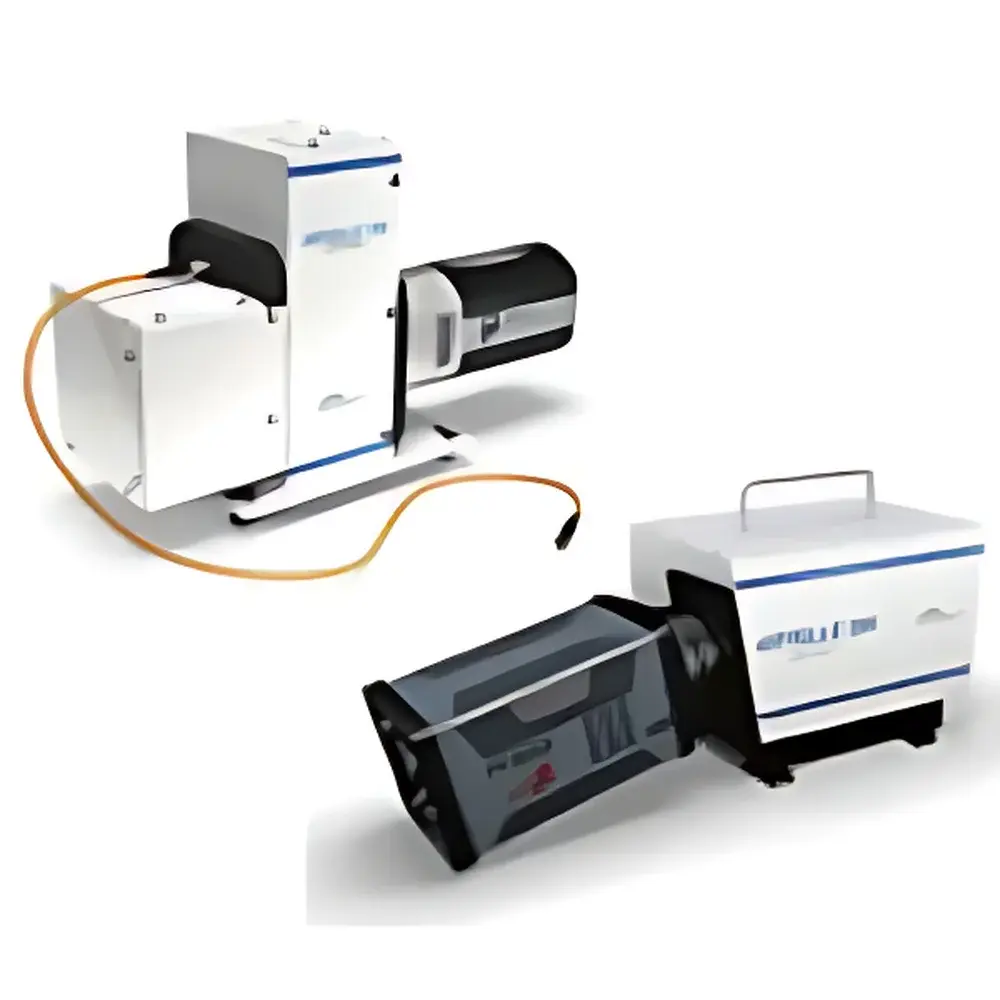
LTB Aryelle 150 Series Ultra-Compact Echelle Spectrometer
| Brand | LTB |
|---|---|
| Origin | Germany |
| Manufacturer Type | Authorized Distributor |
| Origin Category | Imported |
| Model | Aryelle 150 |
| Pricing | Upon Request |
Overview
The LTB Aryelle 150 Series is an ultra-compact, high-performance echelle spectrometer engineered for demanding optical spectroscopy applications requiring exceptional spectral resolution and radiometric stability. Based on the Littrow-mounted echelle grating principle—where diffraction order separation is achieved through high groove density (typically >79 lines/mm) and large incident angles—the Aryelle 150 delivers resolving powers (λ/Δλ) exceeding 40,000 in first order, enabling sub-picometer spectral sampling across UV-VIS-NIR ranges (190–1100 nm). Its monolithic optical bench design minimizes thermal drift and mechanical misalignment, ensuring long-term calibration retention without active stabilization. Unlike conventional Czerny-Turner systems, the echelle architecture leverages cross-dispersion (via prism or secondary grating) to map each diffraction order onto a 2D detector plane, allowing simultaneous acquisition of broad spectral bandwidths with intrinsic wavelength calibration fidelity. This architecture is particularly suited for time-resolved and low-light applications such as spontaneous Raman scattering, laser-induced breakdown spectroscopy (LIBS), and isotopic line discrimination.
Key Features
- Ultra-compact monolithic optomechanical housing (dimensions: 150 × 120 × 85 mm), CNC-machined from stress-relieved aluminum alloy for dimensional stability and thermal homogeneity
- Echelle grating with optimized blaze angle and ruled groove profile for peak efficiency (>35% absolute in UV, >55% in VIS) across multiple orders
- Integrated cross-disperser (fused silica prism or holographic grating) enabling full 2D spectral mapping without moving parts
- Standard interface for back-illuminated, deep-depletion EMCCD or ICCD detectors (e.g., Andor iXon, Princeton Instruments PI-MAX4) with 16-bit digitization and thermoelectric cooling to −80 °C
- Pre-aligned optical path with factory-set focus and astigmatism correction; no user collimation required
- Vacuum-compatible option (10⁻⁶ mbar) available for UV-enhanced operation below 200 nm
Sample Compatibility & Compliance
The Aryelle 150 interfaces seamlessly with standard fiber-optic coupling (SMA 905, FC/PC), free-space input slits (25–100 µm width), and OEM laser excitation modules. It supports both continuous-wave and pulsed sources (nanosecond to femtosecond pulse widths), making it suitable for time-gated LIBS plasma diagnostics and picosecond-resolved Raman kinetics. The system complies with IEC 61326-1:2013 for electromagnetic compatibility in laboratory environments and meets CE marking requirements for optical instrumentation. When integrated into GMP-regulated workflows (e.g., pharmaceutical raw material ID via Raman fingerprinting), its fixed optical configuration supports 21 CFR Part 11-compliant software validation packages—including audit trails, electronic signatures, and calibration lockout protocols—when paired with LTB’s SpectraControl Suite.
Software & Data Management
LTB’s SpectraControl Suite (v5.x) provides native driver support for Windows/Linux and includes real-time spectral reconstruction algorithms that convert raw 2D echellograms into calibrated 1D spectra using polynomial order tracing and pixel-to-wavelength mapping derived from Hg/Ne/Ar lamp references. The software supports batch processing of time-series datasets, automated peak centroiding with sub-pixel interpolation, and export to ASTM E131-compliant .jdx or ISO/IEC 11172-3 (MPEG-1 Audio Layer III) metadata-embedded formats. All spectral acquisitions are timestamped and logged with environmental sensor data (ambient temperature, detector voltage, grating encoder position), fulfilling GLP traceability requirements. Raw frames and processed spectra are stored in HDF5 containers with embedded provenance metadata, enabling reproducible analysis pipelines compatible with Python-based scientific computing stacks (e.g., SciPy, h5py, SpecViz).
Applications
- High-resolution Raman spectroscopy of crystalline phonon modes, strain mapping in 2D materials (e.g., MoS₂ layer-dependent A₁g splitting), and polymer conformational analysis
- LIBS plasma diagnostics for elemental quantification in alloys and geological samples, leveraging isotopic shifts (e.g., ⁶Li/⁷Li, ¹⁰B/¹¹B) at ≤0.003 nm FWHM resolution
- Fine-structure analysis of diode-pumped solid-state lasers (DPSSL), including longitudinal mode spacing (FSR), gain narrowing, and amplified spontaneous emission (ASE) suppression verification
- Absorption spectroscopy of cold molecular beams and cavity-enhanced detection of trace gases (e.g., CH₄ isotopologues at 1660 nm)
- Plasma emission monitoring in semiconductor etch processes, where spectral line ratios (e.g., Cl/Cl₂, F/CF₄) serve as real-time endpoint indicators
FAQ
What detector types are natively supported?
EMCCD, ICCD, and scientific CMOS sensors with 16–25 mm diagonal format and USB 3.0 or Camera Link interface are fully supported.
Is vacuum operation mandatory for UV measurements?
No—standard configurations operate down to 190 nm in air; vacuum or purged (N₂) operation extends usability to 135 nm.
Can the Aryelle 150 be integrated into automated production lines?
Yes—RS-232, TTL trigger I/O, and EtherCAT-compatible motion control interfaces enable synchronization with PLCs and robotic sample handlers.
Does LTB provide NIST-traceable calibration services?
Yes—factory calibration includes Hg/Ne/Ar line reference certification with uncertainty budgets per ISO/IEC 17025.
How is wavelength calibration stability verified over time?
Built-in LED reference source (633 nm) enables daily drift checks; typical long-term stability is ±0.002 nm over 8 hours at constant ambient temperature (±0.5 °C).




