
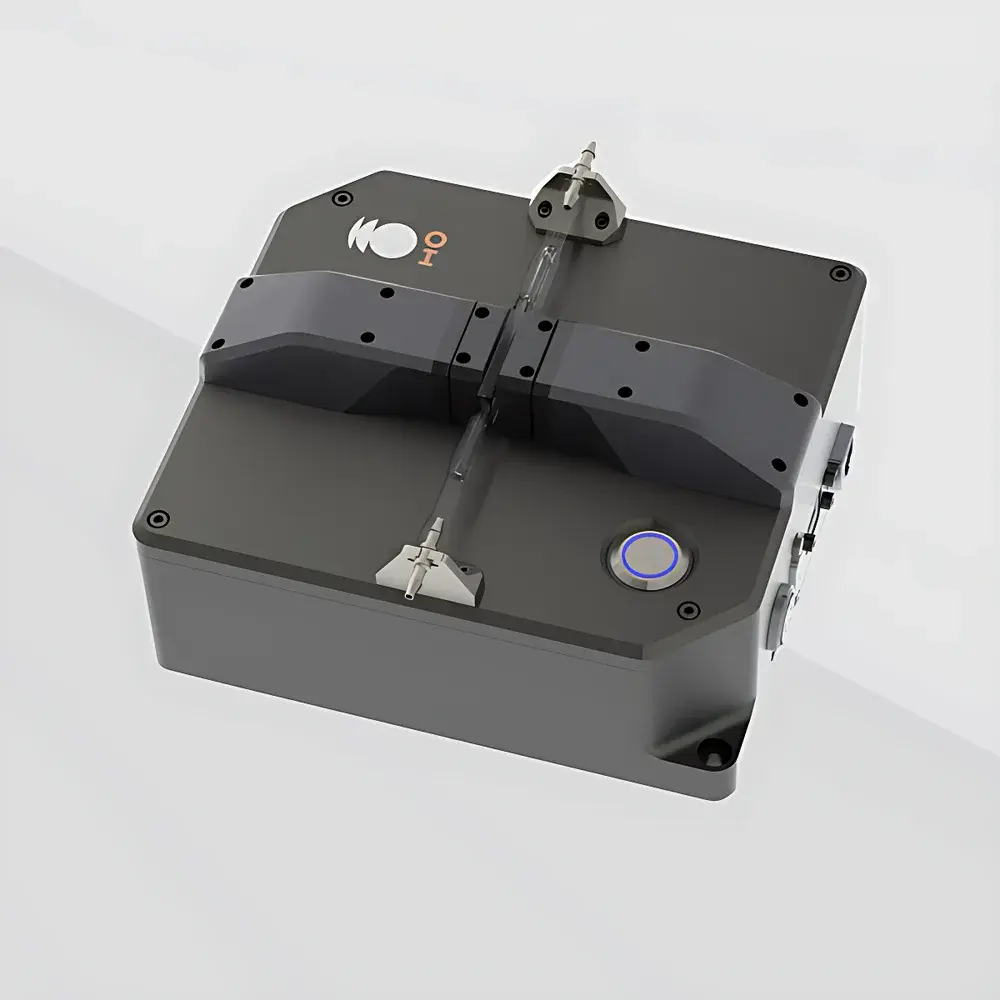
LTMS Modular Liquid Transmission Measurement System
| Brand | Ocean Optics |
|---|---|
| Model | FD-LTMS |
| Wavelength Range | 400–700 nm |
| Detector | 1024-element linear array |
| Optical Design | Asymmetric crossed Czerny-Turner spectrometer |
| Spectral Sampling Interval | 10 nm |
| FWHM | 6 nm |
| Light Source | Pulsed LED (>250 million measurements lifetime) |
| Sample Holders | 10 mm pathlength cuvette & flow-cell interface |
| Connectivity | USB 2.0 |
| OS Compatibility | Windows 7+, 64-bit |
| Enclosure Rating | IP67 |
| Origin | Shanghai, China |
| Manufacturer | Ocean Optics (Shanghai) |
Overview
The LTMS Modular Liquid Transmission Measurement System (Model FD-LTMS) is a compact, field-deployable UV-Vis transmission spectrometer engineered for quantitative analysis of liquid-phase optical density across the visible spectrum (400–700 nm). Based on pulsed LED illumination and high-stability asymmetric crossed Czerny-Turner optical architecture, the system delivers reproducible transmittance spectra with 10 nm spectral sampling resolution and 6 nm full-width-at-half-maximum (FWHM) bandwidth—enabling precise discrimination of overlapping absorption features in multi-component solutions. Unlike conventional benchtop spectrophotometers, the FD-LTMS integrates optomechanical, electronic, and software subsystems into a single IP67-rated enclosure, permitting direct deployment in industrial process environments—including anodizing dye baths, beverage production lines, and pharmaceutical formulation stations—without requiring climate-controlled laboratories.
Key Features
- Modular Integration Architecture: Standardized optical, fluidic, and electrical interfaces support rapid integration with third-party peristaltic pumps, solenoid valves, and PLC-controlled flow cells for automated inline monitoring.
- Pulsed LED Light Source: Engineered for >250 million measurement cycles with minimal thermal drift; eliminates lamp aging artifacts common in tungsten-halogen or deuterium sources.
- Ruggedized Industrial Housing: IP67-rated aluminum enclosure withstands dust ingress, splashing water, and mechanical shock—certified for continuous operation in Class I, Division 2 hazardous locations when paired with appropriate barrier systems.
- High-Fidelity Spectral Acquisition: 1024-pixel linear array detector coupled to a thermally stabilized asymmetric Czerny-Turner spectrometer ensures <±0.3 nm wavelength accuracy and <0.5% photometric repeatability over 8-hour shifts.
- Real-Time Data Pipeline: USB 2.0 interface enables sub-100 ms spectral acquisition and transfer; native support for LabVIEW, Python (via PyOcean), and MATLAB instrument control toolboxes.
Sample Compatibility & Compliance
The FD-LTMS accepts standard 10 mm pathlength cuvettes for laboratory-grade calibration and validation, as well as industry-standard flow cells (e.g., 1/4″ NPT or M6 threaded ports) for unattended process monitoring. It complies with ISO 9001:2015 manufacturing controls and meets electromagnetic compatibility requirements per EN 61326-1:2013. When deployed in regulated environments—including food safety (FDA 21 CFR Part 11), pharmaceutical (ICH Q2(R2), USP ), and aerospace coating (AMS 2470) applications—the system supports audit-ready data logging with timestamped spectral metadata, user access control, and electronic signature workflows via optional software modules.
Software & Data Management
OceanView LTMS Edition provides turnkey tools for absorbance-to-concentration conversion using Beer-Lambert modeling, multivariate regression (PLS, PCA), and color space transformation (CIE XYZ, L*a*b*). All spectral datasets are stored in HDF5 format with embedded calibration coefficients, instrument configuration, and measurement context (temperature, flow rate, sample ID). The software includes built-in compliance features: automatic generation of raw-data audit trails, configurable retention policies, and export to CSV, PDF, or ASTM E2500-compliant XML reports. Remote monitoring is supported through RESTful API endpoints compatible with SCADA and MES platforms (e.g., Siemens SIMATIC IT, Rockwell FactoryTalk).
Applications
- Real-time monitoring of dye concentration in aluminum anodizing electrolytes to maintain consistent color depth and corrosion resistance per MIL-A-8625 Type II/III specifications.
- Quantitative analysis of polyphenols, anthocyanins, and sulfites in wine and fruit juice production—aligned with OIV Method COEI-CECA-06A and AOAC 990.23.
- In-line verification of active pharmaceutical ingredient (API) concentration during liquid filling operations under cGMP Annex 11 guidelines.
- Transmittance characterization of optical filters, display substrates, and architectural glass per ISO 9050 and EN 410 test protocols.
- Calibration-free ratio-metric quantification of dual-absorbing dyes (e.g., tartrazine + sunset yellow) using isosbestic point referencing and derivative spectroscopy.
FAQ
Can the FD-LTMS operate continuously in a humid, corrosive plating bath environment?
Yes. Its IP67-rated housing, gold-plated optical connectors, and sealed LED driver electronics enable uninterrupted operation at ambient temperatures from 5 °C to 45 °C and relative humidity up to 95% non-condensing—validated per IPC-CC-830B Class 3 coating performance standards.
Does the system support calibration traceability to NIST standards?
Yes. Factory calibration includes NIST-traceable tungsten halogen and holmium oxide reference spectra; users may perform in-situ recalibration using Ocean Optics’ CR-10 certified reflectance standards or custom liquid references.
Is it possible to integrate the FD-LTMS with existing DCS or SIS infrastructure?
Yes. The system’s Modbus TCP and OPC UA gateway options allow seamless bidirectional communication with DeltaV, Emerson DeltaV SIS, and Honeywell Experion DCS platforms without middleware.
What is the minimum detectable absorbance change at 550 nm?
Under typical operating conditions (10 mm pathlength, 1 s integration time), the system achieves a noise-equivalent absorbance (NEA) of 1.2 × 10⁻³ AU, enabling detection of <0.2% concentration shifts in dyestuff solutions.
Are firmware updates provided post-purchase, and how are they delivered?
Yes. Ocean Optics releases quarterly firmware revisions addressing spectral stability enhancements, new calibration algorithms, and cybersecurity patches—all distributed via secure HTTPS portal with SHA-256 signature verification and rollback capability.







