
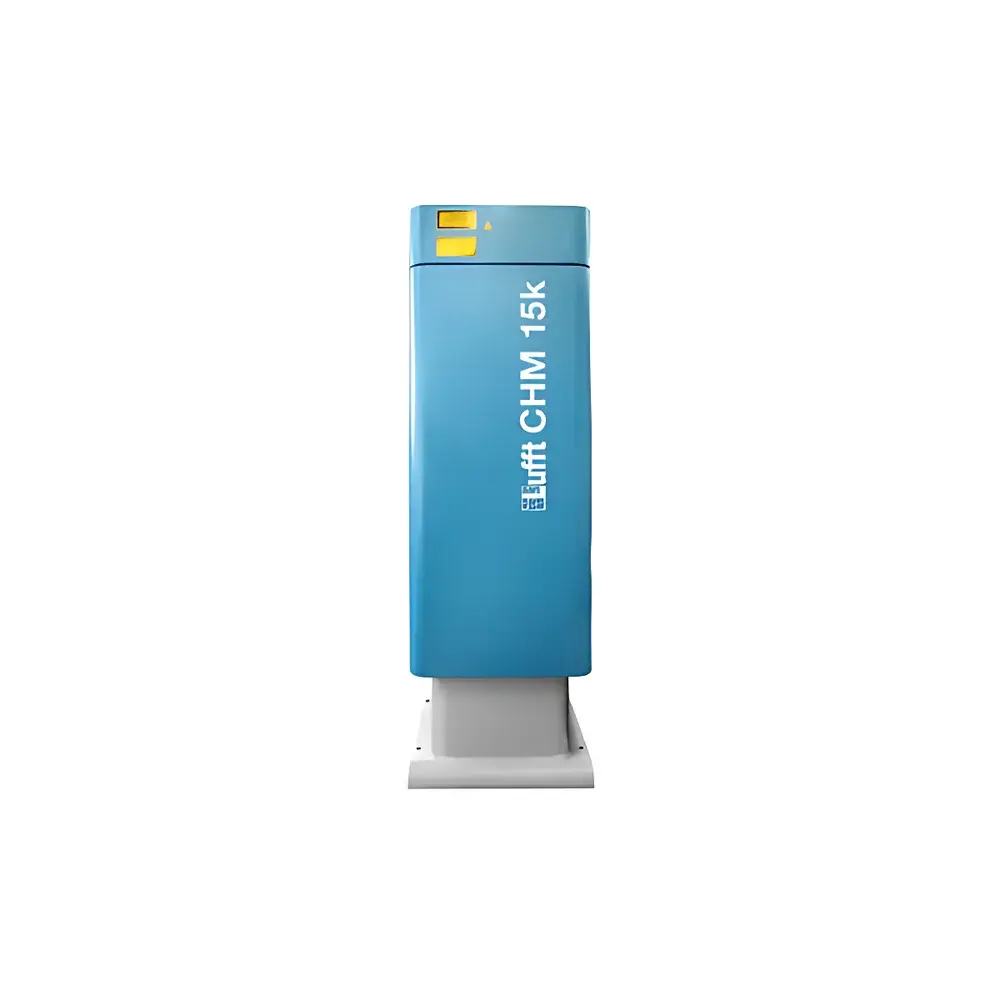
Lufft CHM15K Ceilometer
| Brand | Lufft |
|---|---|
| Origin | Imported |
| Model | CHM15K |
| Laser Source | Solid-State Nd:YAG (1064 nm) |
| Detector Type | Avalanche Photodiode (APD) |
| Maximum Detection Range | 15 km |
| Pulse Repetition Frequency | 100 Hz |
| Vertical Resolution | 5 m |
| Temporal Resolution | Adjustable (1–60 s) |
| Data Output Formats | NetCDF, ASCII, BUFR |
| Communication Interfaces | Ethernet (TCP/IP), RS-485 |
| Environmental Operating Range | −40 °C to +60 °C |
| Enclosure | Dual-layer heated & ventilated housing |
| Calibration | Optional on-site calibration kit available |
| Compliance | WMO Guide to Instruments and Methods of Observation (CIMO Guide), ISO 9001-certified manufacturing |
Overview
The Lufft CHM15K ceilometer is a high-performance, eye-safe, solid-state laser-based atmospheric profiling instrument engineered for continuous, unattended measurement of cloud base height (CBH), vertical visibility, multi-layer cloud structure, aerosol layering, planetary boundary layer (PBL) height, and atmospheric backscatter profiles. Operating on the principle of elastic backscatter lidar (Light Detection and Ranging), the CHM15K emits short-duration, near-infrared laser pulses (1064 nm) vertically into the atmosphere and precisely analyzes the time-resolved intensity and temporal distribution of returned photons scattered by cloud droplets, ice crystals, and aerosol particles. Its narrowband interference filter and thermoelectrically cooled avalanche photodiode (APD) detector ensure exceptional signal-to-noise ratio and immunity to solar background radiation—critical for diurnal stability and long-term data consistency in operational meteorological networks.
Key Features
- Solid-state Nd:YAG laser at 1064 nm with >10⁶ pulse lifetime and stable spectral output—eliminates gas-laser maintenance and enables robust field deployment.
- Dual-layer enclosure with integrated heating, forced-air cooling, and condensation-resistant optical window—ensures reliable operation across extreme climatic conditions (−40 °C to +60 °C).
- Simultaneous detection of up to nine cloud layers and two distinct aerosol layers, supporting complex stratocumulus, cirrus, and mixed-phase cloud analysis.
- Vertical resolution of 5 meters and configurable temporal integration (1–60 seconds), balancing high-resolution profiling with signal averaging for low-SNR conditions.
- On-site calibration option via traceable reference target—minimizes downtime, eliminates shipping risks, and maintains metrological continuity per WMO-recommended practices.
- Embedded web server with real-time status monitoring, remote configuration, firmware updates, and diagnostic logging accessible via standard HTTP/HTTPS.
Sample Compatibility & Compliance
The CHM15K is designed for outdoor, permanent installation in meteorological observatories, airport automatic weather observing systems (AWOS), environmental research stations, and aviation safety infrastructure. It complies with key international observational standards, including the World Meteorological Organization’s (WMO) CIMO Guide (Chapter 12, Ceilometers), ICAO Annex 3 requirements for cloud and vertical visibility reporting, and EU Directive 2007/2/EC on INSPIRE-compliant atmospheric data exchange. Its optical design meets Class 1M laser safety requirements (IEC 60825-1:2014), and its data structure adheres to CF-conventions for NetCDF files—facilitating interoperability with EUMETNET, NOAA, DWD, and ECMWF data assimilation pipelines. The system supports GLP-aligned audit trails when integrated with compliant data acquisition software.
Software & Data Management
The CHM15K delivers fully processed, georeferenced atmospheric profiles in standardized formats—including NetCDF (CF-1.8 compliant), ASCII, and BUFR—enabling seamless ingestion into numerical weather prediction (NWP) models and long-term climate archives. Data output is available concurrently via Ethernet (TCP/IP) and RS-485 (Modbus RTU), with configurable polling intervals and payload compression. Built-in FTP client supports scheduled, encrypted uploads to central servers or cloud storage endpoints. Optional Lufft METEON software provides automated quality control (QC), cloud classification (e.g., CBH, CTH, cloud fraction), PBL height derivation using gradient or variance methods, and integration with external sensors (e.g., temperature, humidity, wind profilers) for contextual atmospheric analysis. All raw and derived datasets include embedded metadata compliant with ISO 19115-2.
Applications
- Meteorological services: Real-time cloud base reporting for aviation weather forecasts, nowcasting, and synoptic observation networks.
- Airport operations: Integration into AWOS and ASOS systems for Category I/II/III approach support and low-visibility procedures (LVP) compliance.
- Climate research: Long-term monitoring of cloud cover trends, aerosol-cloud interactions, and boundary layer evolution under changing radiative forcing.
- Environmental agencies: Vertical profiling of pollution plumes, dust storms, volcanic ash dispersion, and smoke layers from biomass burning events.
- Academic and aerospace institutions: Validation of satellite-derived cloud products (e.g., CALIPSO, CloudSat), UAV-based atmospheric campaigns, and boundary layer model evaluation.
- Oceanic and polar observatories: Remote, low-power-capable operation in autonomous mode with solar/battery hybrid power management.
FAQ
What is the maximum unambiguous detection range of the CHM15K, and how is range ambiguity mitigated?
The CHM15K achieves a maximum reliable detection range of 15 km. Range ambiguity is minimized through precise pulse timing control, optimized dead-time compensation, and adaptive gain switching across altitude bins—ensuring accurate echo discrimination even in multi-layer cloud scenarios.
Does the CHM15K require periodic factory recalibration?
No—its optional on-site calibration kit enables traceable performance verification without removal from installation. This preserves data continuity and aligns with WMO guidance on minimizing observational gaps.
Can the CHM15K operate reliably in high-humidity or icy environments?
Yes—the dual-layer heated enclosure, anti-frost optical window, and active thermal management prevent condensation and ice accumulation, validated for continuous operation at relative humidity >95% and ambient temperatures down to −40 °C.
Is the device compatible with existing meteorological data ingestion frameworks such as BUFR or GRIB?
While native output includes BUFR and NetCDF, GRIB2 conversion is supported via third-party tools (e.g., ecCodes) or Lufft’s METEON middleware; all metadata fields map directly to WMO Table B descriptors.
How does the CHM15K handle solar interference during daytime measurements?
Its 1064 nm wavelength, combined with a narrowband (0.3 nm FWHM) interference filter and cooled APD detector, reduces solar background noise by >60 dB compared to visible-wavelength ceilometers—ensuring consistent SNR across diurnal cycles.







