
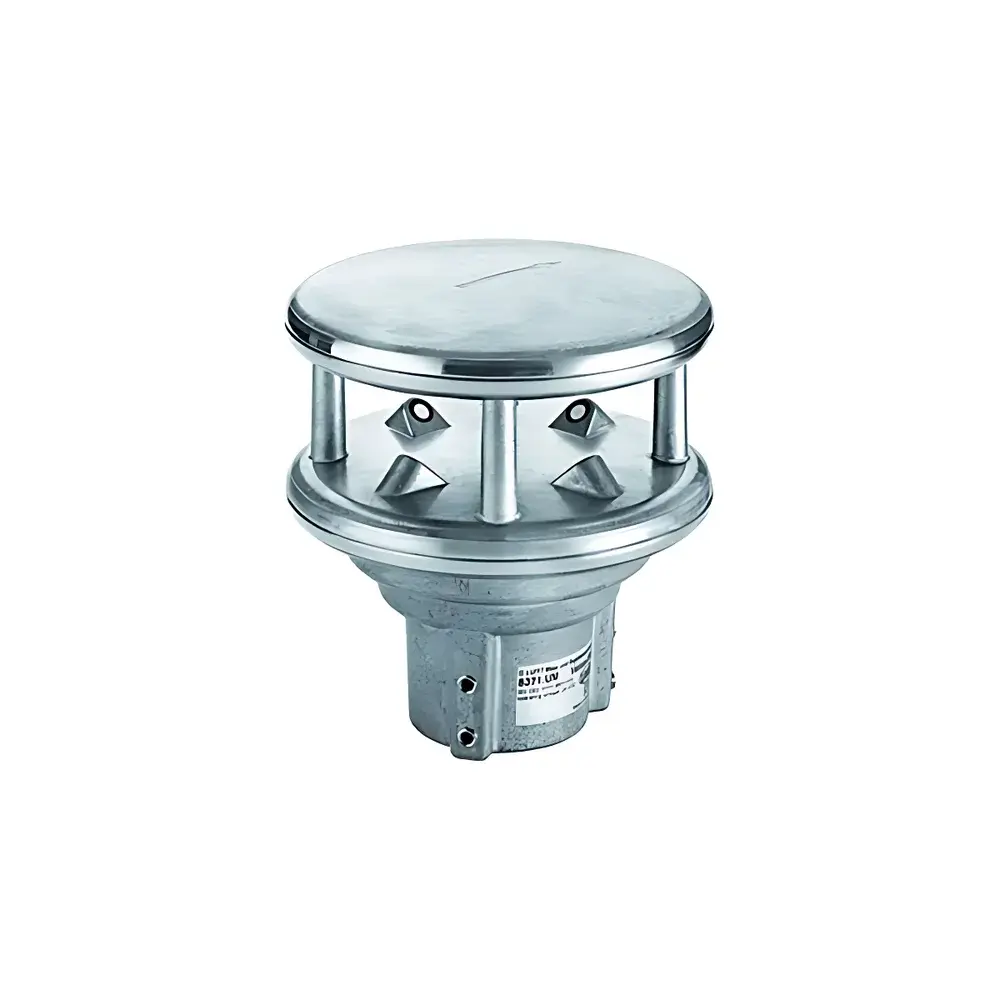
Lufft Ventus-UMB Ultrasonic Anemometer
| Brand | Lufft |
|---|---|
| Origin | Imported |
| Model | Lufft Ventus-UMB |
| Instrument Type | Ultrasonic Anemometer |
| Resolution | 0.1 m/s |
| Measurement Range | 0–90 m/s |
| Accuracy | ±0.2 m/s or ±2% RMS (0–65 m/s), whichever is greater |
| Operating Temperature | −40 °C to +60 °C (with integrated heater) |
| Relative Humidity Range | 0–100% RH |
| Protection Rating | IP68 |
Overview
The Lufft Ventus-UMB is a high-reliability, all-in-one ultrasonic anemometer engineered for continuous, maintenance-free wind monitoring in demanding environmental and industrial applications. It employs the time-of-flight (TOF) principle—measuring the differential transit time of ultrasonic pulses across orthogonal transducer pairs—to derive true 3D wind vector components (horizontal wind speed and direction, plus vertical turbulence intensity when configured). Unlike mechanical cup-and-vane sensors, the Ventus-UMB contains no moving parts, eliminating mechanical wear, inertia-induced lag, and calibration drift associated with rotating elements. In addition to wind parameters, it simultaneously outputs virtual temperature (derived from ultrasonic sound speed), barometric pressure (via MEMS capacitive sensor), and calculated air density—enabling thermodynamic consistency checks and enhanced data interpretation in meteorological and aerodynamic modeling.
Key Features
- True ultrasonic time-difference measurement with four transducer paths for robust 2D wind vector resolution and redundancy
- Integrated PTC heater enabling reliable operation down to −40 °C and effective anti-icing performance in freezing fog, rime, or maritime spray conditions
- IP68-rated aluminum-magnesium-silicon alloy housing—corrosion-resistant, thermally conductive, and validated per ISO 9223 C5-M (marine corrosion class)
- Comprehensive environmental validation: salt mist (IEC 60068-2-52), thermal cycling (−40 °C to +60 °C), random vibration (IEC 60068-2-64), and ice adhesion resistance testing
- Dual-output architecture: simultaneous digital (RS-485/Modbus RTU, SDI-12, CANopen) and configurable analog outputs (0–20 mA, 4–20 mA, 0–10 V, or frequency output)
- Onboard quality control metrics including signal-to-noise ratio (SNR), path validity flags, and cross-wind compensation diagnostics
Sample Compatibility & Compliance
The Ventus-UMB is designed for permanent outdoor deployment across diverse regulatory and operational contexts. Its measurement methodology aligns with WMO Guide to Meteorological Instruments and Methods of Observation (CIMO Guide, Chapter 6) for ultrasonic wind sensors. The pressure channel meets IEC 61262 Class B specifications for barometric accuracy and long-term stability. The device complies with EMC Directive 2014/30/EU (EN 61326-1), Low Voltage Directive 2014/35/EU, and RoHS 2011/65/EU. For aviation and transportation applications, its wind data output supports integration into systems compliant with ICAO Annex 3 and FAA AC 150/5220-22B requirements. All firmware and configuration tools support audit-trail logging compatible with GLP/GMP-aligned environmental monitoring workflows.
Software & Data Management
Lufft’s UMB-DataManager software provides configuration, real-time visualization, and firmware updates via USB or Ethernet. Raw and processed data streams are exportable in CSV, NetCDF, or BUFR formats—ensuring interoperability with SCADA platforms (e.g., Ignition, Siemens Desigo), weather station networks (e.g., WeatherLink, Meteobridge), and cloud-based environmental dashboards (e.g., AWS IoT Core, Microsoft Azure IoT Hub). The sensor supports UTC-synchronized timestamping with optional NTP or PTPv2 time distribution. All communication protocols implement CRC error checking and configurable message retry logic. Data integrity is reinforced through cyclic redundancy verification on every transmitted frame and non-volatile storage of last-known-good configuration parameters.
Applications
- Roadway and tunnel meteorological monitoring per EN 12830 and ASTM E2777 standards for visibility, crosswind, and gust detection
- Maritime and port automatic weather stations (AWS), including shipboard installations requiring salt-tolerant, vibration-resilient sensing
- Wind resource assessment and turbine control feedback loops in onshore and offshore wind farms (IEC 61400-12-1 compliant data acquisition)
- Airport surface wind monitoring for ATIS, ASOS, and AWOS systems supporting Category III landing operations
- Hydrological and coastal observatories measuring boundary-layer dynamics over water bodies and estuaries
- Power plant cooling tower airflow optimization and stack emission dispersion modeling
FAQ
Does the Ventus-UMB require periodic recalibration?
No—its ultrasonic measurement principle and solid-state pressure sensor eliminate drift mechanisms requiring routine field recalibration. Factory calibration certificates (traceable to PTB/NIST standards) are provided; users may perform optional verification using known wind tunnel profiles or reference sonic anemometers.
Can the heater be controlled externally?
Yes—the integrated PTC heater operates automatically below −10 °C but can also be activated manually or via Modbus register command for pre-emptive de-icing during forecasted freezing conditions.
Is the air density output derived solely from pressure and virtual temperature?
Yes—it uses the ideal gas law approximation (ρ = p / (Rspecific × Tv)), where Rspecific is the specific gas constant for dry air (287.05 J·kg⁻¹·K⁻¹), and Tv is virtual temperature in Kelvin. No external humidity input is required, as virtual temperature inherently accounts for moisture content.
What is the maximum cable length for RS-485 communication?
Up to 1,200 meters at 9.6 kbps (with proper twisted-pair shielding and termination); shorter lengths recommended for higher baud rates or electrically noisy environments.
How does the Ventus-UMB handle precipitation interference?
The transducer geometry and acoustic pulse timing algorithms include rain rejection logic that identifies and discards anomalous echo patterns caused by droplet impact or water film formation—verified under simulated heavy rainfall (≥50 mm/h) per IEC 60529 test protocols.
Related Products







