
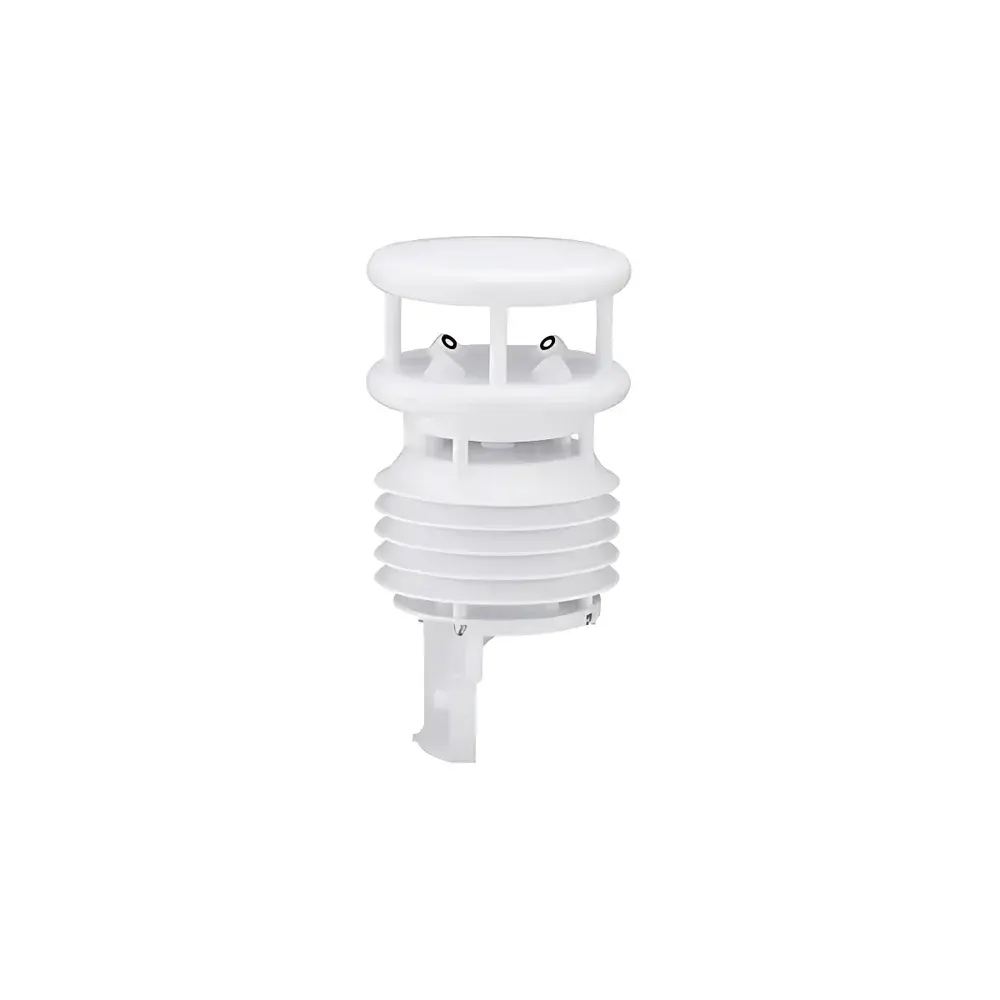
Lufft WS500-UMB Integrated Ultrasonic Weather Station
| Brand | Lufft |
|---|---|
| Origin | Germany |
| Model | WS500-UMB |
| Measurement Principles | Ultrasonic (wind speed & direction), NTC thermistor (temperature), Capacitive polymer (relative humidity), MEMS capacitive (barometric pressure) |
| Wind Speed Range | 0–60 m/s |
| Wind Speed Accuracy | ±0.3 m/s or ±3% (0–35 m/s) |
| Wind Direction Range | 0–359.9° |
| Wind Direction Accuracy | ±3° |
| Temperature Range | −50 to +60 °C |
| Temperature Accuracy | ±0.2 °C (−20 to +50 °C), ±0.5 °C (outside range) |
| Relative Humidity Range | 0–100 %RH |
| RH Accuracy | ±2 %RH |
| Barometric Pressure Range | 300–1200 hPa |
| Pressure Accuracy | ±1.5 hPa |
| Power Supply | 24 VDC ±10%, <4 VA (unheated), 10 W max with heater |
| Output Interface | RS-485, 2-wire, half-duplex |
| Operating Temperature | −50 to +60 °C |
| Enclosure Material | Anodized aluminum |
| Weight | 1.3 kg |
| Dimensions (H × Ø) | 290 mm × 150 mm |
| Color | White powder-coated finish |
| Protocol | Lufft UMB protocol (binary/ASCII over RS-485) |
Overview
The Lufft WS500-UMB Integrated Ultrasonic Weather Station is a compact, all-in-one environmental sensing platform engineered for long-term, unattended operation in demanding outdoor conditions. Designed and manufactured in Germany, it combines five core meteorological parameters—wind speed, wind direction, air temperature, relative humidity, and barometric pressure—within a single robust, weatherproof housing. Unlike traditional mechanical anemometers and vanes, the WS500-UMB employs ultrasonic time-of-flight measurement for wind vector determination, eliminating moving parts and associated wear, icing sensitivity, or mechanical hysteresis. Temperature is measured via a precision NTC thermistor array with multi-point thermal compensation; relative humidity uses a calibrated capacitive polymer sensor with integrated dew point calculation; and atmospheric pressure is captured using a high-stability MEMS capacitive transducer with temperature compensation across its full operating range. The unit features an internal magnetic declination correction algorithm, enabling software-configurable alignment between magnetic north and true north—critical for georeferenced data integrity in hydrological, agricultural, and environmental monitoring networks.
Key Features
- Ultrasonic wind measurement with no moving parts—immune to icing, corrosion, and mechanical fatigue
- Integrated multi-sensor architecture housed in a single anodized aluminum enclosure (IP66 rated)
- Low-power design (<4 VA nominal, unheated) optimized for solar-powered remote deployments
- Internal heater option (10 W max) for anti-icing in sub-zero, high-humidity environments
- Lufft UMB communication protocol supporting both ASCII and binary modes over RS-485 (2-wire, half-duplex)
- Factory-calibrated sensors with documented traceability to national metrology institutes (e.g., PTB)
- Self-diagnostic firmware with real-time status reporting (sensor health, heating status, communication errors)
- Mounting-ready design with standardized M8 threaded base and optional tilt-compensated leveling kit
Sample Compatibility & Compliance
The WS500-UMB is certified for continuous outdoor exposure per IEC 60529 (IP66), EN 61326-1 (EMC for industrial environments), and EN 61000-6-2/-6-3. Its sensor suite meets requirements for Class II meteorological instrumentation under WMO Guide to Meteorological Instruments and Methods of Observation (CIMO Guide). Data outputs comply with standard environmental telemetry formats including SDI-12 (via optional converter), MODBUS RTU (via UMB-to-MODBUS gateway), and direct integration into SCADA, IoT edge gateways, and cloud platforms (e.g., AWS IoT Core, Azure IoT Hub) using custom UMB parsers. The device supports audit-trail-capable configuration logging and is compatible with GLP/GMP-aligned data acquisition systems when deployed with timestamped, signed data packets and secure RS-485 termination.
Software & Data Management
Lufft provides the free UMB ConfigTool for local sensor configuration, calibration verification, firmware updates, and real-time data streaming via USB-RS485 adapter. For enterprise deployment, the station integrates natively with Lufft’s meteoLOG cloud service (optional subscription), offering automated data ingestion, QA/QC flagging (e.g., spike detection, range validation), metadata tagging, and export in CF-compliant NetCDF or CSV formats. All UMB frames include embedded timestamps synchronized to internal RTC (±2 s/month drift), and optional GPS timing modules can be added externally for sub-second UTC alignment. Data security adheres to TLS 1.2+ for cloud uploads, and local storage retains 30 days of buffered measurements during comms outages.
Applications
- Automated hydrometeorological networks for flood forecasting and watershed modeling
- Offshore and inland buoy-based environmental monitoring systems
- Agricultural microclimate stations for irrigation scheduling and frost prediction
- Renewable energy site assessment (wind resource mapping, solar irradiance correlation)
- Urban air quality monitoring networks requiring co-located meteorological context
- Permafrost and alpine research stations where reliability and low maintenance are critical
- Educational and citizen science deployments with standardized, interoperable data output
FAQ
Does the WS500-UMB require periodic recalibration?
No scheduled recalibration is required under normal operating conditions. Lufft specifies a 2-year calibration stability interval for all sensors; however, field verification using reference instruments (e.g., traceable sling psychrometer, portable barometer) is recommended annually for regulatory or QA-critical applications.
Can the WS500-UMB operate without external power for extended periods?
Yes—it draws 30-day autonomy in temperate climates. Heater activation increases consumption significantly and should be duty-cycled based on ambient conditions.
Is the UMB protocol publicly documented?
Yes. Lufft publishes the complete UMB specification (v2.4+) under NDA-free terms, including register maps, command syntax, error codes, and CRC algorithms—enabling full third-party integration without proprietary middleware.
How is magnetic declination handled in wind direction output?
The device stores user-defined magnetic declination (in degrees east/west) in non-volatile memory. Firmware applies real-time offset correction to raw ultrasonic heading data, delivering true-north-referenced wind direction in all output frames.
What mounting options are available for pole or mast installation?
The unit includes an M8 threaded base compatible with standard 30–60 mm diameter mounting poles. Optional accessories include a universal tilt-adjustable bracket (part no. 97.960.308.9.5-01) and vibration-damping isolation mounts for tower-top installations.







