
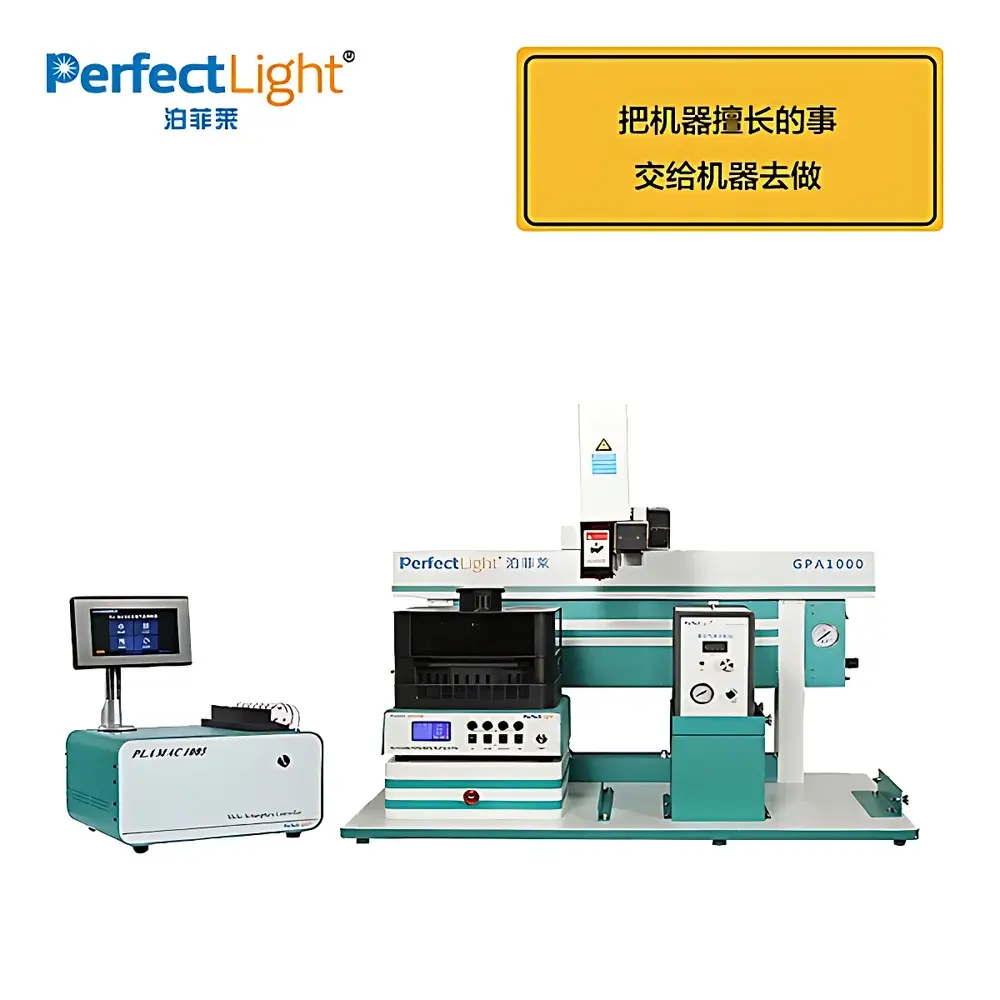
MCP-WS1000 Photoreaction Workstation by PerfectLight
| Brand | PerfectLight |
|---|---|
| Origin | Beijing, China |
| Model | MCP-WS1000 |
| Temperature Range | 10–80 °C |
| Temperature Control Accuracy | ±0.1 °C |
| Reaction Units | 9 |
| Reaction Volume per Unit | 50 mL |
Overview
The MCP-WS1000 Photoreaction Workstation is a benchtop, multi-channel photochemical synthesis platform engineered for high-throughput, reproducible photocatalytic experimentation under controlled thermal and irradiation conditions. It operates on the principle of simultaneous parallel photoreaction—enabling nine independent reaction vessels to be illuminated with uniform spectral irradiance while maintaining precise temperature regulation (10–80 °C, ±0.1 °C). Designed explicitly for mechanistic studies in solar fuel generation and environmental photocatalysis, the system integrates radiometrically calibrated light delivery, closed-loop thermal management, and modular sample handling architecture. Unlike single-vessel photoreactors optimized for discovery-driven “one-at-a-time” screening, the MCP-WS1000 supports hypothesis-driven, condition-space mapping—facilitating systematic variation of parameters such as catalyst loading, sacrificial reagent concentration, pH, and light intensity across replicates. Its hardware architecture aligns with the experimental logic of materials genomics: rapid data generation, traceable metadata capture, and minimal operator-induced variability.
Key Features
- Nine independently controllable reaction stations, each accommodating 50 mL sealed or gas-tight quartz or borosilicate reactors
- Precision Peltier-based temperature control with real-time feedback and ±0.1 °C stability over extended operation (≥24 h)
- Integrated LED or Xe-lamp illumination module with adjustable intensity (0–100 %) and optional spectral filters (UV–Vis–NIR range)
- Automated mechanical arm for sequential sampling and vial positioning—reducing manual intervention and cross-contamination risk
- Modular design supporting gas-phase sampling (via septum-piercing needle), liquid-phase extraction, and in-line gas chromatography coupling
- RS-485 and Ethernet interfaces for remote monitoring, script-based protocol execution, and synchronization with external analytical instruments
Sample Compatibility & Compliance
The MCP-WS1000 accommodates standard 50 mL cylindrical reaction vessels (OD 35 mm, height 120 mm) made from UV-grade fused silica or high-borosilicate glass. It is compatible with aqueous suspensions, organic solvent systems (e.g., methanol/water, acetonitrile), and heterogeneous slurry catalysts (e.g., TiO₂, g-C₃N₄, MOFs, perovskite nanocrystals). All wetted components comply with ISO 8573-1 (compressed air purity) and USP Class VI biocompatibility standards where applicable. The workstation meets IEC 61000-6-3 (EMC emission) and IEC 61010-1 (safety requirements for laboratory equipment). While not certified for GMP manufacturing environments, its logging architecture supports GLP-compliant workflows—including timestamped parameter recording, user authentication, and audit-trail-enabled method archiving per FDA 21 CFR Part 11 guidelines when deployed with validated third-party LIMS integration.
Software & Data Management
The included PerfectLight Control Suite (v3.2+) provides a Windows-based GUI for defining multi-step photoreaction protocols—including ramp/soak temperature profiles, timed irradiation cycles, and automated sampling triggers. All operational parameters (temperature setpoint, actual reading, lamp power, elapsed time) are logged at 1 Hz resolution and exported in CSV/JSON formats with embedded metadata (user ID, experiment ID, vessel mapping). The software supports batch export to MATLAB, Python (Pandas), or OriginLab for kinetic modeling (e.g., Langmuir–Hinshelwood fitting, quantum yield calculation via actinometry). Optional API access enables integration with electronic lab notebooks (ELNs) such as LabArchives or Benchling, ensuring FAIR (Findable, Accessible, Interoperable, Reusable) data principles are upheld across institutional repositories.
Applications
- Photocatalytic water splitting: Quantitative H₂/O₂ co-evolution assays under AM 1.5G-simulated sunlight; stoichiometric ratio validation and apparent quantum efficiency (AQE) determination at 365/420/520 nm
- CO₂ photoreduction: Multi-product analysis (CH₄, CO, CH₃OH, C₂H₄) via online GC-TCD/FID with standardized calibration against NIST-traceable gas standards
- Aqueous pollutant degradation: First-order kinetic profiling of dye (e.g., RhB, MB), phenol, and nitrobenzene under controlled dissolved oxygen and pH conditions
- Photoelectrocatalysis support: Coupling with potentiostats for bias-assisted photocurrent measurements and incident-photon-to-current efficiency (IPCE) mapping
- Stability & deactivation studies: Long-duration (≥100 h) cycling with periodic offline characterization (XRD, XPS, TEM) enabled by consistent, documented reaction history
FAQ
Can the MCP-WS1000 be used for gas-phase photocatalysis (e.g., VOC oxidation)?
Yes—when equipped with gas-recirculation manifolds and mass flow controllers, it supports continuous-flow or batch-mode gas-phase reactions with online GC or FTIR detection.
Is remote operation supported for unattended overnight experiments?
Yes—Ethernet connectivity enables secure SSH or VNC access; scheduled shutdown, emergency thermal cutoff, and email/SMS alerts (via optional gateway) are configurable.
Does the system include radiometric calibration certificates for light sources?
Each lamp module ships with a NIST-traceable spectral irradiance report (250–800 nm, ±5 % uncertainty) measured using a calibrated spectroradiometer.
How is cross-contamination prevented during automated sampling?
The robotic arm uses disposable polypropylene tips per sample; tip-wash stations with ethanol/water rinse cycles are programmable between extractions.
Can reaction vessels be pressurized for high-pressure photochemistry?
Standard configurations operate at ambient pressure; custom high-pressure quartz cells (up to 10 bar) are available as OEM add-ons with pressure-relief valve integration.



