
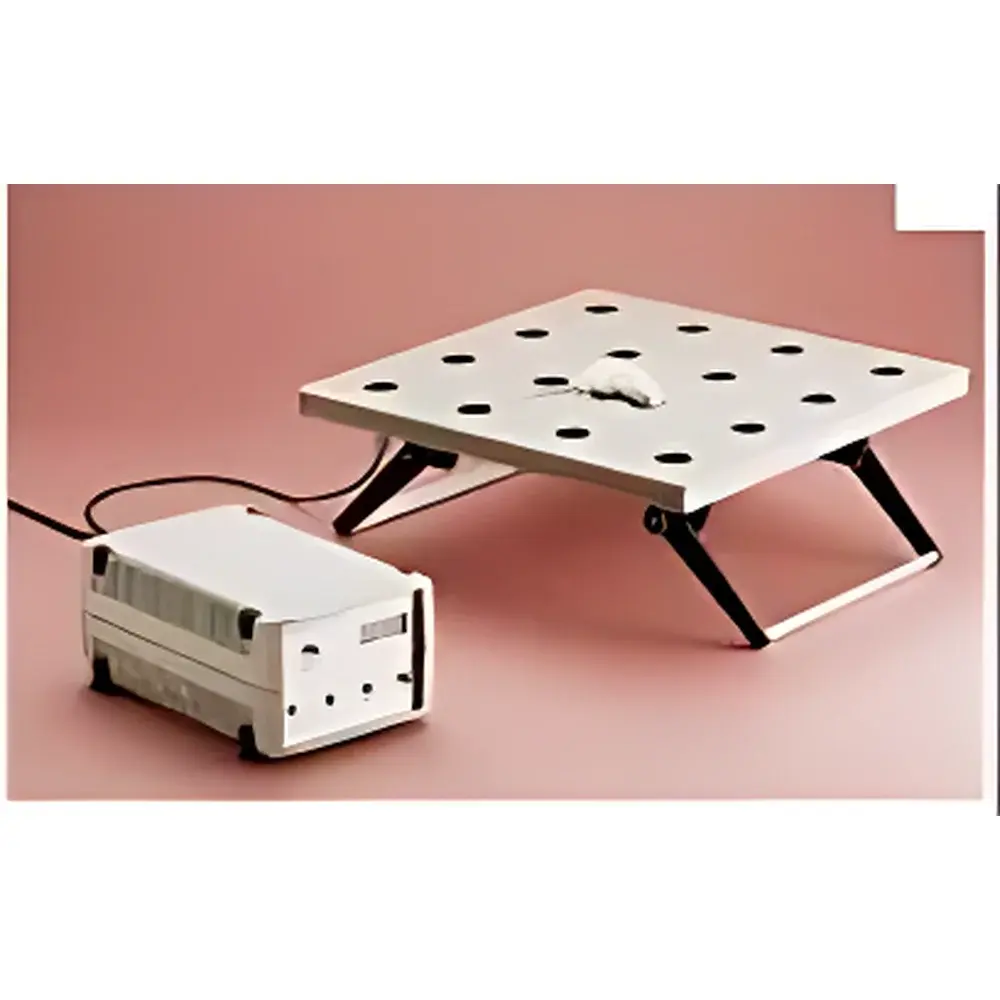
Stoelting Digiscan Hole-Board Behavior System for Rodents
| Origin | USA |
|---|---|
| Manufacturer Type | Authorized Distributor |
| Origin Category | Imported Instrument |
| Model | Digiscan Hole-Board Behavior System |
| Pricing | Available Upon Request |
Overview
The Stoelting Digiscan Hole-Board Behavior System is a standardized, computer-controlled apparatus engineered for quantitative assessment of exploratory behavior, anxiety-related responses, and sensorimotor integration in laboratory rodents—primarily mice and rats. Based on the classical hole-board test paradigm, the system leverages photobeam interruption technology to detect nose-poke entries into vertically oriented holes arranged in a symmetrical grid on an elevated platform. Each hole is fitted with an infrared emitter-detector pair, enabling precise, non-invasive detection of head-dipping events without physical contact or restraint. The system operates on the principle that spontaneous exploration of novel apertures reflects innate curiosity and reduced anxiety, while suppressed exploration correlates with heightened anxiety-like states or altered dopaminergic/serotonergic modulation. Designed for reproducible ethological measurement under controlled environmental conditions (e.g., standardized lighting, ambient noise, and acclimation protocols), the Digiscan platform supports both acute and longitudinal behavioral phenotyping across pharmacological, genetic, and neurodevelopmental studies.
Key Features
- High-resolution photobeam array with 16 individually addressable holes (standard configuration), each equipped with dual-wavelength IR sensors for reliable nose-poke detection and reduced false-trigger incidence.
- Real-time acquisition and display of per-hole entry count, total entries, latency to first entry, and time spent head-dipping—updated dynamically during session runtime.
- Customizable experimental protocol builder: users define session duration (1–30 min), inter-trial intervals, and stimulus delivery timing via intuitive GUI.
- Integrated odor port compatibility beneath each hole: allows precise placement of volatile odorants (e.g., amyl acetate, social urine extracts, or predator cues) to assess olfactory-guided exploration or aversion.
- Digital signal conditioning with hardware debouncing ensures robust performance across variable ambient light conditions and animal coat pigmentation.
- Modular aluminum frame with interchangeable acrylic floor plates—compatible with disinfectant protocols and IACUC-mandated sanitation workflows.
Sample Compatibility & Compliance
The system is validated for use with C57BL/6, BALB/c, CD-1, Sprague-Dawley, and Wistar strains across age ranges from post-weaning (P21) to aged adults (≥18 months). Weight-based aperture sizing ensures anatomical appropriateness: standard 3.2 cm diameter holes accommodate most adult mice; optional 4.0 cm configurations available for larger rat models. All hardware components comply with ISO 14971:2019 (risk management for medical devices) and meet UL 61010-1 safety standards for laboratory equipment. Data acquisition firmware adheres to ALCOA+ principles (Attributable, Legible, Contemporaneous, Original, Accurate, Complete, Consistent, Enduring, Available) and supports audit trail generation required for GLP-compliant preclinical studies.
Software & Data Management
The Digiscan Control Suite (v4.2+) provides native Windows 10/11 compatibility and integrates seamlessly with institutional IT infrastructure. Raw beam-interruption timestamps are stored in binary .dgb format with embedded metadata (subject ID, date/time, operator, protocol ID). Export modules support direct conversion to CSV and Excel (.xlsx) formats—including pivot-ready columns for hole-specific metrics, cumulative totals, and temporal binning (e.g., 30-sec epochs). Optional API access enables bidirectional data exchange with MATLAB, Python (via PyDigiscan SDK), or LabArchives ELN systems. Audit logs record all user actions—including parameter edits, data exports, and calibration events—with timestamped digital signatures satisfying FDA 21 CFR Part 11 requirements for electronic records.
Applications
- Anxiolytic/anxiogenic drug screening (e.g., benzodiazepines, SSRIs, CRF antagonists)
- Validation of transgenic and knockout rodent models (e.g., 5-HT1A KO, BDNF heterozygotes)
- Neurotoxicity assessment following chronic exposure to environmental agents (e.g., organophosphates, heavy metals)
- Age-related decline in exploratory drive and spatial working memory
- Olfactory discrimination deficits in models of Parkinson’s disease or Alzheimer’s pathology
- Pharmacokinetic–pharmacodynamic correlation studies using timed behavioral endpoints
FAQ
Is the Digiscan system compatible with automated home-cage monitoring platforms?
Yes—via TTL synchronization output, the system can be triggered by external stimuli (e.g., cue lights, auditory tones) or integrated into multi-assay behavioral batteries using third-party controllers such as Med Associates AcqKnowledge or Noldus EthoVision XT.
Can hole sensitivity be adjusted per subject or strain?
Sensitivity thresholds (beam break duration and debounce interval) are configurable at the protocol level and may be saved as strain-specific templates.
Does the software support batch analysis across multiple subjects?
Yes—the Batch Analysis Wizard permits concurrent processing of up to 96 subject files, applying uniform filters and generating group-level summary statistics with confidence intervals.
What maintenance is required for long-term photobeam reliability?
Annual recalibration using the included optical alignment jig and verification with NIST-traceable test rods is recommended; no consumables are required beyond routine surface cleaning with 70% ethanol.
Related Products




