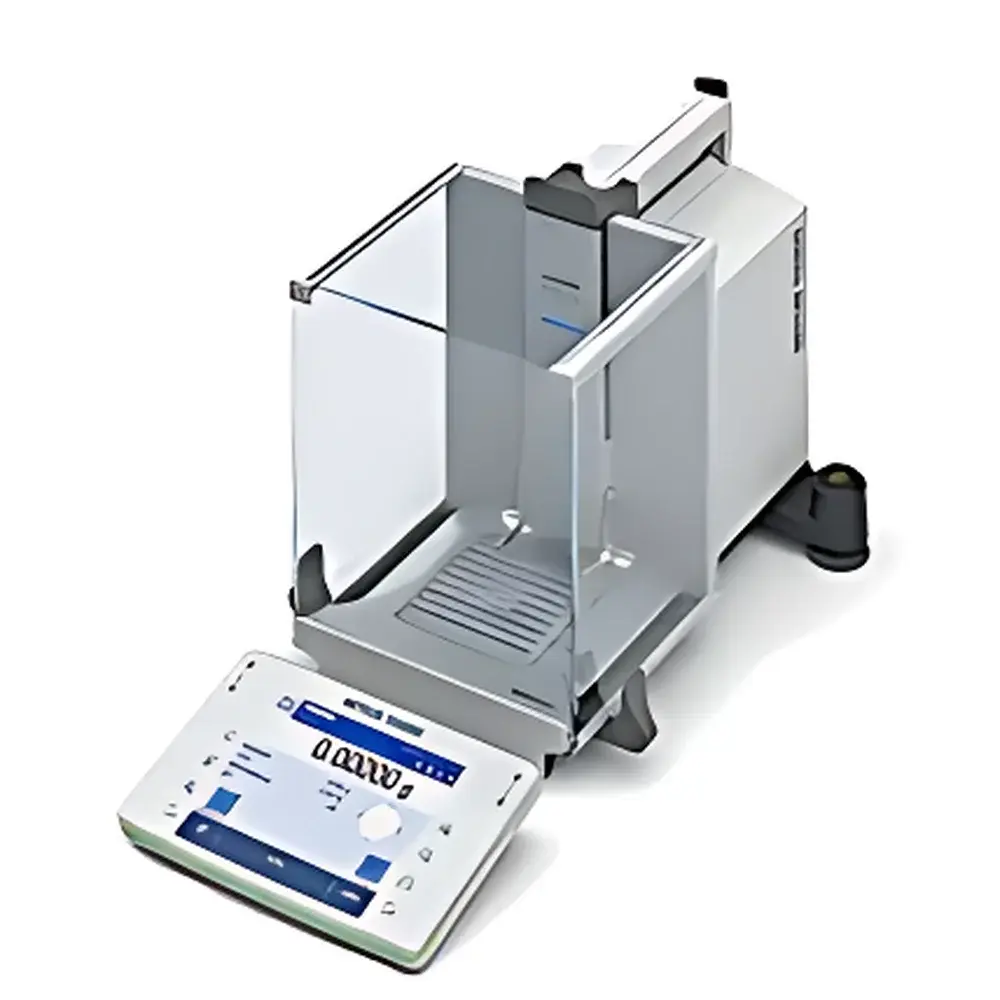
METTLER TOLEDO XPE105 Analytical Balance
| Brand | METTLER TOLEDO |
|---|---|
| Origin | Switzerland |
| Type | Imported Analytical Balance |
| Model | XPE105 |
| Maximum Capacity | 120.0 g |
| Readability | 0.01 mg |
| Minimum Weight (USP) | 14.0 mg |
| Repeatability | 0.015 mg |
| Calibration | Automatic |
| Static Detection & Neutralization | Integrated StaticDetect™ |
| Draft Shield Operation | SmartSens™ Infrared Sensor |
| Software Integration | LabX® Ready |
| Compliance Support | GLP/GMP, USP <41>, <1251>, FDA 21 CFR Part 11 Audit Trail Capable |
Overview
The METTLER TOLEDO XPE105 Analytical Balance is a high-precision laboratory instrument engineered for applications demanding exceptional mass measurement reliability, traceability, and regulatory compliance. Utilizing electromagnetic force compensation (EMFC) technology, the XPE105 delivers stable, drift-free weighing performance across its full 120.0 g capacity range with a readability of 0.01 mg. Its core architecture integrates advanced environmental compensation algorithms—including temperature, air density, and barometric pressure correction—to maintain metrological integrity under dynamic lab conditions. Designed for ISO/IEC 17025-accredited laboratories and pharmaceutical QC environments, the XPE105 meets the stringent repeatability requirement of ≤0.015 mg (2σ) and satisfies USP minimum weight criteria at 14.0 mg—ensuring consistent conformance with pharmacopeial standards for analytical weighing.
Key Features
- StaticDetect™ Technology: Actively monitors electrostatic charge on samples or containers in real time; triggers visual and audible alerts when deviation exceeds user-defined thresholds, enabling immediate mitigation before measurement error propagates.
- SmartGrid™ Weighing Pan: A perforated stainless-steel grid pan optimized for airflow uniformity and rapid stabilization—reducing settling time by up to 30% compared to conventional solid pans while minimizing convective disturbances.
- StatusLight™ Visual Feedback System: A tri-color status indicator (green = ready, yellow = warning, red = error) provides unambiguous operational readiness without requiring screen interaction—critical for SOP-driven workflows and operator training consistency.
- SmartSens™ Infrared Sensors: Enables touchless operation of draft shield doors and function activation (e.g., tare, print, send), reducing mechanical wear and eliminating cross-contamination risks in sterile or hazardous material handling.
- Modular Draft Shield Design: Fully removable glass enclosure with tool-free disassembly allows complete access to the weighing chamber in under 15 seconds—facilitating rapid cleaning, residue inspection, and ISO 14644-1 Class 5 cleanroom compatibility verification.
- RFID Integration Capability: Supports SmartSample™ RFID tags for automated sample identification and metadata transfer (e.g., batch ID, expiry date, calibration history) directly into LabX®, eliminating manual entry errors during multi-step assays or titration workflows.
Sample Compatibility & Compliance
The XPE105 accommodates diverse sample formats—from microgram-scale catalyst powders and enzymatic reagents to small electronic components and lyophilized biologics—within its 120.0 g maximum load limit. Its low-profile weighing chamber (height: 220 mm) accepts standard 100 mm diameter crucibles, volumetric flasks, and custom vials. Regulatory alignment includes built-in support for audit trail generation per FDA 21 CFR Part 11 (electronic signatures, event logging, data immutability), GLP/GMP documentation templates, and automatic calculation of measurement uncertainty per EURAMET cg-18. All firmware and calibration records are digitally signed and exportable in PDF/A-1b or CSV format for third-party review.
Software & Data Management
LabX® software serves as the central control and data governance layer for the XPE105. It enables fully customizable SOP-guided workflows displayed directly on the balance’s 5.7″ color touchscreen, including step-by-step prompts, pass/fail logic branching, and auto-validation of intermediate values (e.g., container tare stability, static threshold check). All raw measurements, metadata (operator ID, timestamp, environment logs), and derived calculations (e.g., % recovery, potency, assay dilution factors) are stored in an encrypted SQL database with role-based access control. Data export supports LIMS integration via OPC UA or direct ODBC connection, and report generation complies with ALCOA+ principles (Attributable, Legible, Contemporaneous, Original, Accurate, Complete, Consistent, Enduring, Available).
Applications
The XPE105 is routinely deployed in pharmaceutical quality control (e.g., active pharmaceutical ingredient (API) assay, reference standard preparation, dissolution testing), academic research (nanomaterial dosing, isotopic tracer quantification), and materials science labs (catalyst loading optimization, thin-film deposition mass monitoring). Its high repeatability and low minimum weight make it suitable for USP method validation studies, gravimetric standard preparation for ICP-MS calibration, and routine verification of pipette performance per ISO 8655. In regulated manufacturing, it supports continuous process verification (CPV) initiatives through automated trend analysis of daily calibration checks and routine test results.
FAQ
What is the minimum weight requirement for USP compliance on the XPE105?
The XPE105 achieves a typical minimum weight of 14.0 mg (k = 2, confidence level ≈ 95%), validated per USP using certified weights and documented environmental parameters.
Does the XPE105 support internal calibration with external reference weights?
No—the XPE105 performs fully automatic internal calibration using a motor-driven internal mass; external calibration is optional and requires certified weights traceable to NIST or equivalent national metrology institutes.
Can the StatusLight™ be customized for site-specific alarm thresholds?
Yes—thresholds for static detection, draft shield position, and environmental drift warnings are configurable via LabX® or the balance’s service menu, allowing alignment with internal QA protocols.
Is the SmartGrid™ pan compatible with corrosive solvents or acidic vapors?
The SmartGrid™ pan is constructed from electropolished 316L stainless steel and rated for intermittent exposure to common laboratory acids and bases; prolonged immersion requires evaluation per ASTM G31 corrosion testing guidelines.
How does LabX® ensure data integrity during power interruption?
LabX® employs transactional database logging with write-ahead logging (WAL) and automatic journal recovery—ensuring no measurement record is lost or corrupted during unexpected shutdowns.