
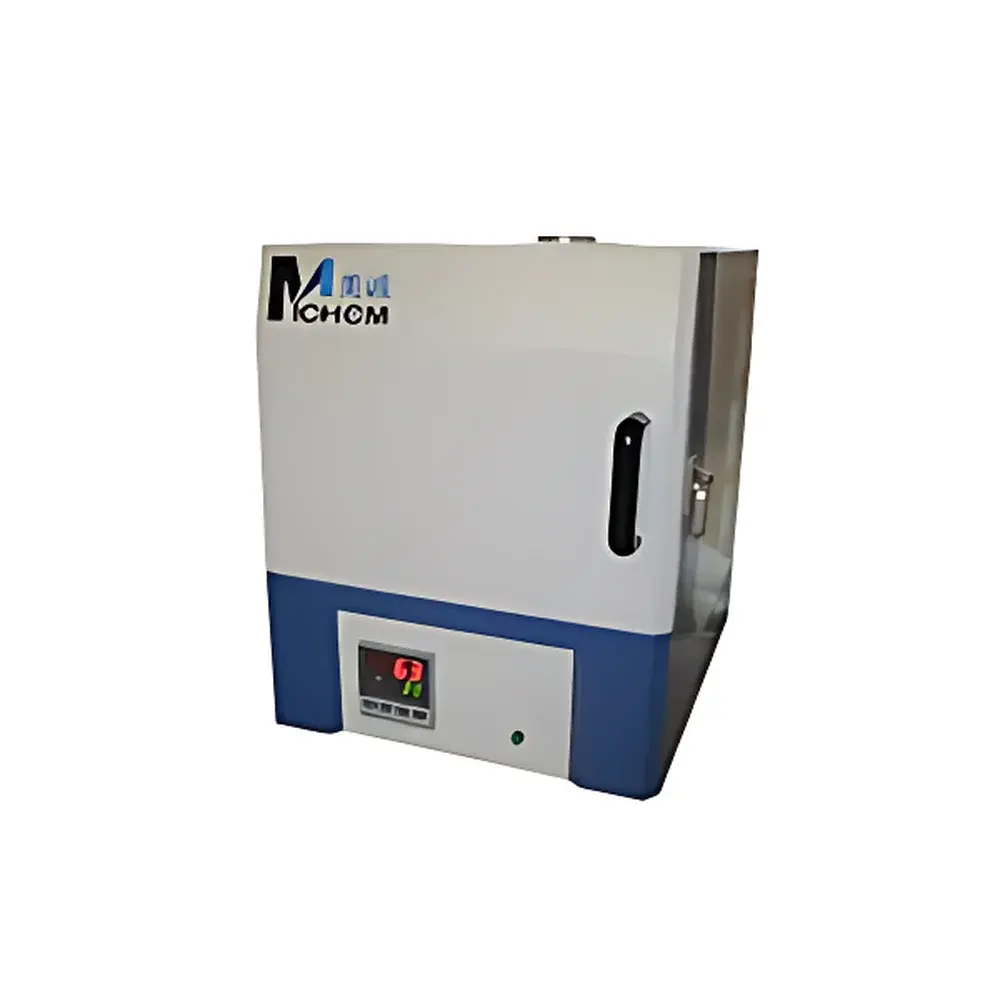
MICHEM TM Series High-Temperature Ceramic Fiber Muffle Furnace
| Brand | MICHEM |
|---|---|
| Origin | Beijing, China |
| Model | TM Series (e.g., TM0617) |
| Instrument Type | Box-Type Muffle Furnace |
| Max Operating Temperature | 1700 °C |
| Temperature Control Accuracy | ±0.1% FS |
| Power Range | 2–7.5 kW |
| Heating Rate to Max Temp | 30–90 min |
| Heating Method | Electrical (Silicon Molybdenum Rods or Resistance Wire) |
| Internal Chamber Dimensions | 200 × 300 × 150 mm (L×W×H) |
| Insulation Material | High-Purity Ceramic Fiber |
| Weight | 52–110 kg (model-dependent) |
| Compliance | Designed for GLP-compliant thermal processing and high-temperature calibration applications |
Overview
The MICHEM TM Series High-Temperature Ceramic Fiber Muffle Furnace is a precision-engineered box-type resistance furnace designed for demanding laboratory and industrial thermal processes requiring stable, repeatable operation up to 1700 °C. Utilizing advanced ceramic fiber insulation and optimized heating element architecture—silicon molybdenum (MoSi₂) rods for 1400–1700 °C models and high-grade resistance wire for ≤1400 °C variants—the furnace achieves exceptional thermal efficiency, rapid ramp rates, and superior temperature uniformity. Its construction adheres to fundamental principles of radiant heat transfer and low-thermal-mass design, enabling precise control of thermal profiles in applications such as ashing, calcination, sintering, fusion, annealing, and high-temperature reference source calibration. The furnace is engineered for integration into quality-controlled environments compliant with ISO/IEC 17025, ASTM E1112 (for thermal stability assessment), and USP requirements for thermal validation.
Key Features
- Rapid thermal response: Achieves 1700 °C from ambient in under 90 minutes; 1000 °C models reach target in under 30 minutes—up to 2× faster than conventional refractory-lined furnaces.
- Ultra-lightweight ceramic fiber insulation: Reduces thermal mass and external surface temperature—typically ≤60 °C at 1000 °C hold—minimizing ambient heat load and operator safety risk.
- High-precision programmable temperature controller: PID-based 30-segment ramp-soak profile capability with ±0.1% full-scale accuracy and ≤0.2% FS long-term stability.
- Dual-voltage compatibility: Standard 220 V/16–25 A single-phase input for 4–6 L models; 380 V/16 A three-phase supply for 20–30 L configurations ensures scalable power delivery without voltage derating.
- Safety-integrated design: Automatic power cutoff upon door opening, redundant overtemperature protection (independent limit controller), and grounded chassis conforming to IEC 61010-1 Edition 3 for laboratory electrical safety.
- Modular configuration: Four standard maximum temperature grades (1000 °C, 1200 °C, 1400 °C, 1700 °C) paired with four chamber volumes (4 L, 6 L, 9 L, 20–30 L), supporting application-specific optimization without compromise on thermal performance.
Sample Compatibility & Compliance
The TM Series accommodates a broad range of sample forms—including crucibles (alumina, platinum, graphite), ceramic boats, metal ingots, and powdered specimens—within its uniformly heated chamber. All models maintain axial and radial temperature uniformity within ±5 °C across the working zone at maximum setpoint, verified per ASTM E220 and ISO 9001 thermal mapping protocols. The 1700 °C variant has been independently assessed as suitable for use as a high-temperature reference source in metrology laboratories, supporting traceable calibration of thermocouples (Types B, S, R) and infrared pyrometers per ISO/IEC 17025 Clause 6.5. The furnace’s low thermal inertia and minimal drift (<2 °C over 4-hour dwell at 1700 °C) meet criteria for high-accuracy thermal validation studies required by FDA 21 CFR Part 11–compliant systems when paired with audit-trail-enabled data loggers.
Software & Data Management
While the base unit features an embedded PP3-series digital controller with local keypad interface, optional RS485 Modbus RTU or USB-to-serial connectivity enables integration with third-party SCADA platforms (e.g., LabVIEW, Delta Tau, or custom Python-based acquisition scripts). Firmware supports time-stamped event logging—including ramp initiation, soak start/end, fault triggers, and manual overrides—with storage capacity for ≥10,000 records. When deployed in regulated environments, the system supports 21 CFR Part 11–aligned workflows via external validation packages that enforce electronic signature, role-based access control, and immutable audit trails. Calibration certificates include NIST-traceable thermocouple verification data and chamber uniformity maps generated using calibrated miniature Type B sensors.
Applications
- Materials science: Sintering of advanced ceramics (SiC, ZrO₂), densification of metal powders, and phase transformation studies under controlled oxidizing or inert atmospheres (when coupled with optional gas purge kits).
- Geochemical & metallurgical analysis: Fusion of silicate rocks for XRF sample preparation; ashing of organic-rich environmental matrices prior to ICP-OES quantification.
- Pharmaceutical QA/QC: Residue-on-ignition (ROI) testing per USP , loss-on-drying (LOD) validation, and excipient thermal stability screening.
- Standards laboratories: Primary and secondary high-temperature fixed-point realization (e.g., Co-C, Pd-C, Re-C); blackbody cavity characterization for radiometric calibration.
- Heat treatment R&D: Isothermal annealing of Ni-based superalloys, stress-relief cycles for additive-manufactured components, and oxidation kinetics evaluation of protective coatings.
FAQ
What temperature uniformity can be expected at 1700 °C?
At 1700 °C, the TM0617 and TM0917 models maintain ±5 °C uniformity across a 100 mm diameter × 100 mm height cylindrical working zone, as confirmed by multi-point mapping using calibrated Type B thermocouples.
Is atmosphere control supported?
Standard models operate in ambient air; optional quartz or alumina tube inserts with flanged inlet/outlet ports enable inert gas purging (N₂, Ar) or reducing atmospheres (5% H₂/N₂), subject to material compatibility constraints.
Can the furnace be validated for GMP use?
Yes—full IQ/OQ/PQ documentation templates, DQ support files, and temperature mapping protocols are available. Validation packages include sensor calibration certificates traceable to NIST and uncertainty budgets per ISO/IEC 17025.
What maintenance is required for silicon molybdenum heating elements?
MoSi₂ elements require no periodic replacement under normal cycling (≤50 °C/min ramp rate, ≤1700 °C max). Avoid thermal shock and mechanical contact; annual visual inspection for surface cracking or sagging is recommended.
Does the controller support remote monitoring?
Via optional communication modules, real-time temperature, power status, and alarm conditions can be streamed to networked HMIs or cloud-based dashboards using Modbus TCP or MQTT protocols.
Related Products



