
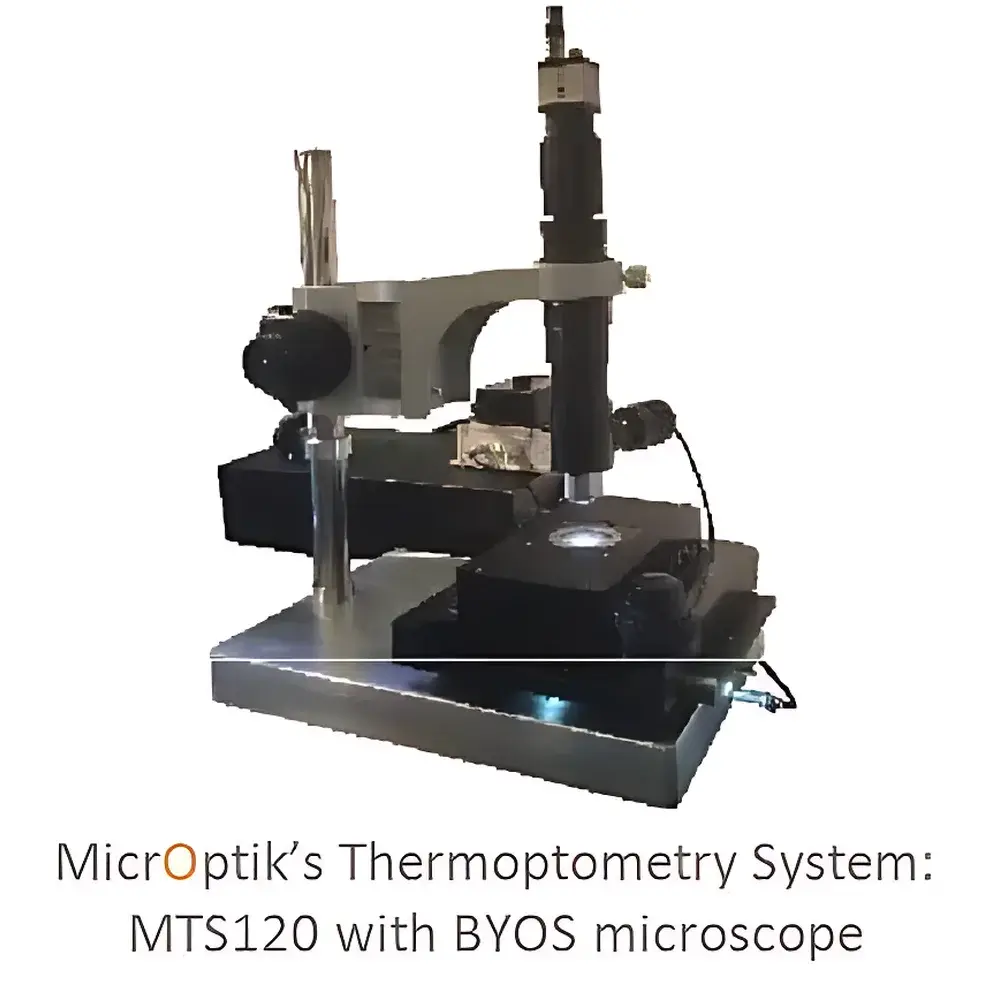
MicrOptik MTS120 Low-Temperature Stage for Metallographic Microscopy
| Brand | MicrOptik |
|---|---|
| Origin | Netherlands |
| Model | MTS120 |
| Temperature Range | −40 °C to +120 °C |
| Temperature Resolution | 0.1 °C |
| Control Method | PID/PID-Switching |
| Sensor Type | RTD (Pt100) |
| Sample Area | 25 mm × 40 mm |
| Chamber Height | 4 mm (standard, optional variants available) |
| Observation Aperture | 32 mm |
| Working Distance to Objective | 6 mm (optional reduced WD configurations) |
| Compatible Controller | MTDC600 Programmable Temperature Controller |
| Optional Auxiliary Cooling | MC-5L Recirculating Chiller |
Overview
The MicrOptik MTS120 Low-Temperature Stage is a precision-engineered thermal stage designed specifically for integration with metallographic, polarized light, and reflected-light microscopes used in materials science laboratories. Based on solid-state Peltier thermoelectric technology, the MTS120 delivers bidirectional temperature control—capable of both active cooling and heating—across a wide operational range from −40 °C to +120 °C. Its architecture prioritizes optical accessibility, mechanical stability, and thermal uniformity across the sample plane, making it suitable for high-magnification imaging, in situ phase transition studies, and time-resolved thermal response analysis of metallic alloys, intermetallics, composites, and semiconductor thin films. Unlike passive cryostats or liquid-nitrogen-cooled stages, the MTS120 eliminates condensation risks through sealed chamber design and integrated dew-point management—critical when observing hygroscopic or oxide-sensitive specimens under long-duration thermal cycling.
Key Features
- Peltier-based dual-mode temperature control enables precise, repeatable thermal ramping, holding, and cycling without external cryogens or compressed gases.
- Optimized optical path geometry: 32 mm central observation aperture, 6 mm objective working distance, and minimal stage profile ensure compatibility with standard long-working-distance and ultra-long-working-distance metallurgical objectives.
- High-resolution thermal regulation: 0.1 °C temperature resolution with PID/PID-switching algorithm ensures stability within ±0.2 °C at setpoint, even during dynamic load changes.
- RTD (Pt100) sensing embedded directly beneath the sample surface provides fast feedback and minimizes thermal lag between sensor and specimen.
- Modular chamber design supports interchangeable inserts for variable sample area (standard 25 × 40 mm), height (standard 4 mm, configurable up to 12 mm), and specialized windows (e.g., CaF₂ for UV transmission or ZnSe for IR spectroscopy).
- Integrated water-cooling interface compatible with the MC-5L recirculating chiller—required for sustained sub-zero operation below −20 °C and optimal thermal recovery after rapid cooldown.
Sample Compatibility & Compliance
The MTS120 accommodates standard 25 × 75 mm microscope slides, polished metallographic mounts (up to 40 mm diameter), and custom substrates secured via vacuum or mechanical clamping. Its inert stainless-steel and anodized aluminum construction resists corrosion from halide-containing etchants, acidic polishing media, and solvent-based mounting resins. The stage complies with ISO 13715 (thermal measurement terminology), ASTM E112 (grain size determination), and ASTM E3 (metallographic specimen preparation) requirements for controlled-temperature evaluation. When operated with the MTDC600 controller and validated calibration protocol, the system supports GLP-compliant documentation workflows—including audit-trail-enabled temperature logging and user-access-controlled parameter locking per ICH GCP and FDA 21 CFR Part 11 guidelines.
Software & Data Management
The MTDC600 programmable controller offers dual-mode operation: local front-panel interface with rotary encoder and full-featured PC connectivity via USB or RS-232. MicrOptik’s proprietary StageControl Suite (Windows/Linux/macOS) enables script-driven thermal profiles (ramp/soak/cycle), real-time overlay of temperature vs. time with microscope image timestamps, and export of synchronized datasets in CSV and HDF5 formats. All temperature logs include metadata (operator ID, instrument serial, calibration certificate ID, ambient RH/T), supporting traceability in QA/QC environments. Remote monitoring and alarm-triggered email/SNMP notifications are configurable for unattended overnight experiments.
Applications
- In situ observation of martensitic transformation kinetics in steel and shape-memory alloys.
- Thermal expansion coefficient mapping of CTE-mismatched layered structures (e.g., Cu–Invar–Cu laminates).
- Phase stability assessment of solder joints, brazes, and high-temperature coatings under thermal cycling.
- Low-temperature embrittlement studies in aluminum-lithium aerospace alloys.
- Controlled-cooling metallography for simulating industrial heat-treatment cycles (e.g., T6 tempering, solution annealing).
- Corrosion product formation kinetics on galvanized steels and magnesium alloys under humidified cold conditions.
FAQ
What is the minimum achievable temperature with the MTS120, and what auxiliary equipment is required?
The MTS120 achieves −40 °C only when paired with the MC-5L recirculating chiller and operated in a climate-controlled environment (<25 °C ambient, <50% RH). Without the chiller, stable operation is limited to approximately −20 °C.
Can the MTS120 be mounted vertically or inverted for upright metallurgical microscopes?
Yes—the stage features symmetrical mounting holes and balanced thermal mass distribution, enabling secure horizontal, vertical, or inverted installation per DIN 31000 mechanical safety standards.
Is the MTDC600 controller compliant with FDA 21 CFR Part 11 for regulated laboratories?
When configured with electronic signature enforcement, role-based access control, and immutable audit trails enabled, the MTDC600 + StageControl Suite meets core technical requirements of 21 CFR Part 11 for electronic records and signatures.
Does the stage support vacuum or inert-gas purging for oxidation-sensitive samples?
A sealed purge port (¼″ Swagelok) is available as a factory option; custom vacuum-rated versions with O-ring grooves and pressure-rated viewports can be ordered separately.
How is temperature uniformity verified across the sample area?
MicrOptik provides NIST-traceable calibration reports showing thermal gradient maps (±0.3 °C max deviation over 25 × 40 mm at 25 °C and −20 °C), measured using calibrated micro-thermocouples arrayed at 5 mm intervals.




