
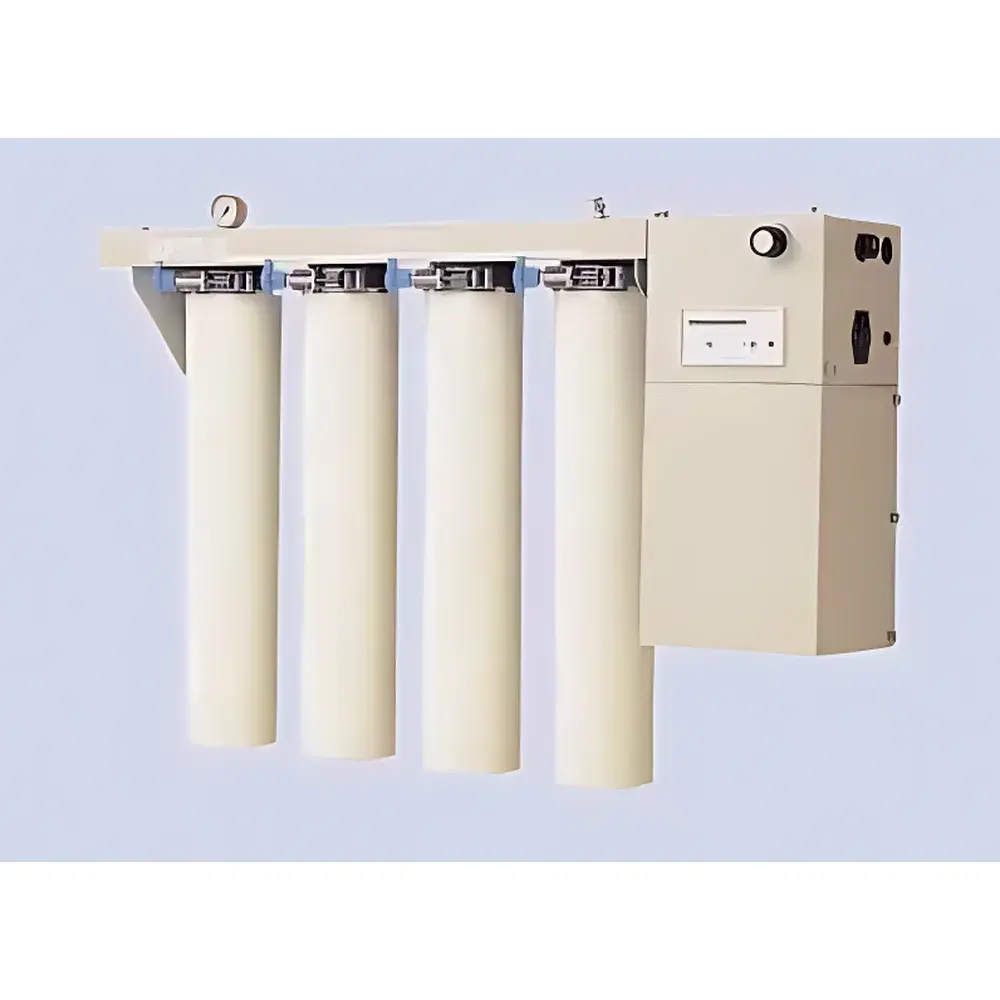
Milli-Q Super-Q™ Plus Reagent-Grade Ultra-Pure Water System
| Brand | Milli-Q |
|---|---|
| Origin | France |
| Manufacturer Type | Original Equipment Manufacturer (OEM) |
| Origin Category | Imported |
| Model | Super-Q™ Plus Reagent-Grade Ultra-Pure Water System |
| Pure Water Grade | ASTM Type III |
| Resistivity | 18 MΩ·cm @ 25°C (with embedded temperature-compensated resistivity sensor) |
| Heavy Metals & Soluble Silica | <0.1 ppb |
| Total Organic Carbon (TOC) | <20 ppb |
| Microbial Count | <10 CFU/mL |
| Endotoxin | <0.001 EU/mL |
| Particles (>0.1 µm) | <1 particle/mL |
| Flow Rate | 10–12 L/min |
| Feed Water Requirements | RO, distilled, or deionized water |
| inlet pressure | 0.03–1 bar |
| Dimensions (W×H×D) | 1150 × 800 × 220 mm |
| Operating Weight (filled) | 63 kg |
Overview
The Milli-Q Super-Q™ Plus Reagent-Grade Ultra-Pure Water System is a high-performance, point-of-use purification platform engineered for laboratories requiring consistent, trace-level purity in analytical and life science applications. It operates on a multi-stage post-treatment principle—accepting pre-purified feed water (e.g., reverse osmosis, distillation, or deionization effluent) and applying final polishing via integrated ion exchange, ultrafiltration, and advanced organic adsorption technologies. Designed to exceed ASTM D1193 Type I, CLSI (formerly NCCLS) and CAP standards for reagent-grade water, the system delivers ultra-pure water with resistivity ≥18 MΩ·cm at 25°C, TOC <20 ppb, endotoxin <0.001 EU/mL, and bacterial levels <10 CFU/mL—making it suitable for HPLC mobile phase preparation, cell culture media formulation, molecular biology assays, and trace metal analysis.
Key Features
- Thermoplastic-welded purification cartridges eliminate solvent- and adhesive-based leachables, ensuring minimal TOC contribution from consumables.
- Proprietary Organex-Q™ TP ultrafiltration column with Durapore® membrane technology provides robust endotoxin and particle retention while maintaining low-pressure drop and extended service life.
- Embedded temperature-compensated resistivity sensor enables real-time, accurate conductivity monitoring with automatic correction to 25°C—critical for regulatory compliance and method validation.
- Automated recirculation mode activates every 90 minutes for 5 minutes when idle, maintaining system hygiene and preventing biofilm formation without manual intervention.
- Modular architecture supports field-upgradable components, including optional UV oxidation (185/254 nm) and additional endotoxin-removing filters for specialized workflows.
- Robust mechanical design with Fast+Tite™ 1/2″ compression fittings ensures leak-free connections and rapid maintenance—compatible with rigid tubing infrastructure common in centralized lab utilities.
Sample Compatibility & Compliance
The Super-Q™ Plus is validated for use with sensitive instrumentation including ICP-MS, LC-MS/MS, ELISA, qPCR, and electrophysiology rigs where background contamination compromises data integrity. Its output meets or exceeds key international specifications: ASTM D1193 Type I, ISO 3696 Class 1, CLSI EP22-A, and USP Purified Water monograph requirements. For regulated environments, the system supports GLP/GMP-aligned operation through configurable audit trails (when paired with optional data logging modules), and its material construction complies with FDA 21 CFR Part 11 readiness for electronic records—provided appropriate IT infrastructure and procedural controls are implemented per organizational SOPs.
Software & Data Management
While the base Super-Q™ Plus operates via intuitive front-panel controls with LED status indicators, optional connectivity modules enable integration into laboratory information management systems (LIMS) and building automation networks. Real-time parameters—including flow rate, resistivity, TOC (when equipped with online TOC monitor), UV lamp status, and cartridge lifetime—are logged with timestamps and exportable via USB or RS-232. All event logs include operator ID fields and tamper-evident digital signatures, supporting 21 CFR Part 11-compliant electronic record retention when deployed with validated software and access controls.
Applications
- HPLC and UHPLC mobile phase and blank preparation, minimizing baseline noise and column fouling.
- Cell culture media and buffer formulation where endotoxin and trace metals directly impact viability and differentiation outcomes.
- Atomic spectroscopy techniques (ICP-OES, ICP-MS) requiring sub-ppt elemental blank levels.
- Nucleic acid amplification and sequencing workflows sensitive to nuclease activity and organic inhibitors.
- Calibration standard preparation in environmental and pharmaceutical QC labs adhering to ISO/IEC 17025 accreditation criteria.
- Electrochemical and surface characterization studies where interfacial contamination alters charge transfer kinetics.
FAQ
What feed water quality is required for optimal performance?
The system requires pre-treated feed water meeting ASTM Type III specifications (resistivity ≥0.05 MΩ·cm, TOC <200 ppb). RO permeate or double-distilled water is strongly recommended as input.
Can the Super-Q™ Plus be connected to a centralized water distribution loop?
Yes—its modular pump and pressure regulation allow seamless integration into passive or active distribution networks up to 30 meters in length, provided loop materials comply with USP and avoid leachable polymers.
How often must purification cartridges be replaced?
Cartridge replacement intervals depend on feed water quality and daily usage volume; typical service life ranges from 6–12 months under standard lab conditions (≤100 L/day), monitored via integrated flow counters and resistivity decay trends.
Is the system compatible with ISO 17025 internal audit requirements?
Yes—its built-in calibration traceability, loggable operational parameters, and documented material compatibility support method validation and equipment qualification per ISO/IEC 17025 Clause 6.4.5.
Does the system provide alarm notifications for out-of-spec conditions?
Yes—audible and visual alerts trigger for low resistivity, high TOC (if monitored), UV lamp failure, or filter saturation, with configurable thresholds and relay outputs for facility-wide notification systems.



