
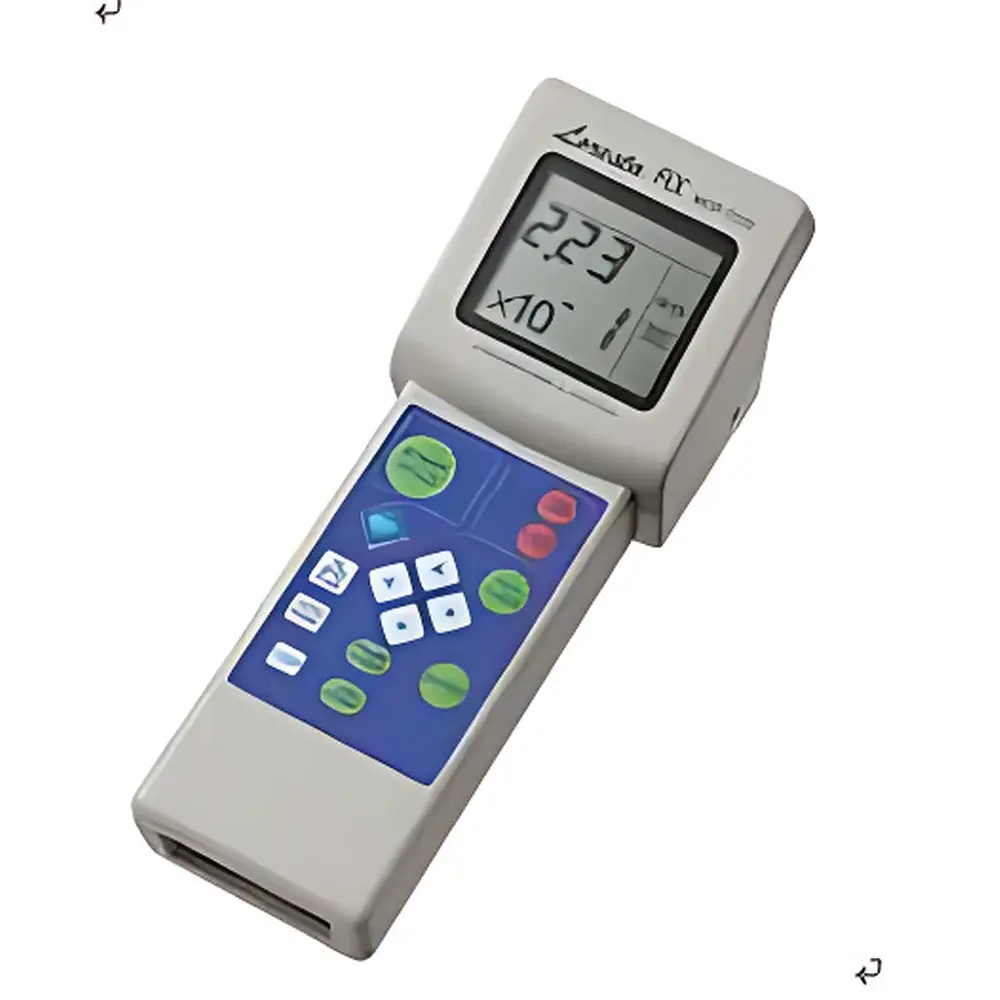
Mitsubishi Chemical MCP-T370 Low-Impedance Analyzer
| Brand | Mitsubishi Chemical |
|---|---|
| Origin | Japan |
| Model | MCP-T370 |
| Portability | Portable |
| Measurement Principle | Four-terminal (Kelvin) DC resistance / low-impedance ohmic measurement |
| Probe Interface | 4-pin coaxial connector |
| Data Output | RS-232C |
| Dimensions | 100 mm (W) × 230 mm (D) × 45 mm (H) |
| Weight | 500 g |
| Power Supply | DC 6.5 V, 350 mA |
| Display | LCD |
Overview
The Mitsubishi Chemical MCP-T370 Low-Impedance Analyzer is a precision portable instrument engineered for high-accuracy, four-terminal (Kelvin) DC resistance measurements of conductive and semi-conductive materials. Unlike conventional two-terminal conductivity meters, the MCP-T370 eliminates lead and contact resistance errors by separating current excitation and voltage sensing paths—enabling reliable impedance quantification down to milliohm-level resolution in solid, paste, film, and anisotropic samples. It is purpose-built for quality control and R&D applications in battery electrode manufacturing, conductive ink formulation, fuel cell membrane evaluation, printed electronics, and carbon-based composite characterization. Its architecture adheres to fundamental metrological principles defined in IEC 60469 and ASTM D257 (Standard Test Methods for DC Resistance or Conductance of Insulating Materials), with design considerations aligned to GLP-compliant laboratory workflows.
Key Features
- Four-terminal (Kelvin) measurement topology ensures elimination of probe contact resistance and wiring parasitics—critical for sub-1 Ω measurements.
- Modular probe ecosystem supporting six interchangeable probe types (ASP, ESP, PSP, QPP, BSP, TFP), each optimized for specific sample geometries and mechanical constraints.
- Compact, handheld form factor (100 × 230 × 45 mm; 500 g) with integrated LCD display—designed for benchtop use, inline QC stations, and field-deployable material screening.
- RS-232C serial interface enables direct data logging to PC-based acquisition software or integration into automated test systems compliant with SCPI command sets.
- Stable DC excitation source (6.5 V, 350 mA) with regulated current delivery—minimizing thermal drift during extended measurement cycles.
- No internal battery; powered via external DC adapter (MCP-TA05) or compatible regulated supply—ensuring consistent voltage profile and long-term calibration stability.
Sample Compatibility & Compliance
The MCP-T370 accommodates heterogeneous, non-uniform, and geometrically constrained samples through its application-specific probe portfolio. The ASP probe (MCP-TP03P) features 5 mm insertion depth and 0.37 mm radius tip for general-purpose bulk resistivity assessment. The ESP probe (MCP-TP08P) applies 240 g/needle spring force for stable contact on uneven or soft substrates such as gel electrolytes or pressed powder pellets. The PSP and QPP probes (MCP-TP06P / MCP-TPQPP) employ 1.5 mm needle length and 0.2 mm tip radius for micro-scale thin films or patterned conductive traces. The BSP (MCP-TP05P) extends needle depth to 2.2 mm for thick electrodes or layered assemblies, while the TFP (MCP-TFP) utilizes a 1 mm needle with 0.15 mm radius tip and 50 g/needle force for ultra-thin flexible substrates (<50 µm). All probes comply with JIS C 5402 and IEC 61000-4-2 ESD immunity standards. The analyzer itself meets CE marking requirements for electromagnetic compatibility (EMC Directive 2014/30/EU) and low-voltage safety (LVD Directive 2014/35/EU).
Software & Data Management
Data output via RS-232C follows ASCII-based fixed-format protocol, enabling seamless ingestion into MATLAB, Python (pySerial), LabVIEW, or custom LIMS environments. While the MCP-T370 does not embed onboard storage or touchscreen UI, its deterministic serial framing supports time-stamped batch logging, pass/fail threshold triggering, and CSV export for statistical process control (SPC). When deployed in regulated environments (e.g., ISO 13485 medical device manufacturing or IATF 16949 automotive battery supply chains), the instrument may be validated per IQ/OQ protocols—leveraging its traceable DC excitation and linear analog front-end to satisfy FDA 21 CFR Part 11 requirements for electronic records when paired with audit-trail-enabled host software.
Applications
- Sheet resistance mapping of transparent conductive oxides (ITO, AZO) and graphene films.
- In-process resistivity verification of cathode/anode slurries and dried electrode coatings.
- Contact resistance evaluation at current collector–active material interfaces.
- Quality screening of conductive adhesives, elastomers, and polymer composites.
- Resistivity profiling across cross-sections of multilayer battery separators or solid-state electrolyte laminates.
- Validation of sintering uniformity in metal-powder compacts used in thermal interface materials.
FAQ
Does the MCP-T370 support AC impedance spectroscopy?
No. The MCP-T370 performs only DC four-terminal resistance measurements. It is not equipped with frequency-sweep capability or phase-sensitive detection required for EIS.
Can it measure conductivity directly without manual calculation?
No. The instrument outputs resistance (Ω) or conductance (S); users must apply geometric correction factors (e.g., thickness, electrode spacing) to derive volume or surface conductivity per ISO 3915 or ASTM D4496.
Is calibration traceable to NIST or JCSS standards?
Yes—when serviced by authorized Mitsubishi Chemical Calibration Centers, certificate of calibration includes traceability to JCSS-accredited reference resistors (±0.01% uncertainty) and documented measurement uncertainty budgets per ISO/IEC 17025.
What is the typical measurement repeatability under controlled lab conditions?
For stable samples with optimal probe contact (e.g., copper foil, 100 mm² area), standard deviation remains ≤ ±0.5% over 10 consecutive readings at 23 ± 1 °C ambient.
Are replacement probes supplied with calibration certificates?
Calibration certificates are provided only for probes used in certified calibration services—not with standard commercial probe deliveries. Users may request JCSS-traceable calibration as an add-on service.






