
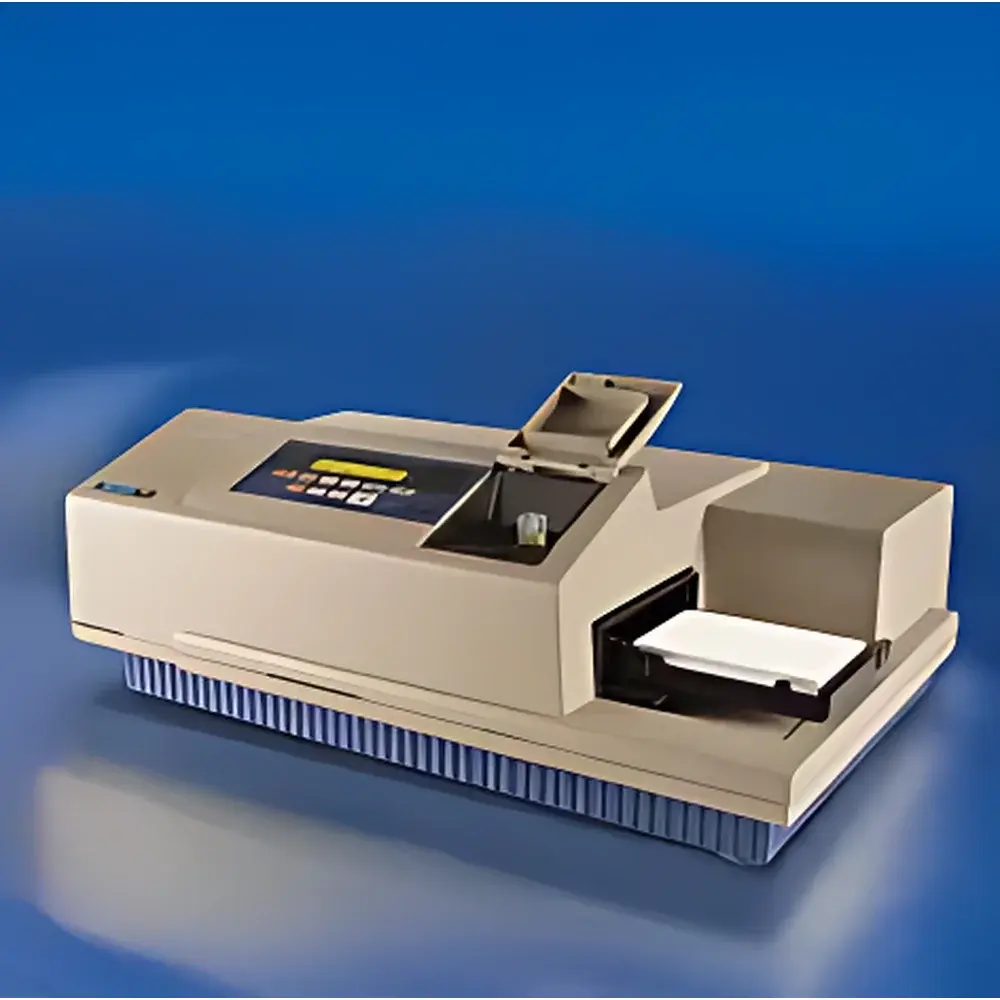
Molecular Devices SpectraMax M4 Multi-Mode Microplate Reader
| Brand | Molecular Devices |
|---|---|
| Origin | USA |
| Manufacturer Type | Original Equipment Manufacturer (OEM) |
| Product Origin | Imported |
| Model | SpectraMax M4 |
| Functionality | Multi-Mode |
| Automation Level | Fully Automated |
| Assay Modes | Endpoint, Kinetic, Full-Wavelength Scan, Single-Well Multi-Point Scan |
| Curve Fitting | SoftMax Pro Software (supports 4PL, 5PL, linear, quadratic, sigmoidal, exponential, and custom equation models) |
| Detectors | Dual Photomultiplier Tubes (PMTs) + Four Photodiodes |
| Wavelength Range | 200–1000 nm (Abs) |
| Absorbance Range | 0–4 OD |
| Absorbance Linearity | 0–3 OD |
| Plate Read Time | 18 sec per 96-well plate |
| Absorbance Precision | < ±0.005 OD |
Overview
The Molecular Devices SpectraMax M4 Multi-Mode Microplate Reader is an engineered platform for quantitative life science assays requiring high-fidelity optical detection across absorbance, fluorescence intensity (FI), time-resolved fluorescence (TRF), and luminescence (Lum) modalities. Built on a dual-grating monochromator architecture, it delivers continuous spectral scanning without reliance on discrete filters—enabling flexible assay development and method transfer across diverse biological targets. Its optical design incorporates UV-transmissive fiber optics, elliptical reflective mirrors, and angled emission path geometry to minimize stray light and maximize signal-to-noise ratio—particularly critical in narrow Stokes shift applications such as TR-FRET and HTRF. The instrument supports microplates from 6- to 384-well formats—including flat-, round-, and V-bottom configurations—and integrates a built-in cuvette port for orthogonal validation of solution-phase measurements. With temperature control via Virtual Lid™ technology (±0.5 °C uniformity across the sample chamber), the SpectraMax M4 maintains thermal stability essential for kinetic enzyme assays and cell-based readouts.
Key Features
- Dual-grating monochromator system enabling continuous wavelength selection from 200–1000 nm (absorbance) and 250–850 nm (fluorescence/luminescence) in 1-nm increments
- Hybrid detection architecture: two high-sensitivity photomultiplier tubes (PMTs) for low-light luminescence and TRF, plus four calibrated photodiodes optimized for rapid absorbance quantitation
- PATHCHECK Pathlength Correction Technology automatically normalizes absorbance readings to 1-cm equivalent pathlength, eliminating manual dilution corrections for variable well volumes
- Virtual Lid™ temperature control system maintains precise, uniform incubation (ambient to 45 °C) without physical lid contact—reducing condensation and evaporation artifacts during extended kinetics
- Integrated cuvette port supporting absorbance, FI, and luminescence measurements in standard 1-cm quartz or plastic cuvettes
- Automated plate handling compatibility with StakMax™ stacker systems (up to 50 plates), barcode readers, and third-party robotic workcells via SoftMax Pro API
- Optical verification suite including ABS1 (absorbance), FL1 (fluorescence), and LM1 (luminescence) reference plates for routine performance qualification
Sample Compatibility & Compliance
The SpectraMax M4 accommodates standard ANSI/SLAS-compliant microplates (6–384-well), including opaque, clear, and black-walled formats, as well as specialty surfaces (e.g., tissue-culture treated, low-binding, streptavidin-coated). It supports ultra-low-volume analysis via the optional SpectraDrop™ microvolume plate (2 µL/sample, 24- or 64-sample format), validated for nucleic acid and protein quantification with inter-plate CVs <2.5%. Regulatory compliance includes full support for FDA 21 CFR Part 11 through SoftMax Pro GxP edition—featuring role-based user permissions, electronic signatures, audit trails with immutable timestamped records, and automated IQ/OQ documentation templates. Instrument qualification is supported by SpectraTest validation kits and vendor-provided protocols aligned with ISO/IEC 17025 and ASTM E2597 standards for microplate reader performance verification.
Software & Data Management
SoftMax Pro software serves as the unified interface for instrument control, data acquisition, and analytical processing. It ships with over 140 preconfigured assay protocols—including ELISA, BCA, Bradford, LDH cytotoxicity, IC50/EC50, and TR-FRET—each with optimized excitation/emission settings, gain calibration, and kinetic sampling parameters. Advanced analysis modules support multi-plate normalization, well-mapping, outlier rejection, and batch reporting. SoftMax Pro GxP extends functionality with 21 CFR Part 11-compliant workflows: user authentication, session locking, change-controlled method templates, and PDF report generation with embedded digital signatures. Data export supports CSV, XML, and LIMS-integrated formats (e.g., ASTM E1384, HL7). The software is validated per vendor-supplied installation and operational qualification (IQ/OQ) packages and integrates natively with major laboratory automation systems (Tecan, Hamilton, Agilent) and enterprise LIMS platforms.
Applications
The SpectraMax M4 is routinely deployed in academic research, biopharmaceutical development, and clinical diagnostics laboratories for endpoint and kinetic ELISA/EIA; enzymatic activity profiling (e.g., kinase, protease, phosphatase assays); cell viability and cytotoxicity (MTT, resazurin, ATP-luciferase); microbial growth and MIC determination; protein/DNA/RNA quantification; reporter gene assays (luciferase, GFP); membrane permeability (PAMPA); ADME/Tox screening; and proximity-based assays including HTRF, LanthaScreen™ TR-FRET, and AlphaScreen®. Its spectral flexibility and detector versatility make it suitable for assay development, QC release testing, and GLP-compliant studies where reproducibility, traceability, and regulatory readiness are mandatory.
FAQ
Does the SpectraMax M4 support TR-FRET assays with commercial reagent kits?
Yes—it is pre-validated for Cisbio HTRF and Thermo Fisher LanthaScreen TR-FRET assays, with dedicated protocols and optimal PMT gain settings stored in SoftMax Pro.
Can I perform both absorbance and luminescence measurements in the same run?
No—modality switching requires manual configuration change between optical paths; however, sequential multi-mode protocols can be scheduled within a single experiment file.
Is the cuvette port capable of temperature control?
No—the cuvette port operates at ambient temperature only; thermal regulation applies exclusively to the microplate chamber.
What validation documentation is included with the instrument?
Each unit ships with factory IQ/OQ certificates, SpectraTest ABS1/FL1/LM1 verification plates, and SoftMax Pro GxP validation support packages compliant with FDA and EU Annex 11 requirements.
How does PATHCHECK correct for variable well volumes?
It uses a reference diode to measure actual pathlength in each well via reflected light intensity, then applies real-time correction to raw absorbance values using Beer-Lambert law normalization.




