
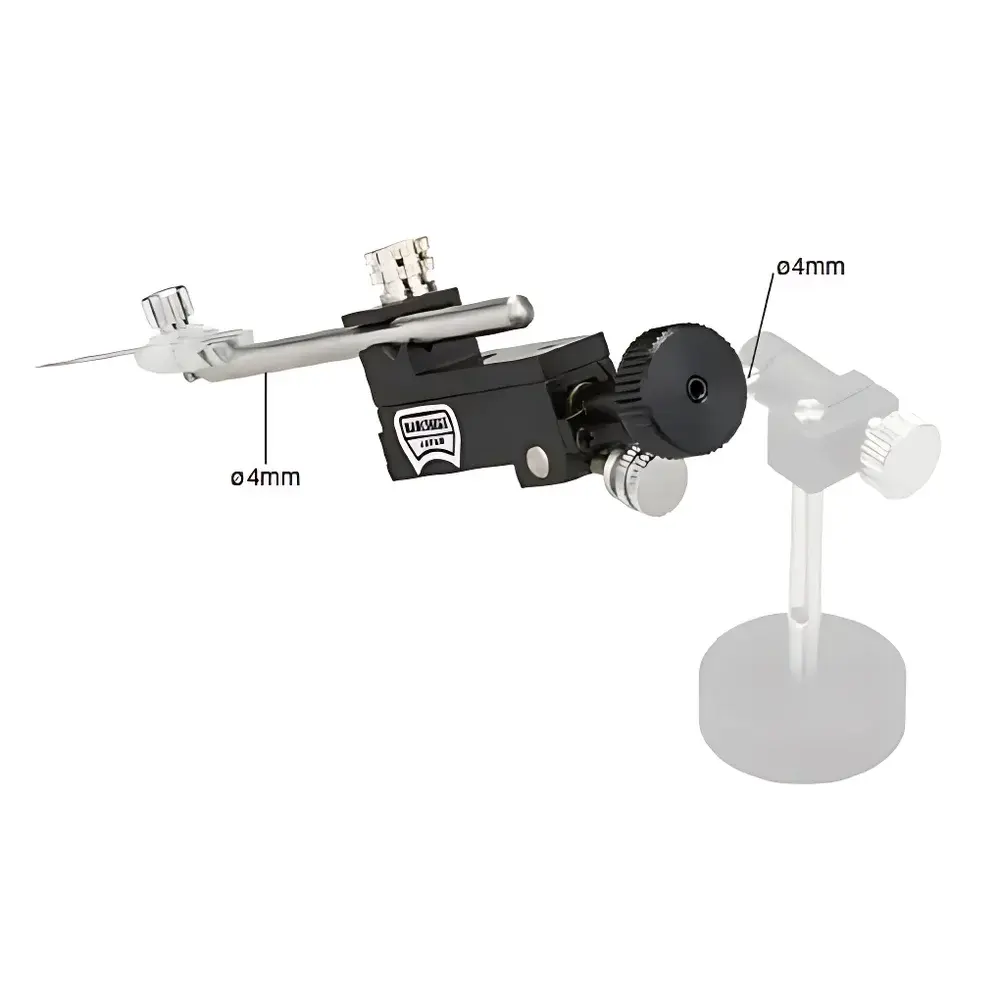
Narishige M-10 Hydraulic Micromanipulator
| Brand | Narishige |
|---|---|
| Origin | Japan |
| Model | M-10 |
| Manipulator Type | Pencil-style hydraulic micromanipulator |
| Fine Adjustment Travel | 10 mm |
| Coarse Adjustment Travel | 21 mm |
| Dimensions (W×D×H) | 57 × 15 × 30 mm |
| Weight | 50 g |
| Compatible Accessories | UPN-1 Pipette Holder, Universal Wrench |
| Mounting | Standard dovetail or threaded base (M3/M4) |
Overview
The Narishige M-10 is a compact, pencil-style hydraulic micromanipulator engineered for high-precision manual positioning in life science and electrophysiology applications. It operates on the principle of incompressible fluid transmission—hydraulic pressure applied via a roller-controlled actuator translates into smooth, backlash-free linear displacement of the manipulator tip. This mechanism eliminates mechanical play and thermal drift commonly associated with gear- or screw-driven systems, making the M-10 especially suitable for delicate, vibration-sensitive tasks such as intracellular electrode insertion, patch-clamp pipette positioning, and microinjection into subcellular structures. Its ultra-low mass (50 g) and miniature footprint (57 × 15 × 30 mm) allow integration into densely configured rigs—including upright and inverted microscopes, stereotaxic frames, and multi-probe electrophysiology setups—without compromising optical access or workspace ergonomics.
Key Features
- Hydraulic actuation architecture: Delivers continuous, stepless fine motion with no stiction or hysteresis; ideal for sub-micron positional stability during prolonged recordings.
- Two-stage motion control: 21 mm coarse travel enables rapid repositioning; 10 mm fine travel provides high-resolution adjustment with tactile feedback optimized for manual dexterity.
- Modular mechanical interface: Standard dovetail mount (compatible with Narishige SM-10/SM-20 series bases) and optional M3/M4 threaded adaptors support flexible integration with custom stages and microscope platforms.
- Minimalist form factor: Cylindrical pencil design minimizes shadowing under objectives and avoids interference with condensers, filter wheels, or motorized stage components.
- Tool-free accessory compatibility: Direct mounting of UPN-1 pipette holders ensures rapid exchange of glass micropipettes, tungsten electrodes, or fiber optics without recalibration.
Sample Compatibility & Compliance
The M-10 is routinely deployed in GLP- and GMP-aligned laboratories conducting preclinical neurophysiology, developmental biology, and single-cell genomics studies. While the manipulator itself is not a regulated medical device, its use conforms to established experimental standards including ISO 13485–aligned instrument handling protocols and ASTM E2919–22 guidelines for micromanipulation system validation in cell-based assays. When paired with certified sterile pipettes or FDA-cleared electrodes, the M-10 supports workflows compliant with 21 CFR Part 11 requirements for electronic record integrity—particularly when integrated with timestamped acquisition software (e.g., pCLAMP, Spike2) that logs positional metadata alongside physiological signals.
Software & Data Management
As a manually operated analog device, the M-10 does not incorporate embedded electronics, firmware, or digital interfaces. Consequently, it requires no driver installation, firmware updates, or cybersecurity configuration—reducing validation overhead in regulated environments. Positional data is inherently non-digital; however, users may document manipulator settings (e.g., roller index marks, scale readings) within electronic lab notebooks (ELNs) such as LabArchives or Benchling using structured templates. For semi-automated correlation, third-party camera-based tracking systems (e.g., μManager-compatible machine vision modules) can overlay real-time coordinate overlays on microscope feeds, enabling retrospective spatial annotation of manipulation events relative to cellular landmarks.
Applications
- Intracellular and whole-cell patch-clamp recordings in primary neurons, cardiomyocytes, and organoid-derived cells.
- Microinjection of CRISPR-Cas9 ribonucleoproteins, mRNA, or fluorescent dyes into zebrafish embryos, mouse oocytes, or C. elegans gonads.
- Positioning of sharp microelectrodes for extracellular field potential mapping in acute brain slices.
- Alignment and stabilization of optical fibers for optogenetic stimulation or two-photon uncaging experiments.
- Manual assembly of microfluidic probe arrays or MEMS-based biosensors requiring micron-level alignment tolerance.
FAQ
Is the M-10 compatible with inverted microscopes?
Yes—the low-profile design and front-access roller control permit unobstructed placement beneath standard inverted microscope stages, including those with motorized Z-drives.
Does the M-10 require hydraulic fluid refills or maintenance?
No—the sealed hydraulic chamber is factory-filled with inert silicone oil and rated for >10⁵ operational cycles without servicing.
Can the M-10 be mounted vertically or upside-down?
Yes—its gravity-independent hydraulic operation allows stable orientation in any axis, provided mechanical fixation meets minimum torque specifications (≥0.3 N·m for M4 threads).
What is the typical resolution achievable with the roller control?
Under controlled conditions, experienced users achieve repeatable positioning within ±2 µm over the 10 mm fine range, limited primarily by human motor precision rather than device mechanics.
Is the UPN-1 holder autoclavable?
The UPN-1 is constructed from stainless steel and polyetheretherketone (PEEK); it withstands standard laboratory autoclaving (121°C, 20 min), though repeated cycles may affect elastomeric grip elements.



