
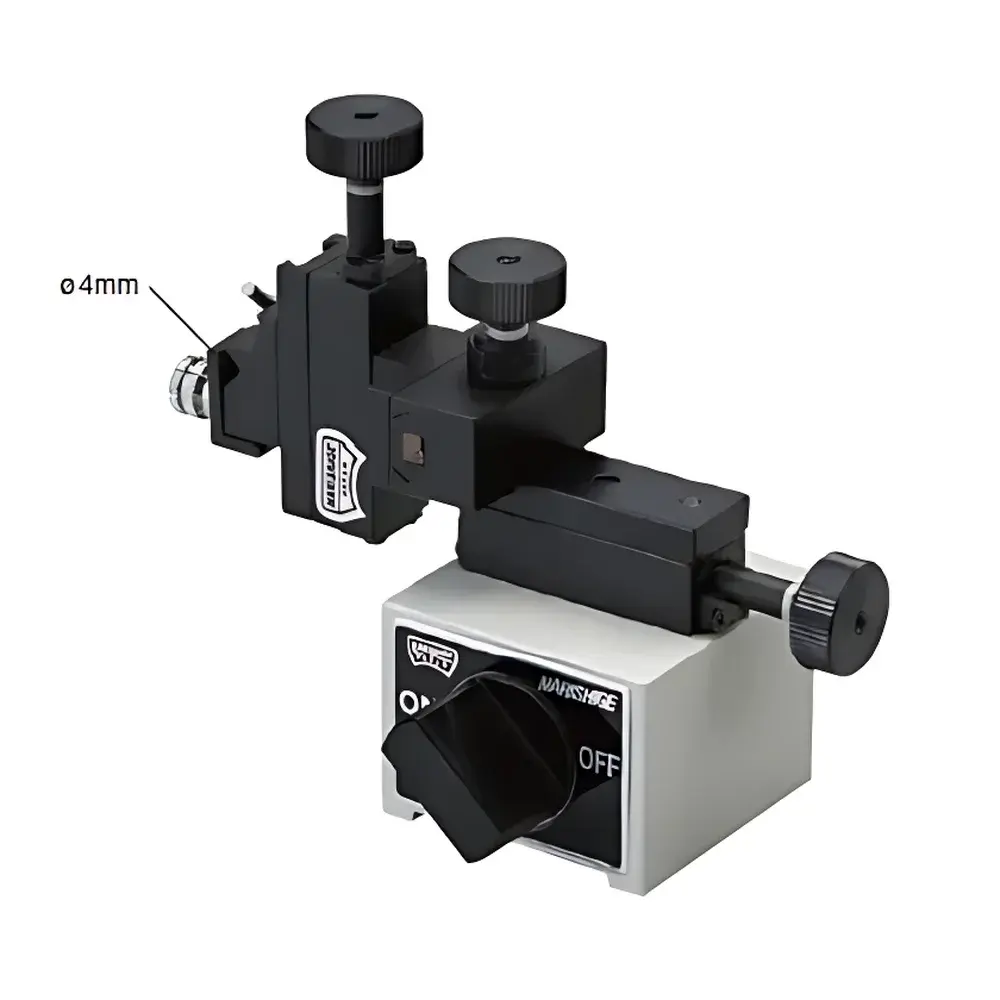
NARISHIGE M-40 Manual Micromanipulator with Magnetic Base
| Brand | NARISHIGE |
|---|---|
| Origin | Japan |
| Model | M-40 |
| Travel Range (Coarse) | X 22 mm, Y 20 mm, Z 22 mm |
| Dimensions | 100 × 55 × 85 mm |
| Weight | 550 g |
| Base Type | Integrated Magnetic Mount |
| Standard Accessories | UPN-1 Pipette Holder, Universal Wrench |
| Compatibility | Universal Microscope Stage & Metallic Surgical Platforms |
Overview
The NARISHIGE M-40 is a precision-engineered manual micromanipulator designed for high-fidelity spatial control of glass micropipettes, electrodes, or microtools in life science and clinical research environments. Operating on a mechanical translation principle—leveraging calibrated lead-screw mechanisms and low-backlash gear trains—the M-40 delivers deterministic, hysteresis-minimized motion without reliance on electronic actuators or software interfaces. Its core architecture supports three-axis orthogonal coarse positioning (X: ±11 mm, Y: ±10 mm, Z: ±11 mm from center) combined with sub-micrometer incremental adjustment via knurled control knobs, enabling reproducible placement within ±1 µm repeatability under standard lab conditions. The integrated neodymium magnetic base ensures rapid, non-permanent fixation to ferromagnetic microscope stages, surgical booms, or custom metallic fixtures—eliminating the need for clamps or adhesive mounts while preserving optical access and stage mobility.
Key Features
- Mechanically actuated three-axis motion system with independent coarse/fine dual-stage controls per axis, optimized for tactile feedback and real-time positional correction.
- 360° continuous rotational capability of the pipette holder (UPN-1) around its longitudinal axis—enabling angular reorientation without disassembly or tool recalibration.
- Compact footprint (100 × 55 × 85 mm) and lightweight design (550 g), facilitating integration into confined spaces such as inverted microscope setups, patch-clamp rigs, or intraoperative imaging suites.
- Modular mechanical construction using stainless steel and anodized aluminum components, ensuring dimensional stability across temperature fluctuations (15–30 °C) and resistance to laboratory solvents and sterilization agents.
- Magnetic base rated for holding force ≥12 N on clean, flat ferrous surfaces—compatible with ISO-standard microscope stage rails and GMP-compliant surgical equipment frames.
Sample Compatibility & Compliance
The M-40 accommodates standard borosilicate or quartz micropipettes (OD 1.0–1.5 mm) via the UPN-1 universal holder, which features adjustable collet tension and axial locking to prevent slippage during pressure-driven injection or resistive recording. It complies with mechanical safety requirements outlined in ISO 13485:2016 (for medical device accessory classification) and supports GLP-aligned experimental workflows through traceable manual operation—no electronic logs required. While not an active medical device, it is routinely deployed in preclinical studies adhering to OECD TG 420 (acute toxicity) and ICH S5(R3) (reproductive toxicity) protocols where precise intracellular delivery is mandated.
Software & Data Management
As a fully manual instrument, the M-40 operates independently of software, firmware, or digital interfaces—ensuring zero electromagnetic interference with sensitive electrophysiology amplifiers (e.g., Axon Instruments Multiclamp), laser scanning systems, or high-speed cameras. This analog architecture eliminates validation overhead associated with FDA 21 CFR Part 11 compliance for audit trails, making it suitable for regulated QC labs performing method qualification under USP (Performance Qualification of Laboratory Instruments). All adjustments are directly observable and documentable via calibrated scale markings on each axis, supporting paper-based SOPs and technician-led calibration verification per ISO/IEC 17025:2017 Annex A.2.
Applications
- Electrophysiology: Stable positioning of patch pipettes for whole-cell, cell-attached, or perforated patch configurations; compatible with upright and inverted configurations on Zeiss Axioskop, Nikon Eclipse, or Olympus BX series platforms.
- Developmental Biology: Embryo micromanipulation including pronuclear injection, blastomere biopsy, and cytoplasmic transfer—validated in mouse, zebrafish, and Xenopus models per NIH Guide for the Care and Use of Laboratory Animals.
- Ophthalmic Surgery Research: Subretinal needle guidance in rodent models of retinal degeneration; used in conjunction with OCT-guided stereotactic frames for spatial registration accuracy ≤5 µm.
- Microfabrication Support: Alignment and placement of microelectrodes onto MEMS devices or photonic chips during probe station-based testing, leveraging its vibration-damped mechanical rigidity.
FAQ
Is the M-40 compatible with non-magnetic microscope stages?
Yes—optional adapter plates (e.g., AP-100 series) provide threaded or clamp-based mounting for aluminum, ceramic, or composite stages.
Can the UPN-1 holder accommodate tapered or coated pipettes?
It accepts pipettes with uniform outer diameter between 1.0 and 1.5 mm; taper transitions must reside distal to the collet engagement zone.
What maintenance is required for long-term positional stability?
Biannual cleaning of lead screws with isopropyl alcohol and light application of silicone-free lubricant (e.g., Dow Corning 111) is recommended.
Does NARISHIGE provide calibration certificates for the M-40?
Factory calibration is performed per internal specification TS-M40-01; third-party metrology certification (e.g., UKAS or DAkkS) can be arranged upon order.
How does the M-40 compare to motorized manipulators in terms of resolution?
While motorized units offer programmable repeatability, the M-40 achieves comparable step resolution (≤0.5 µm/rev) with superior immediate responsiveness and zero latency—critical for dynamic intracellular targeting.



