
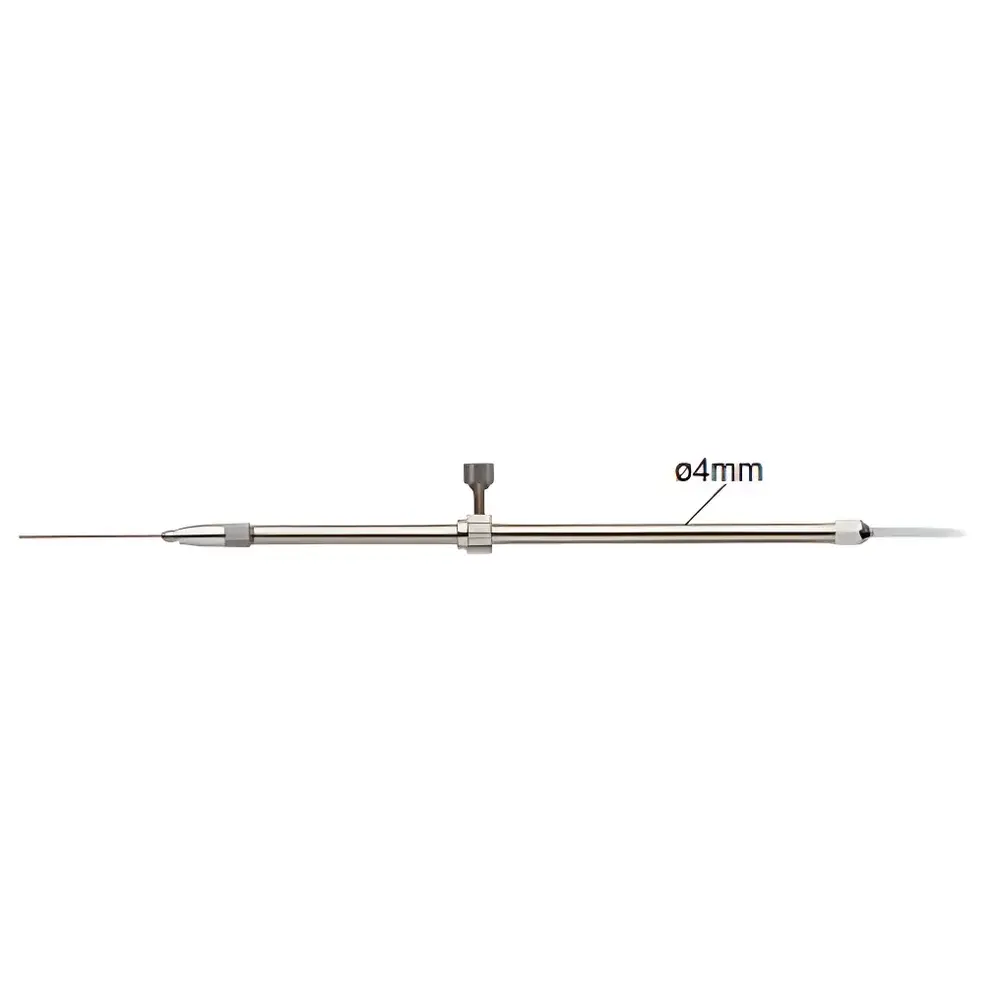
NARISHIGE HI-7 Microinjector Handle
| Brand | NARISHIGE |
|---|---|
| Origin | Japan |
| Model | HI-7 |
| Construction | Stainless steel ferrule and ferrule-integrated end cap |
| Pipette Mounting Diameter | 1 mm |
| Cleaning Rod Length | 140 mm |
| Cleaning Rod Weight | 15 g |
| Adjustable Rotating Clamp | Yes |
| Included Accessories | Silicone rubber gasket (HI01PK01) |
Overview
The NARISHIGE HI-7 Microinjector Handle is a precision-engineered manual control component designed for integration with NARISHIGE’s micromanipulator-based microinjection systems, particularly in embryology, transgenic research, and single-cell analysis workflows. It functions as the ergonomic interface between the user and the microinjector actuator—translating fine rotational or axial hand motion into controlled, repeatable plunger displacement within glass capillary pipettes. Unlike motorized or pressure-driven injection systems, the HI-7 operates on a mechanical lever-and-ferrule coupling principle: its stainless steel ferrule ensures secure, coaxial engagement with the pipette shaft, while the integrated ferrule-equipped end cap eliminates misalignment and slippage during insertion—even when working with capillaries lacking internal core support structures. This design directly addresses a critical operational challenge in manual microinjection: inconsistent pipette seating across multi-well or multi-position setups where pipette cores may be absent or variably seated.
Key Features
- Stainless steel ferrule and end cap assembly—engineered for long-term corrosion resistance, dimensional stability, and precise coaxial alignment with 1 mm outer-diameter glass capillaries.
- Ferrule-integrated end cap eliminates reliance on internal pipette cores, enabling reliable mounting in heterogeneous pipette batches or custom-pulled capillaries without central reinforcement.
- Rotatable, lockable clamp mechanism allows real-time adjustment of handle orientation relative to the manipulator axis—critical for optimizing wrist ergonomics during extended injection sessions.
- Included silicone rubber gasket (part no. HI01PK01) provides compliant sealing at the handle–manipulator interface, dampening vibration transmission and preventing microslip under load.
- Dedicated 140 mm cleaning rod (15 g mass) facilitates routine capillary lumen clearance without disassembly; its length and weight are optimized for tactile feedback and controlled insertion depth.
- Modular compatibility with NARISHIGE’s MO-202, MN-4, and NT-88-V3 micromanipulators via standardized mounting threads and torque specifications.
Sample Compatibility & Compliance
The HI-7 is validated for use with borosilicate and fused-silica capillaries having an outer diameter of 1.0 mm ±0.02 mm, consistent with ISO 7198 and ASTM E2917 standards for microfluidic interface components. Its mechanical coupling architecture avoids thermal or chemical interaction with samples, making it suitable for live-cell microinjection, CRISPR-Cas9 ribonucleoprotein delivery, and pronuclear transfer applications under laminar-flow biosafety cabinets. While the handle itself carries no regulatory certification, its material composition (JIS SUS304 stainless steel) and surface finish comply with ISO 10993-5 (cytotoxicity) and USP Class VI requirements for indirect device contact. When deployed within GLP-compliant embryology labs, the HI-7 supports audit-ready documentation through traceable accessory part numbers (e.g., HI01PK01 gasket) and consistent mechanical performance metrics.
Software & Data Management
As a purely mechanical, non-electronic component, the HI-7 does not interface with software or generate digital data streams. However, it is fully interoperable with NARISHIGE’s optional digital micromanipulator controllers (e.g., MM-890 series), which log positional metadata—including injection timing, depth, and actuation count—when paired with compatible encoder-equipped manipulators. In FDA 21 CFR Part 11 environments, the HI-7 contributes to system-level traceability by maintaining fixed mechanical relationships: its ferrule geometry and clamp torque settings are documented in equipment qualification protocols (IQ/OQ), and accessory lot numbers (e.g., HI01PK01) are recorded in lab notebooks alongside injection session logs.
Applications
- Mouse and zebrafish embryonic pronuclear injection for transgenic line generation.
- Cytoplasmic or nuclear delivery of mRNA, morpholinos, or Cas9-gRNA complexes into oocytes and early blastomeres.
- Single-cell biopsy and cytoplasmic aspiration in preimplantation genetic testing (PGT) workflows.
- Microinjection of tracer dyes (e.g., Alexa Fluor–conjugated dextrans) for lineage tracing in developmental biology studies.
- Calibration and validation of automated microinjection platforms using manual reference benchmarks.
FAQ
Is the HI-7 compatible with non-NARISHIGE micromanipulators?
Yes—provided the manipulator features a standard M6×0.75 threaded mounting interface and accommodates a 12 mm handle diameter; mechanical alignment must be verified using a dial indicator prior to use.
Can the cleaning rod be sterilized using autoclaving?
The stainless steel cleaning rod is autoclavable at 121°C for 20 minutes; however, the silicone rubber gasket (HI01PK01) must be replaced after each autoclave cycle due to compression set degradation.
What is the recommended torque for tightening the rotating clamp?
Maximum clamp retention torque is 0.35 N·m—exceeding this value risks deformation of the aluminum housing and loss of rotational repeatability.
Does the HI-7 support positive-pressure injection modes?
No—the HI-7 is strictly a manual displacement handle; positive-pressure injection requires integration with an external pressure controller (e.g., NARISHIGE MF-900) and pneumatic adapter kit.
How often should the ferrule be inspected for wear?
Visual inspection is recommended before each experimental session; replace the ferrule if groove depth exceeds 0.05 mm or if capillary slippage occurs at ≤0.2 N axial load.





